Two astronomical "news" stories have captivated the attention of the mass media: the possibility of water on Mars and the super lunar eclipse. How much rationality is there in the journalistic accounts? Was the NASA news a publicity stunt?
Being rational is not ignoring sensations, but it is not letting oneself be intoxicated by them. Being rational is trying to be clear about what reality is like and how we perceive it.
According to many media outlets, a phenomenon equal to the recent super lunar eclipse will not be observable until 2033. This, despite the fact that:
1-An eclipse of the moon will be observable from Argentina in 2018.
2-The observable difference between a moon and a super moon is minimal.
If sensationalism is a form of exaggeration, this looks a lot like it.
Sensationalism, or in any case, this type of exaggeration, only leads to frustration. In astronomy, frustrations are a dime a dozen: the images of the cosmos now provided by photos on the internet taken by large ground-based and orbital observatories are not a reflection of what the general public will observe when putting an eye to the eyepiece of a modest amateur telescope. Even more so if we consider that a part of such photographs are in "false color," for example, those taken by X-ray instruments, a wavelength that our eyes cannot perceive.
Another case is meteor showers: if we let ourselves be guided by the "rates" that are usually mentioned before such events, our expectations will be very high, and the effective results, very low.
Such exaggerations border on flagrant lying, deception, or fraud.
The "excitement" for the shocking news, the informational spectacle, is largely the mother of the sheep.
Let's take the case of water on Mars, and we will find the same thing: apparently it is already known, with certainty, without a degree of uncertainty, that there is liquid water on the red planet and then, with greater elegance, reasonings of the type are formulated:
Whenever there is liquid water, there is life.
On Mars, there is liquid water.
Therefore, on Mars there is life.
Then it is clarified that it is a hypothesis, that evidence supporting such a hypothesis was found, and that furthermore the water would be incredibly salty. But it doesn't matter: we have already unleashed the astronomical beast and so now we will go to Mars faster and plants will be harvested!!!
And all this seasoned with a pinch of statements from professional astronomers to give a scientific veneer to what is nothing more than a product that is sold: the news.
It no longer matters why NASA wants to go to Mars. Will it be to conduct "neutral" scientific research? Science, it seems, has no ideology. And don't you dare use the damned word because then people will think you are against scientific and technological progress!
The same thing will be done on Mars as in Jáchal. With workers hired under the same modalities used by Coca-Cola Femsa in Argentina and the world, that is: precarious, although they try to sell us "happiness".
Sometimes scientific discourse is also used to sell "happiness," in this case, extraterrestrial happiness.
Exaggeration, first cousin of alarmism and uncritical optimism, is anti-scientific.
It is true that exaggeration and distortion can also be didactic resources, in more than one sense.
Scientific discourse should not be, in the first instance, either optimistic or pessimistic. The scientific revolution implies first understanding reality, then laughing or crying.
The Martian and NASA's liquid water
As Peter Bradshaw points out in The Guardian 1, it is more than striking that the announcement of supposed liquid water on Mars (which is not something we can call "news") occurred simultaneously with the presentation of the film The Martian (El marciano, translated in Argentina as Misión Rescate).
Days before the film's premiere, press articles were published in various media outlets in Argentina. Those of us in that metier saw there the action of some communication-marketing agency. Such articles, although made with journalistic interest, are also advertising. That's why the big studios give such articles to the big media. It's free advertising.
Pablo Scholz was the writer of a report in Clarín. There he indicates that "Clarín was one of the dozen international media outlets that participated in the visit to the filming set of Misión rescate in Budapest, Hungary." 2
In Newsweek, Gogo Lidz wrote on 09-20 that eight months earlier she put on her boots to walk on the filming set of The Martian. 3
As the reporter notes, the film is based on the novel by Andy Weir. And he adds: "NASA must be the book's biggest fan" because as Weir told Wired 4, the agency saw the project as "an opportunity to re-interest the public in space travel." In May, The Washington Post noted: "Andy Weir and his book The Martian may have saved NASA and the entire space program" in relation to the problems of the US agency in obtaining sufficient funds and how the novel boosted public relations for the agency.5
In Argentina in recent years we have repeatedly used the word "relato" (narrative) to account for statements that do not conform to reality, not by mistake, but deliberately. It is a euphemism to account for a lie, although with a nuance related to a lie that the person telling it believes it.
At this point, such narratives have in common with magical discourse that they abstract from reality.
That science also creates these narratives is also anti-scientific.
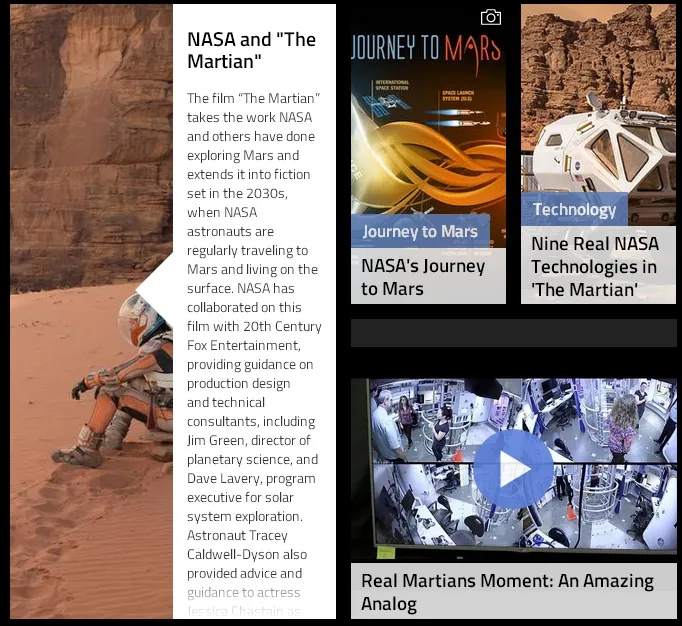
There is no doubt that the production of the film had strong influences from NASA, as NASA itself indicates on the page http://www.nasa.gov/realmartians
A special message from Mark Watney. #TheMartian #MarsAnnouncement https://t.co/60wJUzlJue
— The Martian Movie (@MartianMovie) September 28, 2015
Science as work
Scientists want to know, to know more than before, to discover the world, to explore it, to provide solutions to problems. But scientists do not run NASA. Researchers use instruments that are not theirs not to do what they want, but what they are allowed to do.
When I go to my job, I use computers that are not mine, to produce products that are not mine. In return, I receive a salary. Scientists are workers.
Leaders do not want to go to Mars to meet people's needs. We can assert this based on several objective facts:
1-The possibility of Earth's destruction by asteroids is remote.
2-The possibility of Earth's natural resources running out is remote and abstract.
3-There are sufficient current resources. Enough food is produced so that no human being should go hungry, yet there are millions starving. Therefore, it is not a problem of lack of resources, but of how production is planned and distributed.
4-Earth faces an objective danger related to the future of the Sun, but there is nothing to worry about for another 3 billion years.
The rush to go to Mars responds to other interests, political and economic. Those who deny that man reached the Moon ignore that it was reached for interests of that kind, more than scientific.
Scientific advances, like sporting ones, are often used for political purposes, generally "nationalist" ones. Isn't that the origin of the Olympic Games?
Our position
Does all this mean we should be against it? We cannot be against scientific and technological progress. We do not want to return to feudalism. But we also cannot be "blindly" in favor. That is not "scientific" either. Exaggeration, when it is not didactic but a method to create a narrative, generates a biased, partial, and certainly non-neutral view.
Why, if in our world methods harmful to the population are used in energy and mineral generation, would something different happen on Mars?
There isn't even a legal framework for the exploration of other worlds, but when there is, it will be a legal framework like the one we have here, created by the same people who created it here. That is, not the majority, even though we say we live in a "demo-cracy".
Having a critical sense is not only being against magical thinking, pseudosciences, and the social control of religions, but also being critical of the use—and abuse—of sciences for political and economic purposes contrary to the interests of the majorities, that is, of the workers.
Therefore, it is very possible that NASA's announcement and the premiere of the Matt Damon movie are not a mere coincidence, but the product of public relations and marketing engineering. Because scientific discourse also has its rhetoric.
Sources and related links
- 1 The Martian and Nasa – a coincidence too good to be true?
http://www.theguardian.com/film/filmblog/2015/sep/28/nasa-water-found-on-mars-the-martian-movie-matt-damon-coincidence - 2 Con Matt Damon en Marte
http://www.clarin.com/extrashow/cine/Matt_Damon-The_Martian-Mision_rescate-rodaje-Budapest-Korda-Ridley_Scott-Scholz_0_1439856427.html - 3 NASA and 'The Martian': It Was Written in the Stars
http://www.newsweek.com/2015/10/02/why-nasa-faked-mars-landing-374214.html - 4 THE MARTIAN’S ANDY WEIR IS ALL BUDDY-BUDDY WITH NASA
http://www.wired.com/2015/07/martians-andy-weir-buddy-buddy-nasa/ - 5 Andy Weir and his book ‘The Martian’ may have saved NASA and the entire space program
https://www.washingtonpost.com/blogs/achenblog/wp/2015/05/05/andy-weir-and-his-book-the-martian-may-have-saved-nasa-and-the-entire-space-program/ - Space.com: 'The Martian' Movie and NASA: Full Coverage
http://www.space.com/30690-the-martian-movie-full-coverage.html
About the images
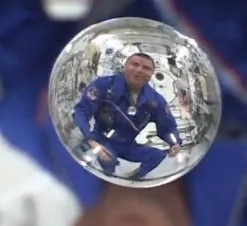
Vine video by Reid Wiseman https://vine.co/v/OAZLrlBjP3V
Actor Matt Damon in his role as NASA astronaut Marc Watney in "The Martian" in a brief video from the movie producers' Twitter account linking NASA's announcement to a part of the film where the protagonist says: "Surprise!".