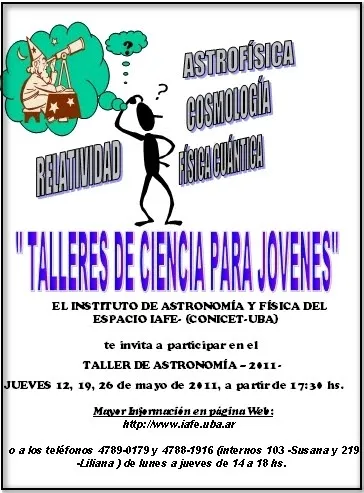
On its 40th Anniversary (1970-2010) the Instituto de Astronomía y Física del Espacio (IAFE) invites all students currently in the last years of high school or entering university who are interested in topics related to the study of the Universe to participate in the "Talleres de Ciencia para Jóvenes" (Science Workshops for Young People). Although the Workshops are aimed at students, they are open to the general public.
The IAFE
The IAFE is a scientific research institute dependent on the Consejo Nacional de Investigaciones Científicas y Técnicas (CONICET) and the Universidad de Buenos Aires (UBA).
Its main lines of research are developed in the fields of Astronomy, Theoretical Astrophysics, Atomic Collisions, Physics of the Upper Atmosphere and Physics of Terrestrial Remote Sensing.
The various groups that make it up maintain working links with related institutions, both national and international, many of them consolidated through Cooperation Agreements.
In addition to its essential activity, the institute is characterized by the permanent training of young researchers who carry out their Licenciatura and Doctorate work in Physical Sciences and Astronomy within it.
Furthermore, the IAFE is an active center for scientific outreach.
This year, as in previous ones, IAFE opens its doors to the public to give a series of workshops with the following schedule:
-First meeting: Friday 1/10/2010 at 18 h.
"Historical aspects of the Special Theory of Relativity"
Dr. Rafael Ferraro
The concepts of space and time are part of the foundation of physical theories. From them, the notion of motion is deduced. The natural attributes of motion according to Aristotle differ greatly from those conferred by modern science starting with Galileo and Newton. Newtonian Mechanics accepts the validity of "Galilean" composition of motions, which is supported by natural prejudices about space and time. However, the Galilean composition of motions came into conflict with the properties of light towards the end of the 19th century. Special Relativity will resolve that conflict by modifying our way of seeing space and time.
-Second meeting: Friday 8/10/2010 at 18 h.
"Notions on General Relativity"
Dr. Daniel Sudarsky
Albert Einstein's Theory of General Relativity is widely considered one of the most important intellectual achievements of humanity. It is, however, a subject often considered "inaccessible" to non-experts, due to the mathematical complexities it involves. In this talk we aim to overcome that barrier, presenting an introduction to the conceptual foundations, without going into the mathematical aspects but emphasizing some of the most important physical implications of the theory. Finally, we will give a brief description of the most spectacular experimentally confirmed predictions.
-Third meeting: Friday 15/10/2010, at 18 h.
"Introduction to Quantum Physics."
Dr. Darío Mitnik
In this meeting we will try to explain what Quantum Physics is and what it is for, why it is important and why it seems to be so difficult.
-Fourth meeting: Friday 22/10/2010, at 18 h.
"Quantum Physics: paradoxes, games and magic"
Dr. Darío Mitnik
-Fifth meeting: Friday 29/10/2010, at 18 h.
"The Big Bang"
Dr. Alejandro Gangui
We will see how modern cosmology was conceived and what its fundamental pillars are, and we will describe the latest astrophysical observations that support our credibility in Big Bang models. Reading material for the general public, available at: http://cms.iafe.uba.ar/gangui
-Sixth meeting: Friday 5/11/2010. at 18:00 h
"Black holes in astrophysics"
Dr. Ernesto Eiroa
In recent decades, black holes have ceased to be mathematical curiosities of the theory of general relativity to play an important role in understanding various astrophysical phenomena. In this talk, the basic aspects of black hole physics and their importance in current astrophysics will be analyzed.
-Seventh meeting: Friday 12/11/2010. at 18:00 h
"The darkest side of the Universe"
Dr. Gabriel R. Bengochea
We scientists seek to know the answers to basic questions by observing and/or modeling what surrounds us. Since 1929, with Edwin Hubble's observations, we know that the Universe is expanding, this fact being one of the pillars of the Big Bang cosmological model. Recently, evidence has been found that suggests the possibility that the Universe is expanding in an accelerated manner as a consequence of it being dominated by what is generically known as Dark Energy. This talk discusses which observations suggest these results and which alternative theoretical models seek to explain the existence and nature of this Dark Energy.
Registration
To attend, you must register by email with the data indicated on the Talleres de IAFE page. The institution informs that the 70 available places will be granted in order of arrival of the application, giving priority to students in the last 2 years of secondary education and CBC.
Pabellón IAFE - Cdad. Universitaria
Av. Int. Güiraldes 2620 - Cdad. De Buenos Aires - Argentina.
How to get there?
Sources and related links
- IAFE: Taller de Relatividad, Física Cuántica y Cosmología 2010
About the images
- IAFE logo. Credit: IAFE.