Today the Lord of the Rings is at opposition, that is, at its minimum distance from Earth. On Saturday it can be observed with telescopes from the Buenos Aires Planetarium.
Two objects are said to be in opposition when, relative to our planet, they are at two opposite points. In this case, Jupiter and Earth are 180º of celestial longitude apart, but on the same side of the Sun, otherwise it would be a conjunction.
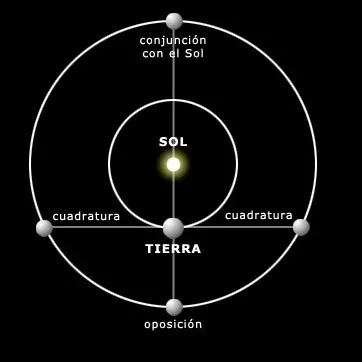
And how do you find out about these things? they ask around. You don't need to read a blog or website to keep up with these things. This does not mean the reader should run away from here, but it is good to know how to find out these things to have some independence.
One way to know when a planet will be at opposition is with some software, for example the often mentioned here GSky Digest:
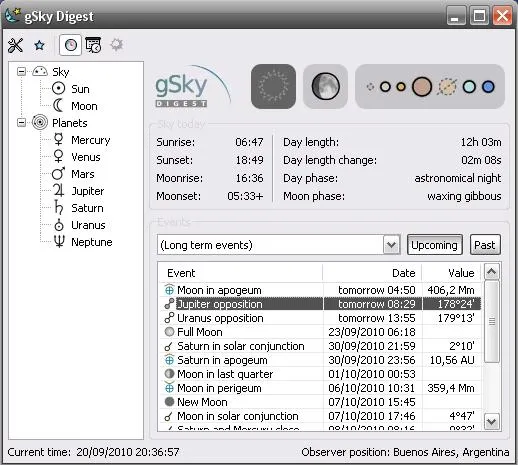
Here I show the program maximized. When closing the program it remains in the Windows taskbar. It is also possible to use notifications that alert us when some event is approaching.
As we see here, Jupiter's opposition is indicated. It says "tomorrow" because I took the image on 9/20. The time (08:29) and the degrees (178º24') are shown.
We also see that Uranus will also be at opposition five hours later.
In fact, they are very close to each other:
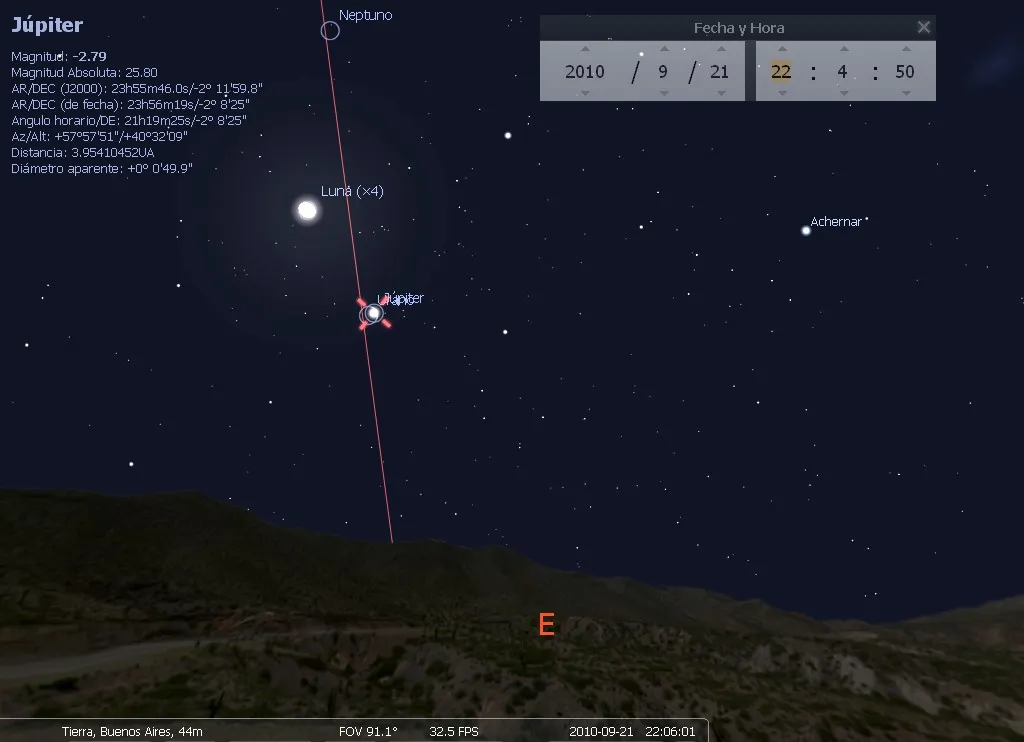
When a celestial body is in opposition to Earth, it means it is at its smallest distance from home in the year. But in some oppositions the object can be closer than in others. Some years Jupiter is much closer than in other oppositions. In this case, Jupiter's approach will be the greatest until 2022, at about 592 million kilometers (3.95 Astronomical Units). The last time the gas giant was this close was in 1963.
To know this type of data, for example the distance between two objects, we can use web tools like the JPL/NASA Horizons system, or the JPL Solar System Simulator.
In the latter case it is simpler to use and what we get is an image. We can select Jupiter, as seen from Earth:
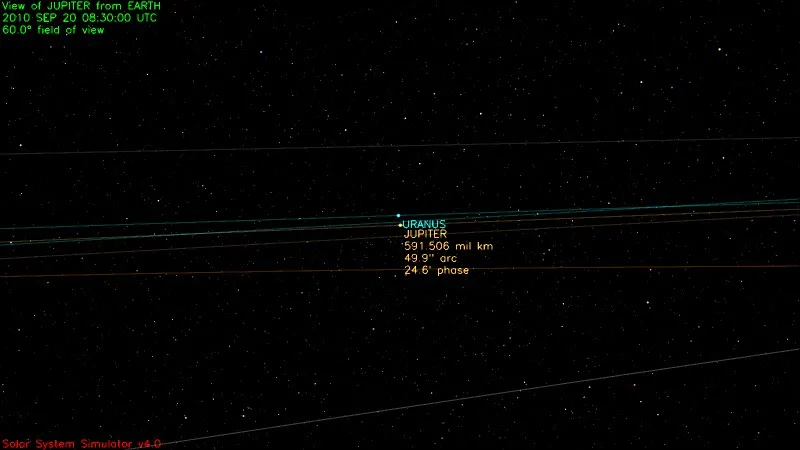
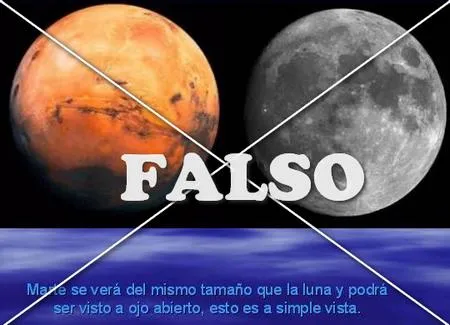
It will in no way look as big as the Moon, as has been pointed out on other occasions about Mars, as we commented in due time (in The Lie About Mars), where we talked about an opposition at perihelion.
With telescopes we can take advantage to observe the Great Red Spot and the Galilean moons. If we want to know where Jupiter's moons will be we can use a Sky&Telescope web application (made in javascript).
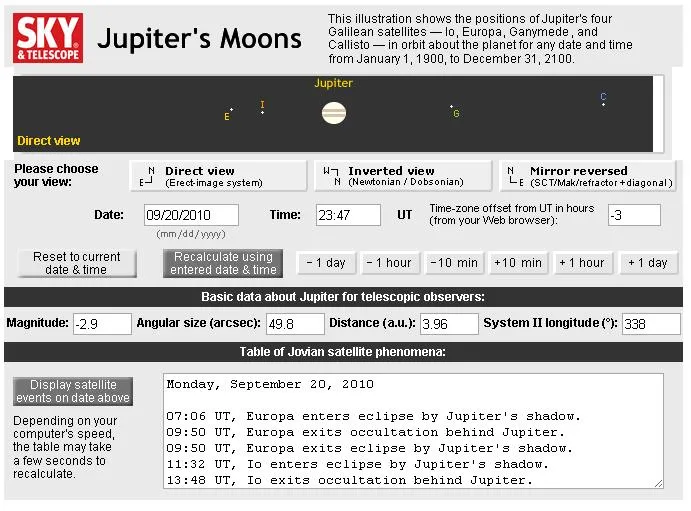
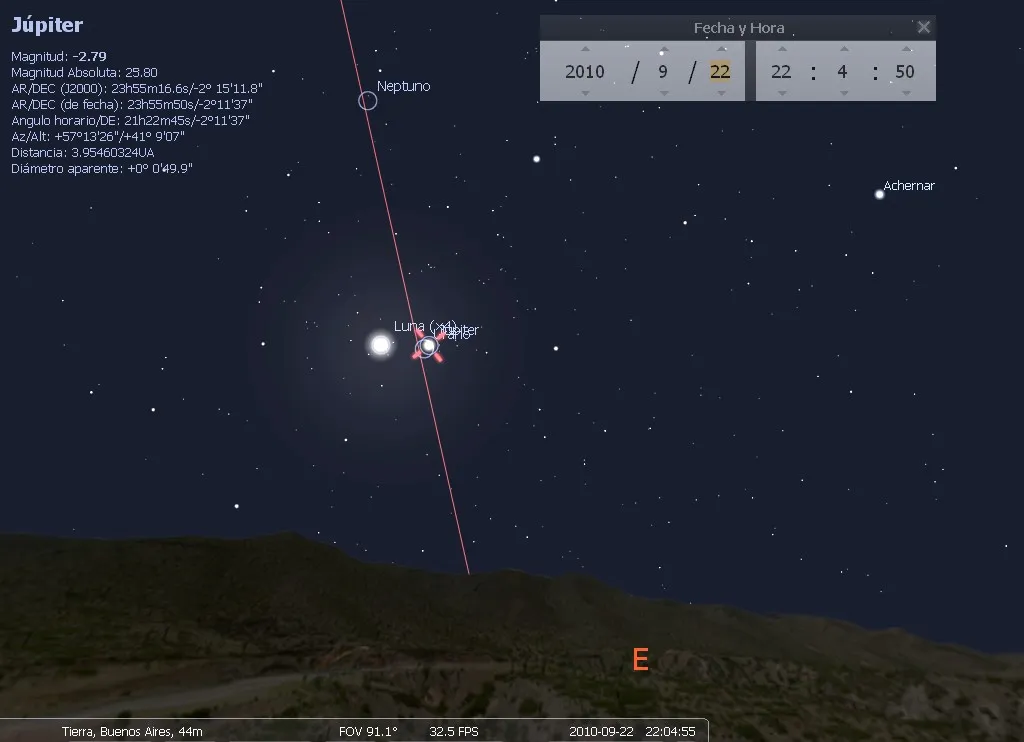
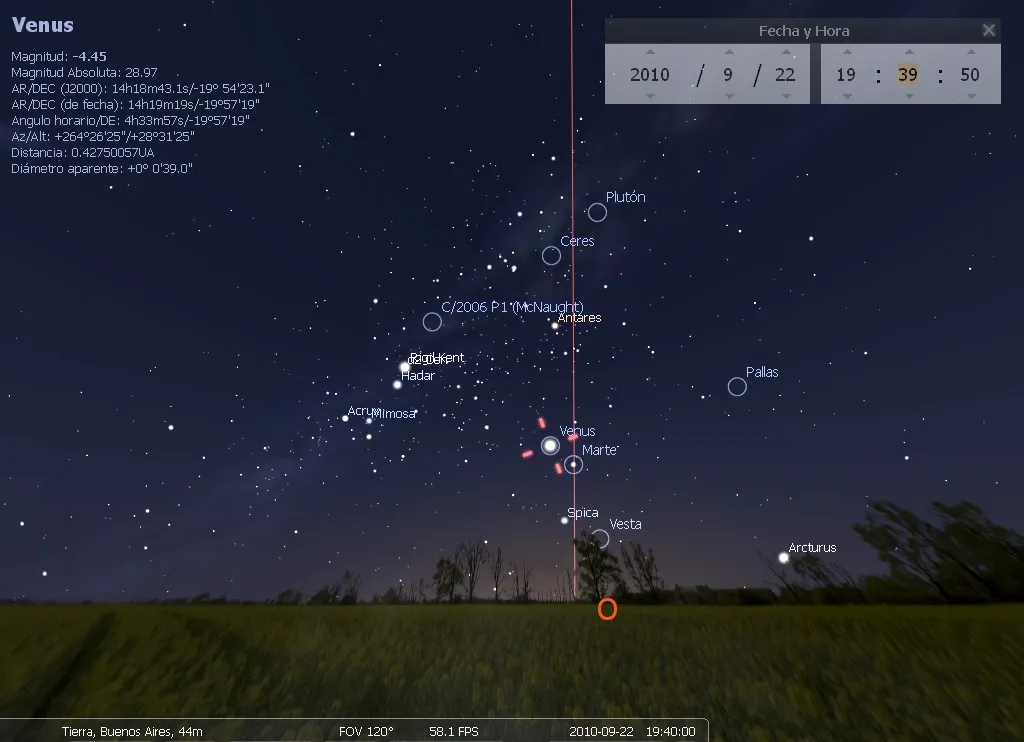
The observation, however, can also be done with the naked eye. With a magnitude of almost -3, it will be only the brightest Moon, after Venus sets (in the West). A good pair of binoculars, if you don't have a telescope, can also be useful.
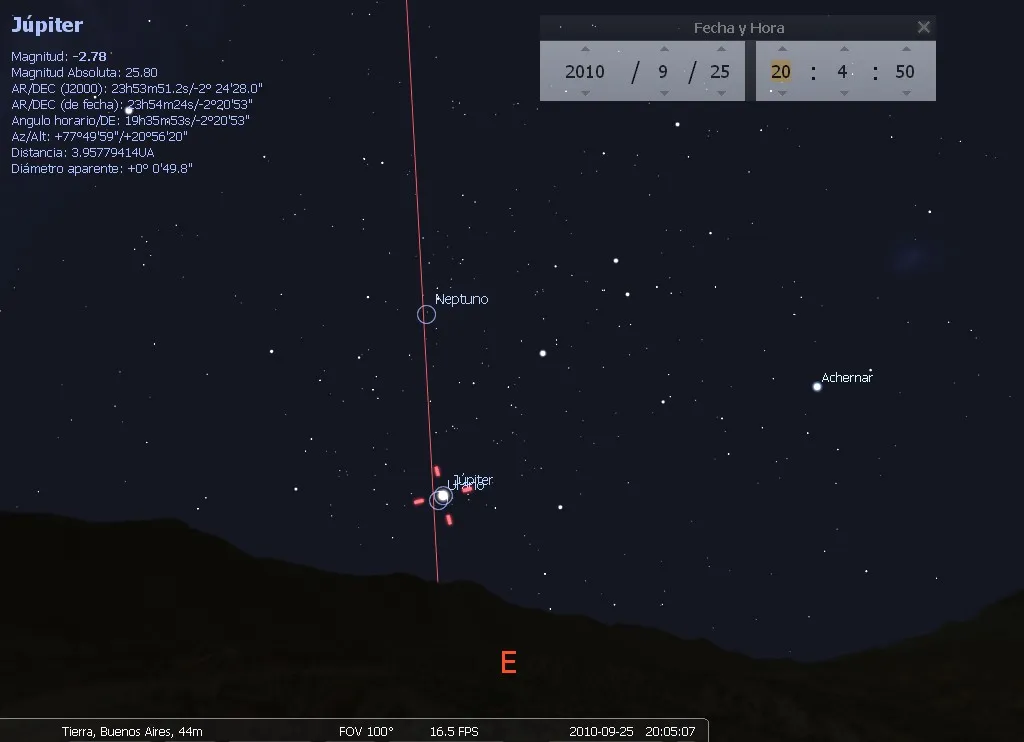
But the thing is not to look only today. Let's keep observing the following days and we will continue to see a beautiful show in the sky.
And towards the West:
At the Planetarium
On the occasion of this historic approach of Jupiter, the Buenos Aires City Planetarium will organize a special, public and free event.
A screen will be set up to project the live image and educational talks in the showroom. The meeting is on September 25 at 21:00 and will last until 2:00 in the morning on Sunday.
More information at Planetario Galileo Galilei
Sources and related links
- In the sky the stars: The Jupiter Show
About the images
- Screenshots made with Stellarium. The red line is the ecliptic.
- Images from JPL/NASA Horizons System and Simulator.
- Opposition-Conjunction graphic by UngaMan (Julio Vannini).