It's a true mystery, slowly being unraveled. How are stars formed? A group of astronomers says that a phenomenon that seems common in the gas and dust clouds that give rise to stars would be key to understanding them.
It's not that we don't know, in broad strokes, how stars are formed. Astronomers and astrophysicists point to dense regions of cosmic gas and dust clouds, molecular clouds, as the responsible ones. These clouds, which are denser in some regions than in others, accumulate matter until they collapse under their own gravity. The accumulation makes those regions denser and hotter each time, until finally fusion occurs. That fusion process, by which the hydrogen atoms present in the cloud join to form helium, is what gives us the light of the Sun, for example.
But what happens in the earliest stages of this collapse? An international group of astronomers led by Laurent Pagani (LERMA, Paris Observatory) and Jürgen Steinacker (Max Planck Institute), say they have discovered a new phenomenon that promises crucial information about the early phases of star and planet formation: core shine.
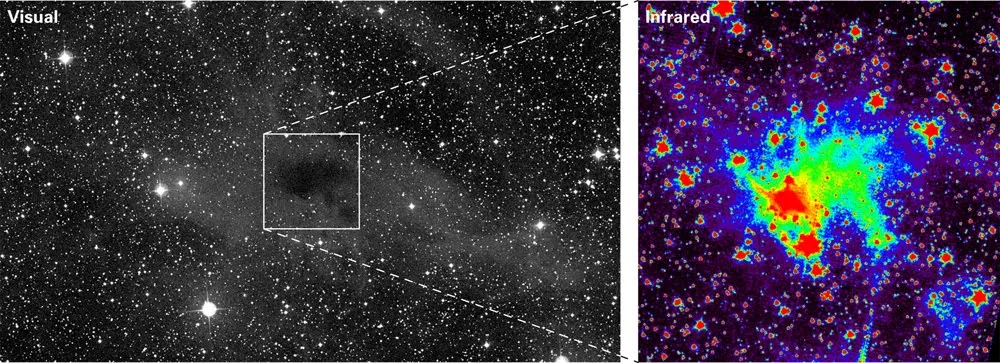
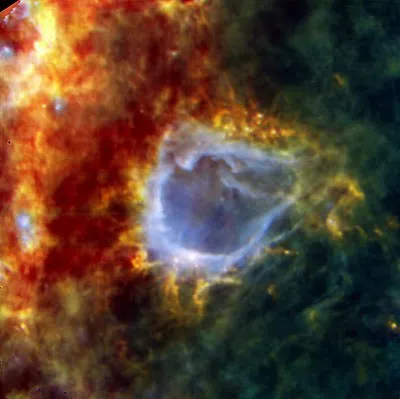
The molecular cloud CB 244 in Cepheus, 650 light-years from Earth. In those clouds, light from the Milky Way is scattered in different ways: visible light is scattered mainly by small dust grains in the outermost regions of the cloud. The false-color image shows infrared light scattered by larger dust grains in the interior of the cloud.
Thanks to observations with the Spitzer infrared telescope, these astronomers published in February the detection of infrared radiation they did not expect, from the molecular cloud L 183 in the constellation Serpens Cauda (the "Serpent's Tail") about 360 light-years away. The radiation seemed to come from the core of the cloud. Comparing their measurements with detailed simulations, the astronomers showed that it was light scattered by dust particles with diameters of around 1 micrometer (one millionth of a meter).
But one observation is not enough and more were made. The new publication in Science indicates that 110 molecular clouds at distances between 300 and 1300 light-years were studied, observed with Spitzer in several survey programs. The analysis shows, according to the astronomers, that the previous analysis was not a coincidence. Instead, it revealed that the effect of "core light" is a widespread astronomical phenomenon.
Almost half of the cloud cores exhibit this "core shine" or "coreshine," an infrared radiation associated with the scattering of dust grains in the densest regions.
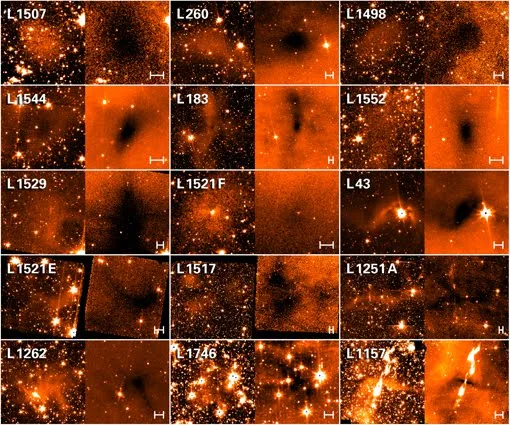
The discovery opens a new field of research both for the Spitzer Observatory and for the upcoming James Webb Space Telescope, which would be launched in 2014.
The first observations show unexpected large dust grains that would have begun to grow before the cloud collapse. An observation of particular interest lies in the constellation Vela where the phenomenon is not observed. Perhaps due to the many supernova disturbances it had. At least that's what the authors of the work hypothesize, assuming that those supernova events destroyed the larger dust grains in the region.
But, what does "core shine" mean?
It is a radiation detected in molecular clouds that seems to originate in the cores of the clouds. Hence the name. This radiation would occur thanks to the light of nearby stars that "bounces" off the cloud cores.
The discovery was surprising when detecting that starlight was scattered from the dark core in the form of infrared radiation, which the Spitzer telescope can detect. It was thought that the dust grains that formed the core of the molecular cloud were too small to reflect starlight. The finding indicated that they were larger dust grains than thought (1 micron instead of 0.1 micron. For comparison, think that a human hair is about 100 microns thick!).
It may seem insignificant, but it can modify models of star and planet formation. On one hand, the dust grains being larger implies that planets could form more quickly. That is, the small "seeds" for planet formation could form very early, when the star is still in primitive phases.
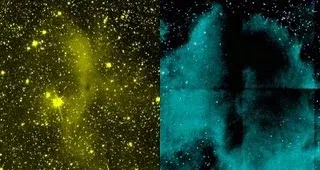
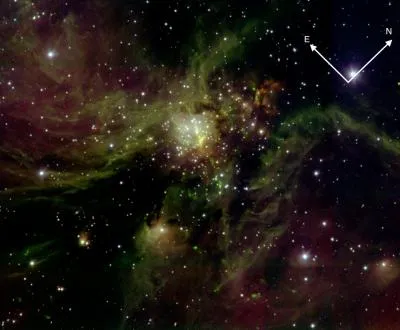
In near-infrared light (shown in blue) there is a "cloud shine" from light scattered by the smaller grains in the outer regions.
The mid-infrared image (in yellow) shows the newly discovered effect or "Core shine" produced by larger grains in the dense core of the cloud. An animation can be seen at MPIA.
Sources and related links
- MPIA: New astronomical phenomenon: Coreshine provides insight into stellar births
- NASA: Shining Starlight on the Dark Cocoons of Star Birth
- Direct evidence of dust growth in L183 from mid-infrared light scattering
J. Steinacker, L. Pagani, A. Bacmann, S. Guieu
A&A 511, A9 (2010)
DOI: 10.1051/0004-6361/200912835
arXiv:0912.0145v2 - The Ubiquity of Micrometer-Sized Dust Grains in the Dense Interstellar Medium
Laurent Pagani, Jürgen Steinacker, Aurore Bacmann, Amelia Stutz, Thomas Henning
Science 24 September 2010:
Vol. 329. no. 5999, pp. 1622 - 1624
DOI: 10.1126/science.1193211 - Claudio Marchesin: Coreshine provides insight into stellar births
About the images
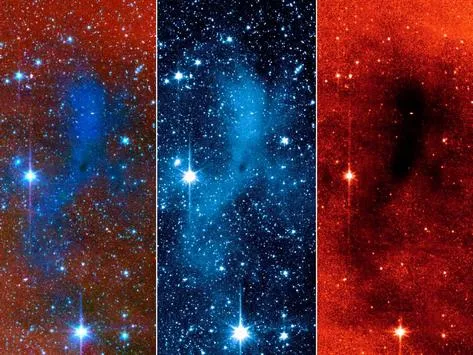
- Image 1: This series of Spitzer images shows a large mass of gas and dust, called a core, where stars and planets will be able to form.
The rightmost image shows the core seen at longer wavelengths of infrared light (8 microns). When viewed at this wavelength, the core appears dark.
The middle image shows the core at a shorter infrared wavelength (3.6 microns). Now the core lights up because it is reflecting light from nearby stars. That unexpected light, called "core shine," tells astronomers that the dust in the core must be larger than thought.
The left image is a combination of the other two.
This core lies deep within the L183 cloud.
Credit: NASA/JPL-Caltech/Observatoire de Paris/CNRS - Figures 1 to 3. Credit: MPIA, J. Steinacker et al.