The two halves of a meteorite that fell in Argentina were united in Frankfurt. They symbolize international scientific cooperation, which includes the country. The Minister of Science, Technology and Productive Innovation made arrangements in the U.S., Germany and the shipment of the part that was on display at the Planetarium.
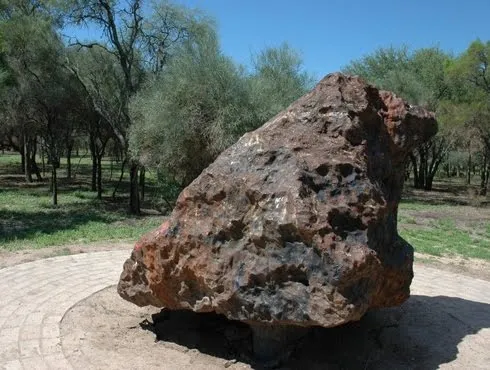
The story actually begins before the creation of Earth, when a meteorite dissolved in the asteroid belt, which is between Mars and Jupiter. And it was found more than a thousand years ago in an area of the Chaco, called Campo del Cielo (Pinguem Nonraltá in Guaycurú), where celestial body falls occurred. Today, Campo del Cielo has become an occasion for wonder.
This meteorite was found in 1962 by the guide Lázaro Melovich who found in Campo El Rosario (Santiago del Estero) a meteorite of 1998 Kg and gave it the name "El Taco". It is "a fraction of the original, which weighed more than 800 tons, which, as it passed through the atmosphere, fragmented," explained Lino Barañao, Minister of Science. Barañao is participating in the Frankfurt Fair in the symbolic meeting between Argentine scientists who are outside the country and those who stayed, materialized in the reunion of the halves of the meteorite that fell in Chaco, which was cut half a century ago for research in the U.S. and Germany.
In his office at the Ministry of Science, Technology and Productive Innovation, he told Sala de Prensa that "since there are not many meteorites of these characteristics, there was a North American researcher who tried to determine the composition. For that, it was necessary to split it. They tried to do it in the U.S., couldn't, and had to take it to Germany, where the Max Planck Foundation took charge of the cutting process, which took more than a year."
Explaining what happened with the meteorite from then on, he indicated that "it was analyzed, a small section remained in Germany: one part went to the Smithsonian museum in the United States, and another returned to Argentina."
He continued: "The meteorite was sectioned in 1962. The Argentine half was on display at the planetarium of the City of Buenos Aires and the other was neatly packed and stored in a warehouse of the Smithsonian museum."
Regarding the process that led it to the fair stand, he pointed out that "about two years ago, two young Argentine photographers, Nicolás Goldberg and Guillermo Faivovich, came with the proposal to unite those two halves on the occasion of the Bicentennial and we took that reunion with a metaphorical content as well. It seemed interesting to us to unite those two halves as a symbolism of the union between Argentine scientists who are abroad and those who remain in the country. And to keep them linked despite the distance."
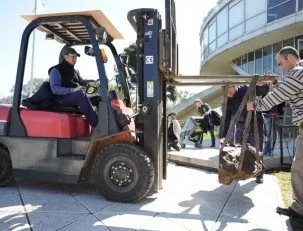
Asked about this, he said that "we began arrangements, I visited the Smithsonian museum the year before last, spoke with its director, told him about the initiative, he thought it was good, they directly authorized the departure of that half of the meteorite, then we began arrangements here in Argentina, to send this other half and thus that historic event occurred where the two halves came together in an exhibition that is taking place in the German city of Frankfurt, which is at the Portikus gallery, where now, after almost 50 years, these two halves reunited can be seen."
He highlighted that it is also "an opportunity to show the work that these photographers have done, a book that shows the history of this locality in the Chaco, which also has scientific, cultural value, because it is a pilgrimage site for many aboriginal communities. In fact, long ago, they used to go there to extract pieces of iron from the meteorites that were there and use them in arrowheads."
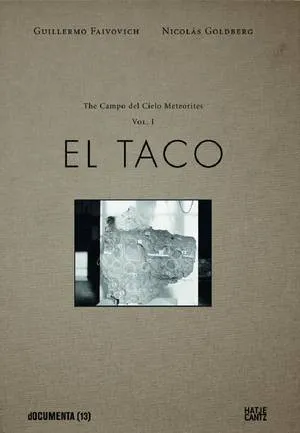
The exhibition "Meteorite: El Taco" opened on September 24 and was accompanied by the publication of the book "Los Meteoritos de Campo del Cielo - Vol. 1: El Taco". The book, published by dOCUMENTA (13) and Hatje Cantz, compiles and narrates the different moments in the history of El Taco, and includes different texts that interpret the phenomenon from art, history and science. The exhibition will continue until 11/14.
The union of the two halves is the product of joint work between the Ministry of Science, Technology and Productive Innovation, the Smithsonian Institution and the National Museum of Natural History of the United States, the Portikus Gallery with the Senckenberg Naturmuseum of Germany, and the Government of the province of Chaco.
Video: The Minister of Science narrates the experience
http://www.youtube.com/watch?v=yEy9r7PHKr0
"A Guide to Campo del Cielo"
Guillermo Faivovich and Nicolás Goldberg are visual artists and for more than two years they have been working on the project A Guide to Campo del Cielo researching the phenomenon of meteorites fallen in the Gran Chaco, compiling and updating the available information, doing fieldwork, interviewing related actors and generating pieces of photography, video and text, with the aim of composing a nucleus as a source of inspiration for the production of original work and as an alternative for heritage preservation; as well as the search for a space for reflection that stimulates possible relationships between the fields of art, science and history.
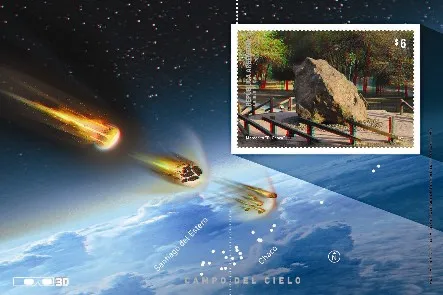
Since then they have carried out a series of actions which include the issuance of the first three-dimensional stamp made by Correo Argentino, as well as an artistic intervention at the Palacio de Correos in Buenos Aires. Then they present the stamp together with the Museo de Arte Contemporáneo de Rosario as part of the 3rd Art Week at the Palacio de Correos in that city. In 2006 they donate the exhibition Retrato de La Sorpresa and the meteorites that are no longer in Campo del Cielo to the provincial meteorite park in Gancedo, Chaco, where it is permanently displayed.
Sources and related links
- ART AND SCIENCE: A METEORITE AS A SYMBOL OF INTEGRATION
- They will unite the Argentine meteorite El Taco
About the images
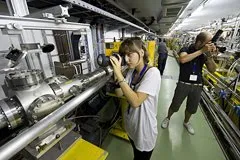
- Image of the transport of the fragment from the Planetarium. Credit: Ministry of Science.
- Cover of the book El Taco. Credit: GUILLERMO FAIVOVICH & NICOLÁS GOLDBERG
- Clarín: Campo del cielo: The meteorite reserve in the Chaco that NASA wants to protect
- More images in Ojos del cielo