SciFaiku is a form of poetry inspired by Japanese haiku. They are also called scifi-h or scifiku. SciFaiku are short, minimal poems about science and science fiction themes. They are presented in a direct way, with tangible images, in simple language.
In 1995 some principles for SciFaiku were established, the SciFaiku Manifesto:
SciFaiku is a distinctive and powerful form of expression for science fiction. It encompasses all human understanding, technology, and vision of the future in moving few lines.
SciFaiku takes its form from contemporary haiku. A poem usually has 3 lines and contains 17 syllables. Traditional haiku is composed of 3 lines of 5, 7, and 5 syllables respectively. That is a useful guide, but it is not necessary to follow it strictly. More or fewer syllables or fewer lines may be appropriate:
Asteroids collide without sound...
We move among fragments.
Another example:
Naked he sees she is not human
When we mentioned "syllables" above, we should actually say that it is about "morae".
Haiga are paintings that usually accompany haikus. And haiku authors are often called Haijin. For SciFaiku, scifaijin.
If we are interested in the topic of traditional haikus we can visit El Rincón del Haiku. There we can view books, some beautifully illustrated, with the haikus in several languages.
Science fiction
The theme of traditional haiku is about nature. SciFaiku does not need to contain natural elements, although it can.
Haiku contain a season word, a word that evokes the season, like snow evokes winter and flowers spring. SciFaiku often contain a "science word" like space, robot, laser.
Since many technological terms are often long, it is possible to make SciFaikus longer than 17 syllables, but the use of long terms that could be replaced by others without reducing clarity should be avoided.
Human thought
Perhaps one of the most relevant aspects of science fiction is how it provides a deep reflection on the human condition, even when the subject in question is computers or aliens. Not restricted to the tangible, SciFaiku allows the exploration of the thoughts and feelings of characters in a poem:
I am a ramjet: nostalgically I think of you
(A Bussard ramjet or ramscoop or ramjet is a futuristic concept of jet propulsion for space vehicles, proposed in 1960 by American physicist Robert W. Bussard, and popularized by astronomer and science communicator Carl Sagan, in his book Cosmos. The implication is that the traveler is on a very long interstellar journey, perhaps long enough to have no intention of returning).
I want SciFaiku, where do I go?
To read and know more: http://www.scifaiku.com
To share SciFaikus we can join a Yahoo group: http://groups.yahoo.com/group/Scifaiku/
Another site is Versería, where we can find the Manifesto and some selected SciFaiku http://www.verseria.com/haiku_de_cf/haiku_de_cf_intro.htm

SciFaiKuest http://www.samsdotpublishing.com/scifaikuest/cover.htm
Planet Magazine: http://planetmagazine.com/sfku.htm
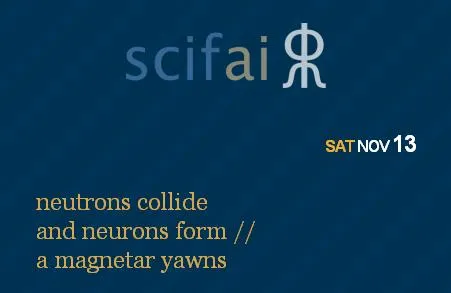
and don't forget to visit SciFai and its RSS.
For those who find space, astronomy, and other related disciplines interesting, but also artistic expressions, this form of expression may be enjoyable both to read and to create.
The structure does not have to be followed to the letter. Rather, the idea is to be concise and clear.
A kind of Twitter of sci-fi poetry. In fact, sending the tweet-SciFaiku can be a good way to share the taste for this form with others.
Let's take, then, this poetic license that allows us to use knowledge, but also imagination.
Sources and related links
About the images
- "Boxed Sunset", by Bruce Boston.
- Screenshots of Versería and SciFai.