On December 21 there will be a lunar eclipse and on January 4 a solar one, among the next games of light and shadow in which the Earth participates.
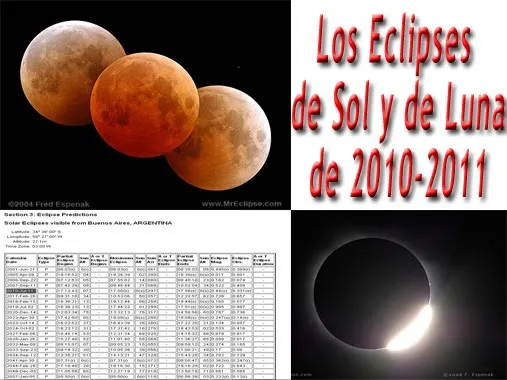
Next December 21, between 5:30 and 11 (Universal Time) a lunar eclipse will be visible in different parts of the planet.
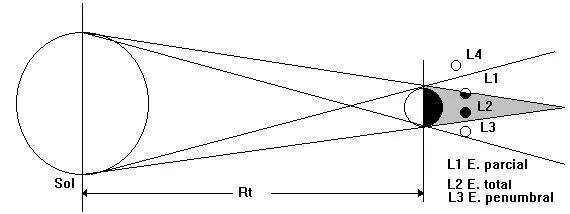
In a lunar eclipse what happens is that the Sun illuminates the Earth and it projects a shadow. If the Moon is at the "correct" distance, the shadow can be somewhat smaller or larger than the moon, darkening it totally or partially.
In this case, the eclipse will be total, but we will not see the same thing from any location. In a total eclipse the shadow of our world completely covers the Moon, but as the minutes pass, the shadow moves, and in different parts the Moon will no longer be seen completely darkened.
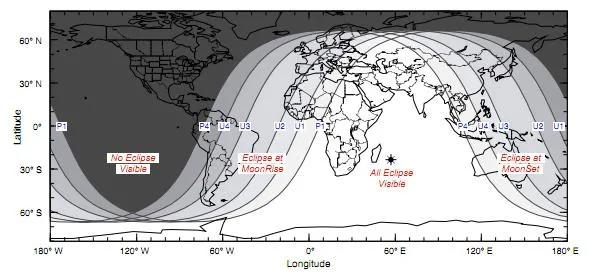
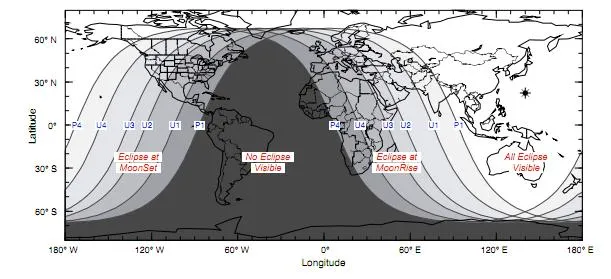
In the following graph we can see that:
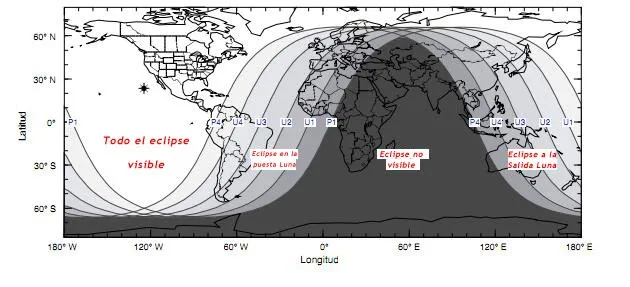
Where it says Pnumber is the penumbra. Where it says Unumber is the umbra.
In Argentina we will witness the eclipse at moonset (U3-U4), as well as in Uruguay, Chile, Bolivia, Brazil, Paraguay.
Further west they will witness the penumbra (P4) and if we move even further, the entire eclipse will be seen.
On the other hand, part of Africa, Europe and Asia will not see the eclipse, while further east they will see it partially at the rise of Selene.
Times:
U2=07:40 UTC
U3= 08:53 UTC
U4=10:01 UTC
P4=11:04 UTC
For Argentina, which uses UTC-3, we must subtract 3 hours.
Let's keep in mind
If the Moon were much larger or were at a greater distance from Earth, lunar eclipses would not occur.
They occur because the Earth-Moon distance is about 384000 km and our satellite has a radius of 1736 km. Earth has a diameter of 12,000 km, that is a radius of 6,000 (Rt).
Also, the average Earth-Sun distance (Rt) is 150 million km.
The height of the shadow cone (H) can be calculated like this:
Graphic 1
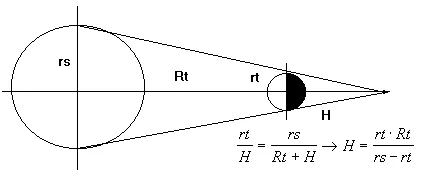
The Sun, Earth and the projection of Earth's shadow, H, are shown. The Moon, will it be inside or outside H? Since we know it is at an average distance of 384,000 km, if H is larger it will be inside. And yes, it is much larger.
Once we have H, we can calculate S, the shadow radius:
Graphic 2
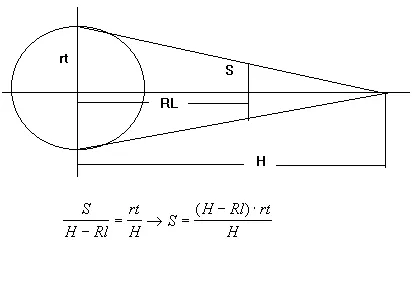
Here we have Earth and the Moon. This H is the same we calculated before.
Don't believe me?
Let's go to the calculation of H, with pencil and paper. A calculator at hand in case we don't want to do simple mental math...
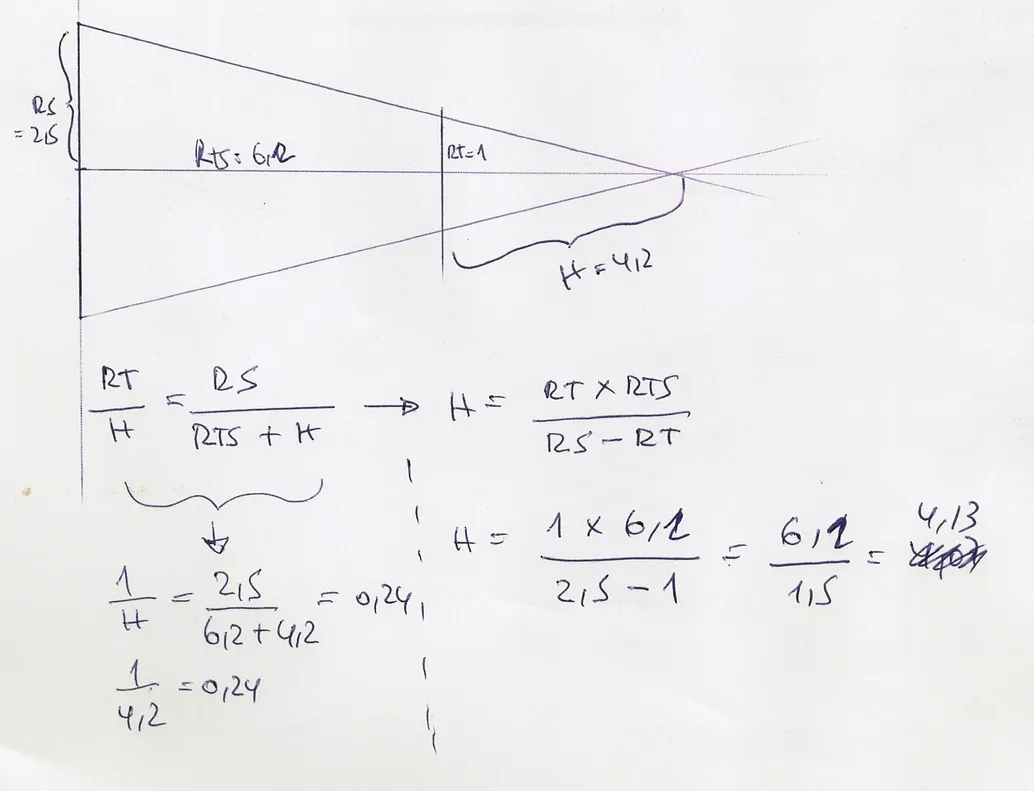
What I did quickly on paper is to replicate the situation in Graphic 1, but now with small values that I can test with enormous ease.
Rs is the radius of the Sun, RTS would be the average Earth-Moon distance, Rt the radius of Earth and H what we would want to know.
But in this pair of triangles the values of Rs (2.5), RTS (6.2), Rt (1) and H (4.2) do not correspond to those of the solar system, and have a value measurable with a ruler, in centimeters. Although we should want to calculate H, in reality we could easily measure that segment.
But here the idea is to demonstrate that the calculations indicated before are correct, they are compatible with these simple data we can measure with a ruler.
Update
I am asked why the equality is indicated in graphic 1, where does it come from? and also how H was solved from that equality.
The equality occurs because the tangent of an angle is opposite leg / adjacent leg. If inside a right triangle I add a line parallel to the opposite leg I get inside the first triangle another one, which has the same angle and the same tangent. What perhaps is not clear in Graphic 1 is that this happens precisely.
To explain both things, it seemed easier to me to do it in pencil and paper again and the result is this (opens separately).
Where it says that bq = cq, it should say, approximately. The important thing is that H=bq, the height of the shadow cone.
More information about the December 21 lunar eclipse at NASA.
The next solar eclipse
The first solar eclipse of 2011 will be partial and will not be visible from Latin America. It will be visible in part of Europe, part of Africa and part of Asia.
http://eclipse.gsfc.nasa.gov/OH/OH2011.html#SE2011Jun01P
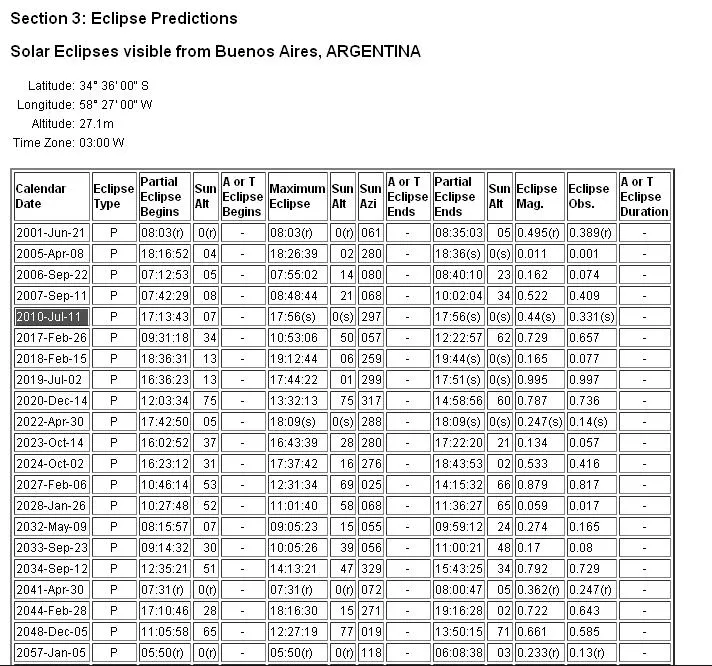
If we want to know the local circumstances for any solar eclipse from a city and for any date from 1500 BC to 3000 we can use an online application from NASA: the Javascript Solar Eclipse Explorer http://eclipse.gsfc.nasa.gov/JSEX/JSEX-SA.html
We can also consult a javascript for the Moon.
If I indicate Buenos Aires and choose this century (2001-2100) I get a table only with the eclipses visible from this latitude:
The following solar and lunar eclipses of 2011
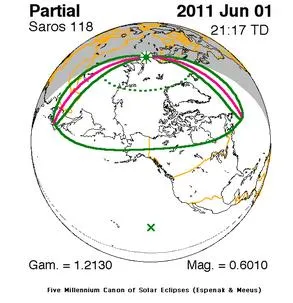
The next partial solar eclipse will be on June 1, also not visible in these parts, but in China, Siberia, Alaska, Canada.
http://eclipse.gsfc.nasa.gov/OH/OH2011.html#SE2011Jun01P
Then, on June 15 there will be a total lunar eclipse in which something inverse to the nearest one at present will occur. In North America it will not be visible, but it will be in Africa, Europe and Asia. In South America, the most western part, from northern Peru, will not be visible either.
In Buenos Aires, at Moonrise, around 19 h the penumbra will be visible.
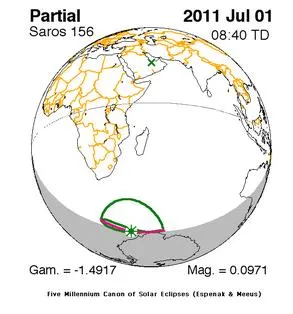
On July 1 there will be another partial solar eclipse that we will miss in America, but that Africans will enjoy.
http://eclipse.gsfc.nasa.gov/OH/OH2011.html#LE2011Jun15T
On November 25, another one, only visible for the All Blacks!
http://eclipse.gsfc.nasa.gov/OH/OH2011.html#LE2011Jun15T
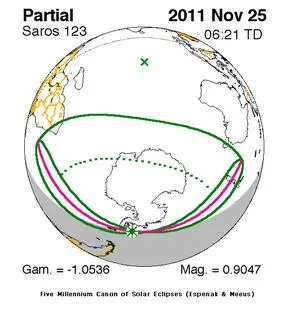
Another total lunar eclipse will be seen on December 10, 2011 http://eclipse.gsfc.nasa.gov/OH/OH2011.html#LE2011Dec10T but we will not be able to see it here.
If we want to have a calendar to our measure, in English, with the eclipses and phases of the Moon, we can consult NASA's Sky Calendar http://eclipse.gsfc.nasa.gov/SKYCAL/SKYCAL.html?cal=2011#skycal
In summary: from Argentina and much of South America we will not see any solar eclipse and we only have ahead two lunar eclipses, the one on December 21 and the one on June 15.
Sources and related links
- NASA Eclipse
- Geometric aspects of Lunar Eclipses by J. García Ferrer.
About the images
- Maps from Nasa Eclipse
- Black and white images of calculations by J. García Ferrer.
- Photos by Fred Espenak of the lunar and solar eclipse.