The European Southern Observatory highlights Dr. in astronomy Andrea Ahumada in its latest issue. It also notes the participation of an Argentine in the Hidden Treasures contest.
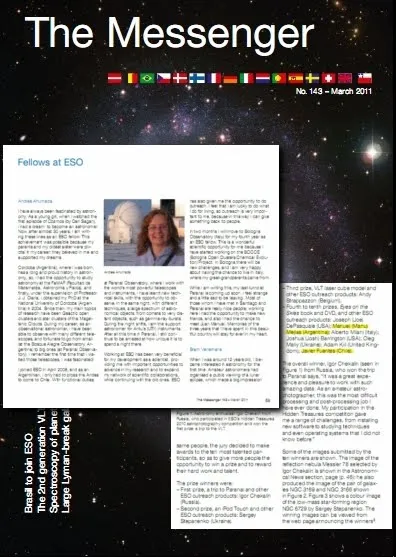
The Messenger is a quarterly publication published by ESO, the European Southern Observatory.
In its issue 143 from March 2011, released these days, it highlights the participation of Argentine astronomer Andrea Verónica Ahumada, in the Fellows section at ESO.
In that section researchers can tell how they came to ESO and to astronomy and what projects they have.
The magazine can be obtained for free from the ESO publications page and/or from Scribd.
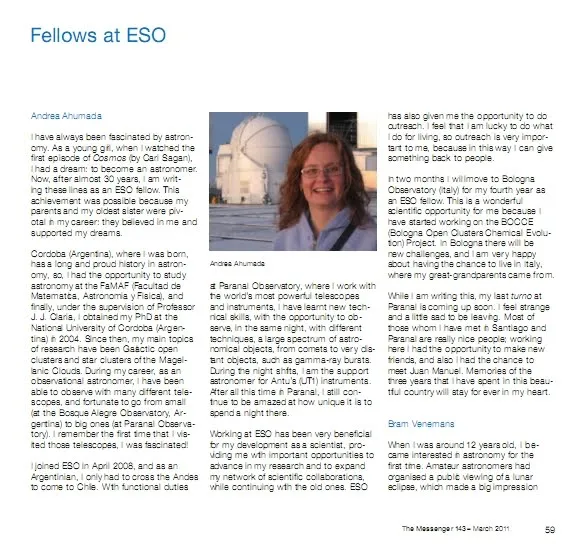
On page 59 of The Messenger the young professional says that astronomy always fascinated her. "Since I was a child, when I watched the first episode of Cosmos (by Carl Sagan) I had a dream: to become an astronomer. Now, after almost 30 years, I write these lines as an ESO [Fellow] researcher," she states with pride and takes the opportunity to thank the support of her parents and her older sister who supported her in her career by believing in and supporting her dreams.
Ahumada does not miss the opportunity to remember her origins by highlighting that Córdoba, where she was born, has a long and proud history in astronomy and that she had the opportunity to study at the Faculty of Mathematics, Astronomy and Physics (FaMAF). Finally, under the supervision of Professor J. J. Clariá, she obtained her doctorate from the National University of Córdoba in 2004.
Since then, her main research topics have been the open clusters of the Magellanic Clouds.
She relates that during her career as an observational astronomer she had the possibility to observe with different telescopes and go from the small ones (in Bosque Alegre) to the large ones (Paranal).
She says she joined ESO in April 2008 as an Argentine. There, with the most powerful telescopes in the world she learned new technical skills with the opportunity to observe in the same night with different techniques, a wide spectrum of objects, from comets to very distant objects like gamma-ray bursts (GRBs).
In two months, Ahumada says, she will go to the Observatory of Bologna (Italy) in her fourth year as an ESO fellow, which will give her an incredible scientific opportunity by working on the BOCCE project (which studies the chemical evolution of open clusters).
Dr. Andrea Ahumada, among her several achievements, was awarded in 2006 the Carlos Varsavsky Prize for the best thesis in astronomy. Bulletin 185 of the La Plata Observatory reported on that award with an interview with the awardee. I recommend reading it.
In 2007, the Córdoba Stock Exchange also distinguished her in the contest that awards the Ten Outstanding Young People of the year.
Dr. Ahumada is also a member of the IAU, as a member of Division VII commission 37 on stellar clusters and associations, of the Córdoba Observatory and of CONICET.
An Argentine among the treasures
At the beginning of the year the winners of the ESO astrophotography competition called Hidden Treasures were announced.
Among the almost 100 entries, published on Flickr, the fifth prize went to Manuel (Manu) Mejias, from Argentina, as The Messenger notes on page 58.
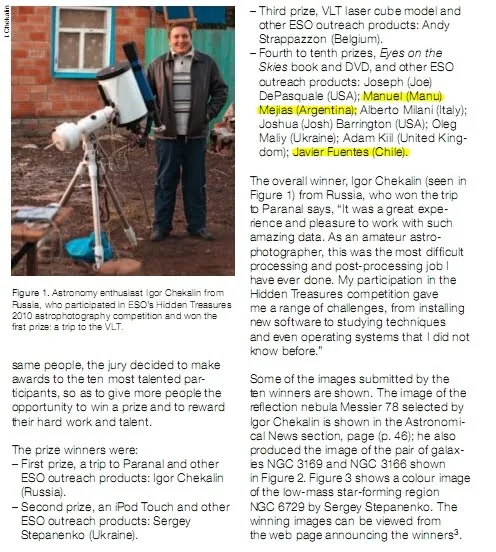
It is also worth highlighting the award to Javier Fuentes, from Chile.
These two astrophotography lovers received the book+DVD Eyes on the skies and ESO merchandise.
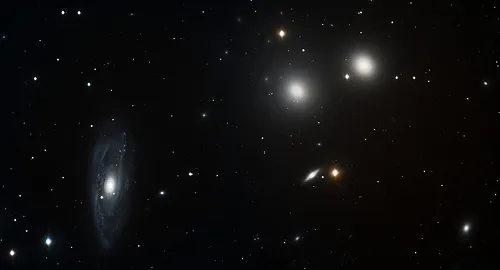
Among the photos processed by Manuel Mejias (user Another Eye on Flickr) are: NGC 371, Abell 1060 and NGC 1929, N44.
For his part, Fuentes participated with Haffner 18 and 19.
Sources and related links
- ESO Messenger No. 143, March 2011
About the images
- The Messenger is an ESO publication.
- Image of Abell 1060. Credit: ESO/M.Mejias.