The fifteenth member of the organization that brings together European countries will be the first not to be from that continent.

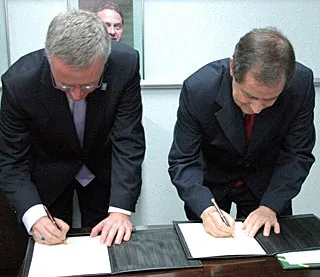
On December 29, in a ceremony in Brasilia, Sergio Rezende (Brazil's Minister of Science) and Tim de Zeeuw, Director General of ESO, signed the formal agreement, which must be ratified by the Brazilian Congress.
"Joining ESO will give new impetus to the development of science, technology and innovation in Brazil as part of the considerable efforts our government is making to keep the country moving forward in these strategic areas," said Rezende.
ESO has a long history of successful involvement in South America, since Chile was selected as the best site for its observatories in 1963.
In fact, if you allow me a personal digression, precisely because of what was noted above, the fact that ESO's large telescopes (VLT, La Silla, ALMA, E-ELT) are in Chile, allowed me to imagine some time ago that that country could become part of the organization.
"Brazil's membership will give the vibrant Brazilian astronomical community full access to the world's most productive observatory and open opportunities for industry to contribute to the Extremely Large Telescope (E-ELT) project," said Tim de Zeeuw.
The neighboring country's entry into ESO will not be free. If one wonders why Brazil and why now, perhaps the bad economic path that seems to be sweeping Europe has contributed to generating this opportunity. The 250 million euros (about 550 million dollars!) that Brazil's entry into the European consortium will cost over eleven years will not be negligible. A truly astronomical figure.
According to the Brazilian Government press release, that country will be exempt from the additional contribution being imposed on other members and will benefit from the advantage that the payment calculation will be different. It is normally done in relation to GDP, but Brazil showed that its wealth is not proportionally related to the other countries in the group. Since Brazil's astronomical community is small, by comparison, ESO decided to promote a gradual increase in the Brazilian annuity. This means that, from the value calculated in relation to GDP, Brazil will only pay 25% in 2012 and that percentage will increase until reaching 100% of the calculated value of its GDP in 2021.
Hopefully Brazil's access opens opportunities for other countries in the region in the future. It is also true that, regardless of this, South American states should join together in their own consortium to install instruments in the area and operate them themselves. The LLAMA Project is an example that seems to be heading in that direction.
Sources and related links
- MCT and ESO sign agreement for astronomical research in the southern hemisphere
- Brazil to Join the European Southern Observatory
About the images
- Marcos Freitas/Brazilian Ministry for Science and Technology/ESO