The year 2012 marks the 50th anniversary of ESO, the European Southern Observatory. The year in which the anniversary is celebrated is an opportunity to review the history of ESO, celebrate its scientific and technological achievements, and look toward the next ambitious future programs. ESO is planning several activities that will take place during the year.
On October 5, 1962, representatives of six European countries — Germany, Belgium, France, the Netherlands, Sweden, and the United Kingdom — signed the ESO Convention in Paris. (Later the United Kingdom withdrew and rejoined in 2002).
Their signatures represented a formal commitment to establish the European Organization for Astronomical Research in the Southern Hemisphere, today commonly known as the European Southern Observatory.
“The 50th anniversary of ESO comes in the midst of the most exciting period for ground-based astronomy, both European and international. ESO has come a long way since its creation in 1962. Fifty years later, ESO is a leader in research within the astronomical community, with the world's most productive astronomical observatory,” states Tim de Zeeuw, Director General of ESO, in a press release issued today detailing the organization's history.
A series of events for this year are also announced:
-From September 3 to 7, 2012, the ESO headquarters will host a scientific symposium covering topics such as exoplanets, the Solar System, stellar formation and evolution, Cosmology, etc.
-On the anniversary day, October 5, 2012, ESO intends to organize coordinated public events in the fifteen member states. Organized with the help of the ESO Science Outreach Network and collaborating Outreach Organizations, the events will be an excellent way to connect the public in each country directly with the ESO astronomical community and its impressive observatories in Chile.
-On October 11, 2012, the Director General of ESO, Tim de Zeeuw, and the President of the Council, Xavier Barcons, will welcome ministers from the member states and the host country, Chile, to the ESO Council, representatives of ESO committees, former directors general of ESO, renowned astronomers, and other people who have played important roles at ESO. It will be at the anniversary gala taking place in Munich (Germany).
-During the year, an exhibition to celebrate the anniversary will be displayed at different locations in the member states. Those interested in hosting the exhibition can request it through the contacts (at the end of this note).
-On the anniversary day, a documentary video will be distributed, along with a lavishly illustrated book. The film will also be offered in chapters in the well-known ESOcast series. Adrian Blaauw's book, ESO’s Early History, will be followed by a second historical book written by Claus Madsen to complete the 50-year history of ESO.
The first image of the week of each month during 2012 will be a special Then and Now Images, presenting ESO sites as they were in the past and as they are now in the present.
-For those who have witnessed ESO's historical journey from within, whether as staff members or simply as visitors, we have expanded the Flickr Your ESO Pictures group to include historical images. Please share your ESO souvenir photos with us and the rest of the world by including them in the group as “postcards from the past” (ann12001).
-To celebrate the anniversary, commemorative products will be offered in the ESO Shop.
Congratulate ESO by sending messages to the ESO facebook page or the Twitter account @ESO_Observatory using the hashtag #ESO50years.
This set of initiatives by ESO, which is one of the organizations that pays the most attention to communication with the public and the media, is appreciated because it allows celebrating the wonder of astronomy and scientific discovery to a very broad audience. And thanks to Spain being one of the member countries and Chile being where the important telescopes have been installed, the organization generates a lot of content in Spanish.
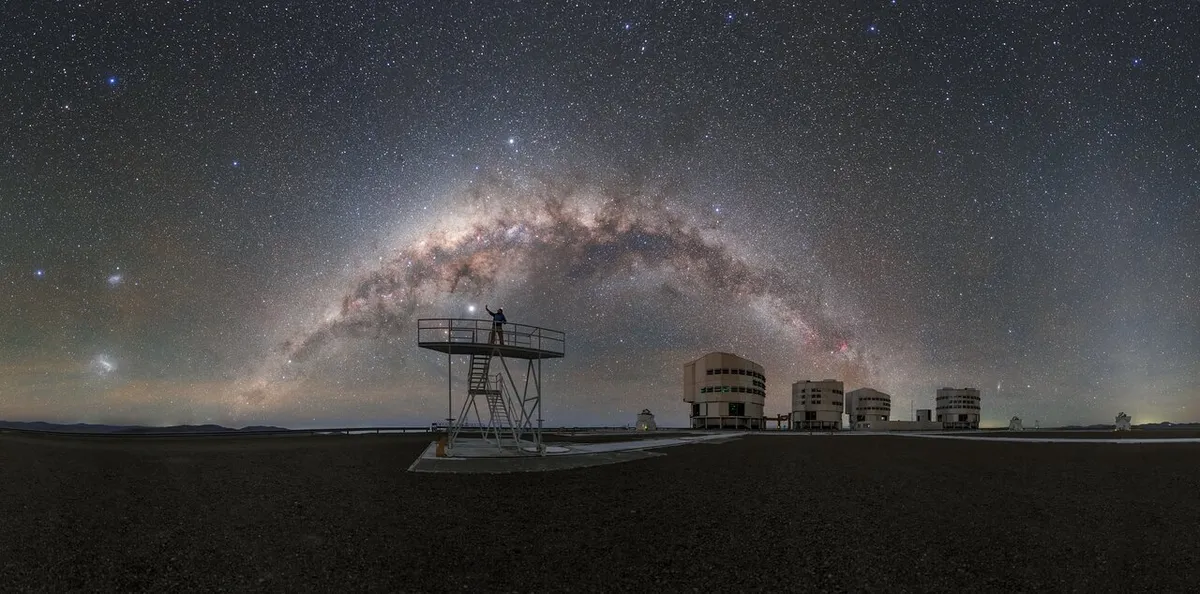
ESO includes the La Silla Observatory and the Paranal Observatory where the Very Large Telescope (VLT) is housed. VISTA is also there. Furthermore, ALMA will have 66 antennas when its construction is completed in 2013, although it is already doing science. And as if that weren't enough, it will have the European Extremely Large Telescope, known as E-ELT, whose 40 meters will be located on Cerro Armazones, near Paranal.
“I look forward to the next 50 years of ESO, as they will undoubtedly present innovative science beyond imagination, thanks to the VLT and VLTI, ALMA and the E-ELT, as well as future flagship projects. Thanks to the dedication, passion, and professionalism of the ESO staff, the organization leads ground-based astronomy today. Happy 50th anniversary to all!,” wishes Tim de Zeeuw.
Sources and related links
- ESO 50th anniversary website
- Participate in the ESO Anniversary in 2012
ESO Chile
About the images
- Credit: ESO.