If analogies are a fabulous resource, they also have their harmful side. Is everything connected to everything? Hmmm, one second...
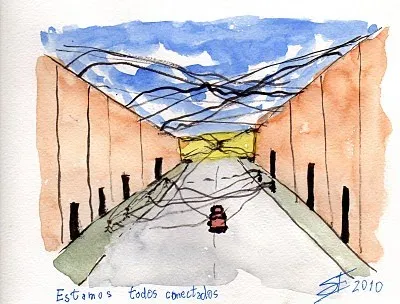
A famous Argentine broadcaster used to say in his programs that "Everything is connected to everything." Readers may have experienced finding relationships between supposedly different things, where one least expects it.
On the other hand, from a physical point of view, it is possible to think that the phrase is something more than an analogy. After all, there are physical relationships between what happens in the microcosm, in the subatomic world, and what happens in the macrocosm, in the large structures of the universe.
Current science, necessarily interdisciplinary, supports this idea.
But...
Analogies
Look at this image:
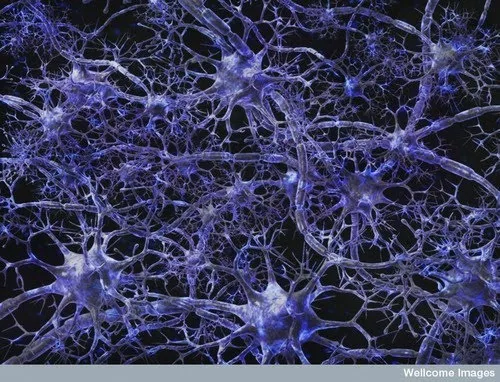
Dense network of myelinated nerve cells.
Credit: Arran Lewis, Wellcome Images[Image 1]
Now, look at this other one:
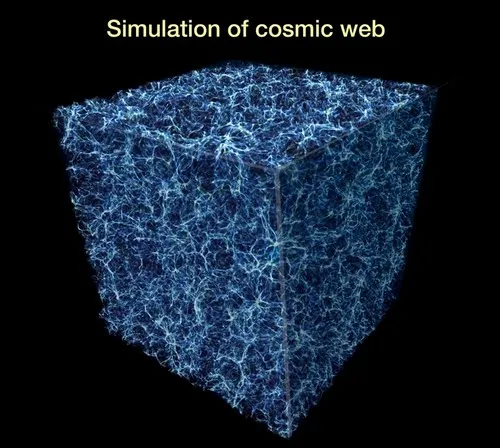
The graphic represents a portion of the structure of the universe known as the "cosmic web." The large filaments are mainly dark matter located in the space between galaxies.
Credit: NASA, ESA, and E. Hallman (University of Colorado, Boulder)[Image 2]
Do you see an analogy between one and the other, despite knowing they are two very different "things"?
There is, perhaps, a search or, in any case, an interpretation of things in our brain related perhaps to symmetry.
Why is it that we like to find symmetries?
Marcus du Sautoy: Symmetry, the riddle of reality.
The world turns on symmetry -- from the spin of subatomic particles to the dizzying beauty of an arabesque. But it is more complex than it seems at first glance. Here, Oxford mathematician Marcus du Sautoy offers a glimpse into the invisible numbers that unite all symmetrical objects.
The limits of analogy
If we want, we can find symmetries anywhere. In the history of science, there are ideas that seem to bathe everything, from the principle of least effort to Occam's razor: Nature seems to prefer simplicity and the search for equilibrium. Even in Chaos Theory, it is possible to glimpse an order and simplicity where prima facie none seems to exist.
In this sense, analogies can enhance discoveries. If we manage to understand that through a process that seeks simplicity, then perhaps something similar happens with that other thing.
The symmetry of structures is beautiful and elegant, but we must not overlook that the apparent is not always real.
We cannot study a star-forming region as if it were a rose, nor the flowers of that kind as if they were a grouping of gas and dust, even if they seem similar to us in some way.
This seems obvious, but it is exactly what has been happening these days, by treating Nature as a living and vengeful consciousness, acting symmetrically to human behavior. There is NO such symmetry. To act, react, respond, are terms sometimes applied to Nature, but far from the meaning we give to those verbs when referring to human behavior. There is NO symmetry because Nature does not act with intentions.
Beyond the barriers of the mind (without our brains falling out)
Todd Siler has a degree in visual arts and sciences from MIT. His book, "Beyond the Borders of the Mind"[1] establishes, in its 343 pages of the Spanish translation, a set of analogies of all kinds. In the introduction, Siler says:
"The messages of this book are basic. The universe imparts its creative processes to us. We, for our part, impart our creative processes to the things we create. Our creations directly reveal the nature of our minds, and indirectly that of the universe."
But later, he warns: "This book is allegorical in many respects. Although numerous literal connections are presented, I ask the reader to investigate them as ideas."
Despite this, there are people who interpret that text as literal. The book seeks analogies, metaphorizations according to the author, between the elements of the micro and macro cosmos, between the brain and the universe.
The great Carl Sagan wrote "The Cosmic Connection."[2] In some way, a relationship is also established there between the different components of the whole, here on Earth, in the solar system and beyond the galaxy.
There are enormous distances between the relationships established in that and other books by Sagan and those established by Siler in his book. However, in the background, there is this idea that "we are all connected." The most modern postulates of ecology and environmental care point to the same thing. Sagan said we are made of stellar matter. Neil deGrasse Tyson points out that we are star dust. And he realizes there is a kinship between this idea and others...
Video: Neil deGrasse Tyson - The Universe is in Us
http://www.youtube.com/watch?v=HAGcwHRYzsI
Note: if subtitles are not displayed, press the "cc" button.
But in this tangle of unequal things, we find currents of ideas that embrace analogies literally. As if the spin of a coin affected the way the solar surface rotates...
What is the problem?
The problem is not that people think in a specific way, but the confusion that is favored by the reductionism of thinking that "we are all connected" is literal, even reversible.
If climate change and global warming have any anthropogenic cause, it does not mean that everything that happens to Nature is a product of human action.
If I wrote this, it was not only because I heard a broadcaster on channel C5N on Friday saying that the Earth is taking revenge on humanity. In favor of that professional (whom I respect), it must be noted that he quickly stopped and retracted. But then on other channels, especially on radio, these ideas are spat out without turning back. Luckily there are sensible listeners and viewers, but the incredible thing is that sometimes they seem few.
The general idea that seems to imbue a few is that we are all related by an immaterial consciousness that connects us. It is a non-scientific postulate, despite which it attempts to explain how and why things happen.
There is also a kind of disturbing hope, that the end of something is approaching, a destructive end, like Noah's ark.
The Earth will split, the skies will be on fire, space probes will behave anomalously, a new order will arise...
The strange, the sad thing is not to realize that if everything is connected to everything, then our future is a product of our present. Human beings do not cause earthquakes, but they do cause confusion and stupidity. When opinion leaders generate this false expectation that a new era is coming, they should take responsibility for the consequences that will entail when it does not arrive.
If we want a new order, we do not have to wait for any planetary alignment, for any extra-ordinary event. We have to start looking at ourselves in the mirror, to look at others. Intentions are human. Some of those who today preach that we are all connected are the same ones who, a few months ago, given the problems of land occupations in Buenos Aires, called for closing the borders and expelling immigrants...
Video: We Are All Connected
http://www.youtube.com/watch?v=61sTgu8DVck
Opening the mind to new ideas is auspicious. Establishing different metaphorical connections between dissimilar elements fosters human imagination and creativity, which are wonderful and can even enhance discoveries. And, undoubtedly, the idea that we are all connected is true on a certain level and very...inspiring, motivating.
It is also tragic because when we think a little, I have food to eat and someone -to whom I am supposedly connected- has nothing. And part of human behavior is not beneficial either for ourselves or for the environment.
We must not lose either the social consciousness or the motivation generated by the idea that we are all related. But neither should we lose our brains.
When we begin to confuse reality with fiction, when consequences are seen as causes, without rational explanations, then our brain is escaping beyond the barriers of the skull.
Sources and related links
- Art and Metaphorizations
- [1] Beyond the Barriers of the Mind, Todd Siler, Paidós, 1st edition, 1993.
- [2] The Cosmic Connection, 1986, Plaza & Janés, Biblioteca de Divulgación Científica Muy Interesante
- Symmetry in an Asymmetric World
- Learning through Comparison
About the images
- The image that opens the post corresponds to:
Work "We Are All Connected", Watercolor and Chinese ink - Sergio Ferrari, from Un físico en la vida. - [Image 1]: Arran Lewis, Wellcome Images
- [Image 2]: Hubble Survey Finds Missing Matter, Probes Intergalactic Web