Is it possible to be happy and seek self-knowledge, or are they mutually exclusive options? What does this have to do with Betelgeuse, NASA, Hubble, and science?
I read an article by Richard A. Friedman, a psychiatrist, that he wrote for The New York Times. The original title is "When Self-Knowledge Is Only the Beginning". María Elena Rey translated the article for the Argentine newspaper La Nación with the title "Self-knowledge is not always the path to happiness". Anyway...
The idea this psychiatrist proposes is that self-knowledge does not guarantee happiness. And who had thought such nonsense? Moreover, what is happiness?
For some, happiness may consist of "feeling good" day to day. For others, on the other hand, it may have to do with achieving medium/long-term goals.
Employment is an example. Sometimes we work at what we like, other times it's just a means to get money and be able to do other things we do like.
What the NYT psychiatrist says is that self-knowledge is often recommended. For example, for someone who doesn't feel happy, it might be useful to realize that the day-to-day in a job they don't like is the problem. In short: the first step to solving a problem is to recognize its existence.
But upon becoming aware of this, the need for change then arises. "I must change jobs, if that's what makes me unhappy," the individual will say. And that can be a problem, it creates uncertainties for us (like any change), etc.
It's clear that being aware of our problems is not the only step to solving them. It's the first one.
Below, the doctor tells that a chronically depressed patient arrived one day very happy. He had left his very lucrative job for one in the art world because, according to the patient, "I'm doing what I like."
But doesn't that mean that self-knowledge led him to a better situation? Yes, but not just by knowing the origin of his sadness, but because he took action. Hence the title of the original article.
Alternatives: the transition
Self-knowledge implies questioning what we think, say, and do. And, in some cases, we will conclude that we must change something in ourselves. There is a difficulty there, certainly, because any change generates uncertainty, fears. If we get stuck there, we will be in trouble.
However, we don't necessarily have to change immediately. Often we can't. Perhaps we can change little by little, in a transition.
What does this have to do with science?
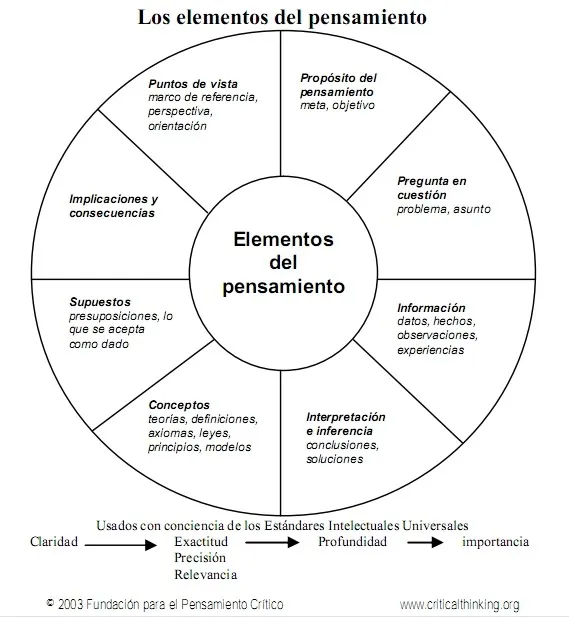
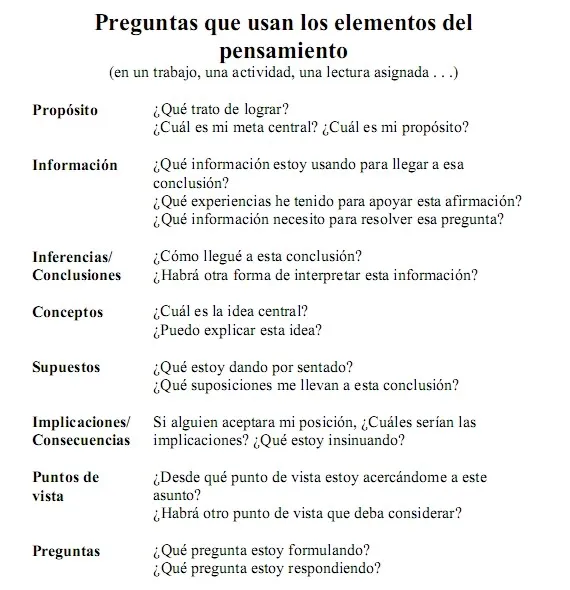
Science, scientific thinking, is part of a broader form of thinking: critical thinking. This kind of thinking is useful not only in science or philosophy, but also in everyday life. In all cases we must think. But how?
The kick-off is questioning. Why do we do or say this or that? Truly, the real reason. Do I need to do this or is it a "fictitious need"? What is my goal, objective, purpose? Do I have sufficient and adequate information? Are there other possible points of view?
The discomfort of the question
Not everyone is in a position to ask themselves questions. There are topics for which we can be a bit "dogmatic," we have certain quite fixed ideas and we flatly discard different ideas.
In some cases nothing will happen because perhaps they are topics that don't have a direct impact on our lives. But in others, be careful, because they can.
Let's take responsibility
Do you remember that NASA announcement a while ago about extremophile bacteria? A whole uproar on the net about the possible discovery of extraterrestrial life. I was remembering it yesterday on Facebook with the geologist and blogger Miguel Vera, regarding the space agency's announcement of a new press conference, this Wednesday. It is said that findings made with the Hubble telescope that has been able to "see beyond what has been seen until now," that is, farther in time and distance, will be communicated. The researchers who will speak have been conducting a study with Hubble, of ultra-deep galaxies, which would have originated about 600 million years after the big bang. Perhaps they will announce something about that. There is an article embargoed by Nature until that day. These two researchers also recently sent work to other journals. It would be logical for it to be on a similar topic.
This is relevant because in the arsenic topic, in my opinion, NASA did not consider (or did it?) that the astrobiology topic would have the repercussion it did.
But, again, are we looking at our own navel?
On that occasion, NASA did the same as in this case. It announces the conference, indicates the topic, and says which researchers will participate. If one takes the trouble to see what those researchers have done recently, it's very possible to have an idea quite close to what will be presented. The vast majority of scientists do not invest their time in several parallel investigations, but usually dedicate themselves to one thing at a time.
On the other hand, what were they expected to say? That they had an alien trapped in a military base, that they had a spaceship, that they had made contact? And did we arrive at that idea just from the announcement of a common press conference?
So in that case there will be "faults" of NASA in its communication, but why do we think the way we do?
Earth, like Tatooine? NO.
If I told you that the ideal would be to use critical thinking ALWAYS, I would be lying to you. In sentimental matters we often act more by "gut feeling" than by possible personality compatibilities, right? On the other hand, there are topics that are more important to us than others, and therefore, we will be more critical about those that we find interesting/important.
But look: if I tell someone who is into technology (gadgets, software, etc.) something that seems extraordinary to them ("400-core computer costs $2"), they probably won't believe me. But how will the same person evaluate statements like "Betelgeuse will explode in 2012 and become a second Sun"? Well, for some, such a statement is plausible.
As Phil Plait explains, the star may have already exploded (and we detect it tomorrow, next year, next century, within 100 thousand years), but it will be far from resembling our Sun, although it would certainly look much brighter than now. And life on Earth would not be harmed at all.
Last stop: Critical thinking
Having said that, I think it's clear that critical thinking can be applied at all times, although perhaps we don't use it in every act of our lives. But we often come across "extraordinary claims." It is common that, in the field we move in or are interested in, we are critical. But sometimes, we lose that critical sense with other topics that, deep down, may be similar. Is there much difference between the extraordinary claim about the computer (invented by me) and that Betelgeuse will explode in 2012 (not tomorrow, not in 2013)?
What Betelgeuse is doing from Orion's shoulder is sending us a red alert signal: To make better decisions, one must get informed, learn, know oneself. That does not guarantee us happiness; in fact, it can temporarily put us in a bind. "And now what news do I tell, if this is false?" Well, tell one that is true, I believe that should make us happier, shouldn't it?
Resources in Spanish
- CriticalThinking.org is a good site with resources, some in Spanish, that can serve to approach these ideas or help in their dissemination.
- Note: My ex-coworker, Germán Furlani, is part of a band called Betelgeuse. You can see a video of the song Fantasía en la noche celta on TN y la gente or visit the Betelgeuse Rock website. Also on Youtube.
Sources and related links
- Self-knowledge is not always the path to happiness
- When Self-Knowledge Is Only the Beginning
About the images
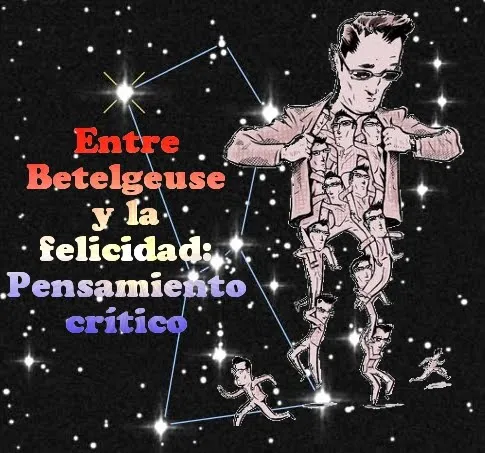
- Images: Combination of illustration by Lars Leetaru and Hubble PRC96-04 by A. Dupree (CfA), NASA, 15-01-1995
- Graphics from The Miniature Guide to Critical Thinking by R. Paul and L. Elder. www.criticalthinking.org