A site allows you to download interactive applications, games and use online applets with the goal of disseminating the search for gravitational waves.
In support of the GEO 600 and LIGO projects, the outreach group Gravitational Wave Group, based in the United Kingdom, developed the site gw optics.
There we can find several games, an electronic book with information and web-applets to use online, all developed with Processing, an open source project designed to open the world of algorithms to people with little experience in computing or mathematics.
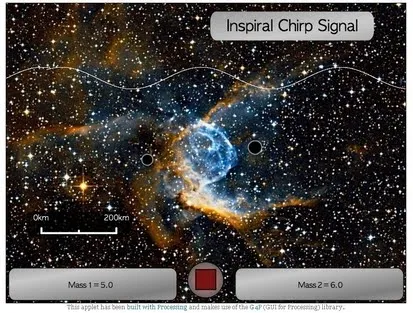
Among the applets we find Inspiral Signal: it is a Processing program that shows the gravitational wave signal from two colliding black holes. Sliders are used to set the mass of both objects.
Another applet is Pendulum which tries to show the problem of vibration isolation.
It also has applications to download and install. Installation is usually as simple as unzipping a file and that's it.
Some of these programs interact through the user's webcam and have been used in science exhibitions, like You are Einstein, an application that contains a face recognition algorithm. Thus, it substitutes the frontal face images from the webcam with a photograph of the famous German physicist's face.
Another application is Augmented reality pendulum, in which the webcam must visualize an image that we must print beforehand and that has a logo. The application generates a pendulum that "hangs" from that logo that we will have in our hands in front of the webcam. If we move the image, the pendulum will too.
Games
There are two other games that do not require the use of webcams. Black Hole Pong is a new version of the classic Pong. There is a version for Mac and another for Windows, but they indicate there will be another for Linux as well.
A problem with the game is that it is only for two players, that is, we cannot play against the computer.
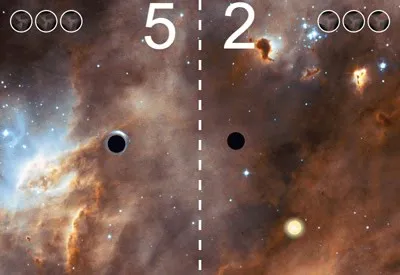
If in the original pong what we had was a simile of table tennis, with two paddles and a little ball, here we have a star and two black holes that will act as paddles due to their gravitational force. As the game progresses, more stars appear simultaneously.
Video: Black Hole Pong
http://www.youtube.com/watch?v=hrFhtWWVJms
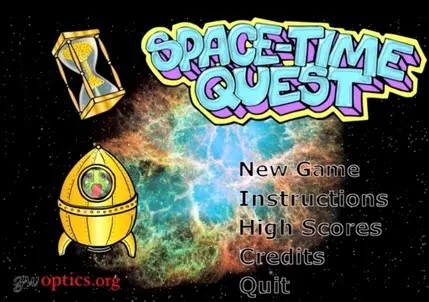
The latest novelty is Space Time Quest. A kind of strategy game in which we have 100 million pounds sterling to develop an experiment. Each part of it can be configured in different ways to have greater precision or possibilities of finding gravitational waves. But, the good stuff costs a lot, so the idea is to create the correct spending strategy to produce an ever better result.
Here we can indeed play alone, although upon seeing the highest scores, we have a motivation to improve. At the time of writing this there were 359 scores (for version 1.0). The second and third places belong to...(See highest scores).
The idea of the game is to design an interferometer to detect gravitational waves from very distant astrophysical sources. This will be achieved by increasing the sensitivity of our detector so it can find very weak signals.
One of the problems is noise, being here on the surface of the Earth, which comes from the environment and the equipment. So our goal will be to reduce the noise that could contaminate our experiment.
To start the game we write a name for ourselves and one for our detector. Then we must decide where we will install the detector: in the city, in the desert, on an island or in a jungle. According to our choice, we will have more or less ambient noise, but also a larger or smaller budget. For the desert, you start with 75 million, not 100 anymore.
Video: Space Time Quest - Tutorial
http://www.youtube.com/watch?v=lAvJrePR7F4
Notes on gravitation, with wave
On the site there is an e-book, as its creators decided to call a set of explanatory pages.
There it informs what gravitational waves are:
Imagine that space-time is like a giant rubber sheet. When a massive object (like a star) sits on this sheet, space-time curves and anything near the large object will accelerate and fall towards the massive object.
From Einstein we know that gravity works quite similar to that. When we experience a gravitational force accelerating us towards the Earth, we are traveling along curves in space-time!
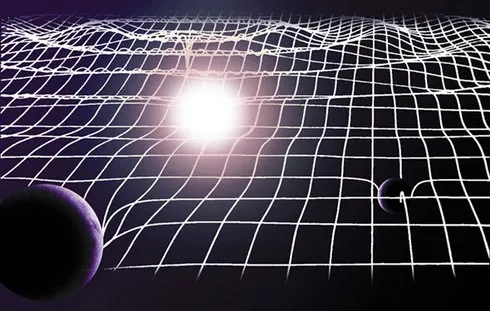
If two black holes were very close together, they would accelerate each other and mutually orbit in a spiral until finally colliding in a big way. During that process the space they occupy will be perturbed and that distortion would propagate to the rest of the universe, at the same speed as light. This phenomenon is what is known as a gravitational wave.
And what do those waves do? The simplest way to describe it would be that they "stretch" and "squeeze" the space through which they travel or, in other words, change the distances between objects.
Among the most promising sources for gravitational waves are colliding black holes, but although they are extremely powerful sources, they cause things to stretch or squeeze very little: a 1-meter ruler would change by only 10-22m (or 0.0000000000000000000001 m). So really very sensitive instruments are needed to detect this effect.
Interferometry
A Michelson interferometer consists of three mirrors, a detector and a light source. The mirrors reflect the light source and the detector observes the light after being reflected. The light from the source reaches the first mirror at an angle. Since this mirror is half transparent, half of the light is reflected and goes in one direction, while the rest continues its course. This first mirror (or half-silvered surface) is often called a "beam-splitter".
So now we have two identical beams traveling in different directions. The different paths of these beams are usually called "arms" of the interferometer. At the end of each arm there is another mirror. These mirrors are totally reflective, so they send the light back towards the splitter.
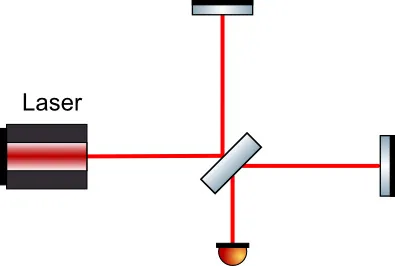
Now things get interesting: when the beams return to the splitter, half of each one is reflected and the other half continues, as before. The crucial part is that now the beams from the two arms interfere. That's why the instrument gets its name.
Interference occurs when we add one wave onto another. If the waves have their crests and troughs at the same points, they add together to form a larger wave. That is called constructive interference. But if the crest of one is at the same point as the trough of the other, they cancel out in destructive interference. Thus, when adding waves, the result depends on the different positions of the crests and troughs of the waves.
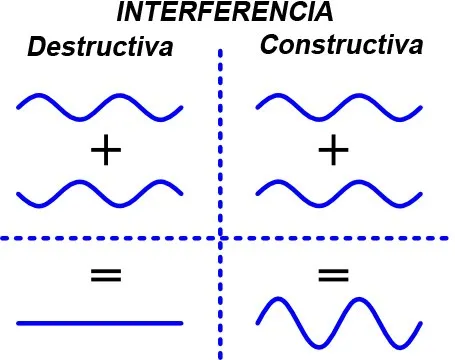
We can describe light as a set of waves, so if we add two light beams we expect interference, which is what happens when the beams return to the beam splitter to recombine. The crest and trough positions of the beams depend on the length of each arm. Thus, by measuring the light from the beam that exits the interferometer, researchers can know how well the crests and troughs of the beams from the arms align and if there is, therefore, a difference in their lengths.
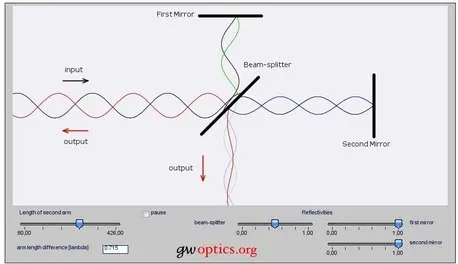
We can understand this process a little better by "playing" with the Michelson Interferometer application.
In the online application we will see sliders. Let's leave the beam-splitter and the mirrors (first, second mirror) as they appear by default, as indicated before: the splitter at 0.5 and the mirrors at 1 reflectivity. And let's change the length of one arm (length of second arm). The result is the two output beams.
Other considerations:
Noise must be considered. Some variables that are not the ones being sought can interfere negatively with the experiment. So they make them large and in quiet places.
The mirrors are essential. They are basically crystals, fused silica, of different sizes. For the planned Advanced LIGO it would be 34 cm in diameter and 20 in thickness. A special coating is then applied to them, giving them their reflective characteristics.
Furthermore, the movement of the mirrors must be considered, which should be reduced to a minimum, even from ground motion. One way to isolate the mirrors from seismic noise is with a series of pendulums. The amount of motion of a pendulum reaches a maximum at a frequency known as the resonant frequency. When the pendulum oscillates faster, it moves less and less. Thus, suspending a mirror like a pendulum makes it quieter than the ground. By adding more pendulums, the motion can be reduced even further.
A few days ago I reported here on a new discovery by Einstein@Home. One of the goals of that project is to find gravitational waves. So if the topic interested you, perhaps you can contribute with the unused time of your computer.
Note written for the XVII Carnival of Physics, in this edition hosted by Vega 0.0. To join and read the entries there is a social network on Ning.
Sources and related links
About the images
- All images used are from gw optics.