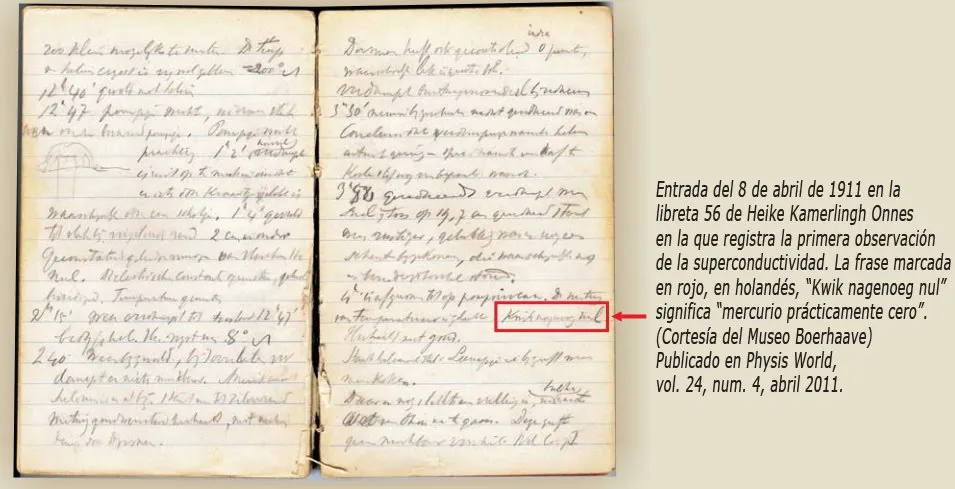
Written in a notebook of the Dutch physicist Heike Onnes on April 8, 1911, those words allude to a discovery whose 100th anniversary is being marked. What did Onnes write? Resisting reading this article is futile.
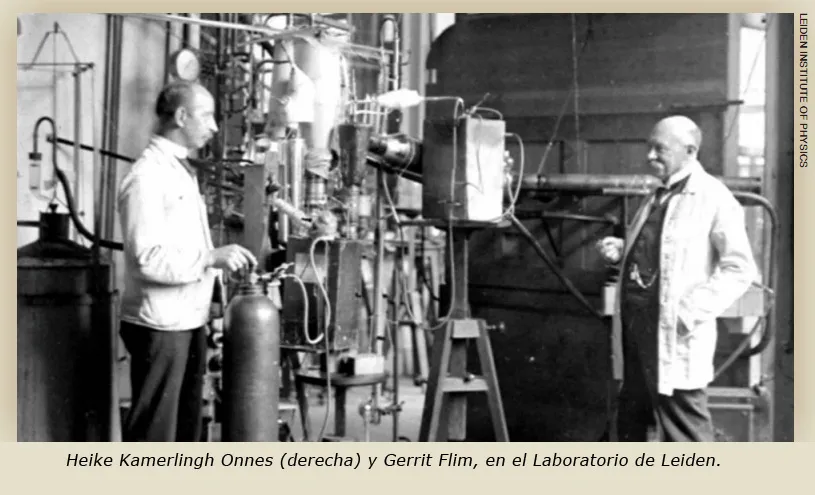
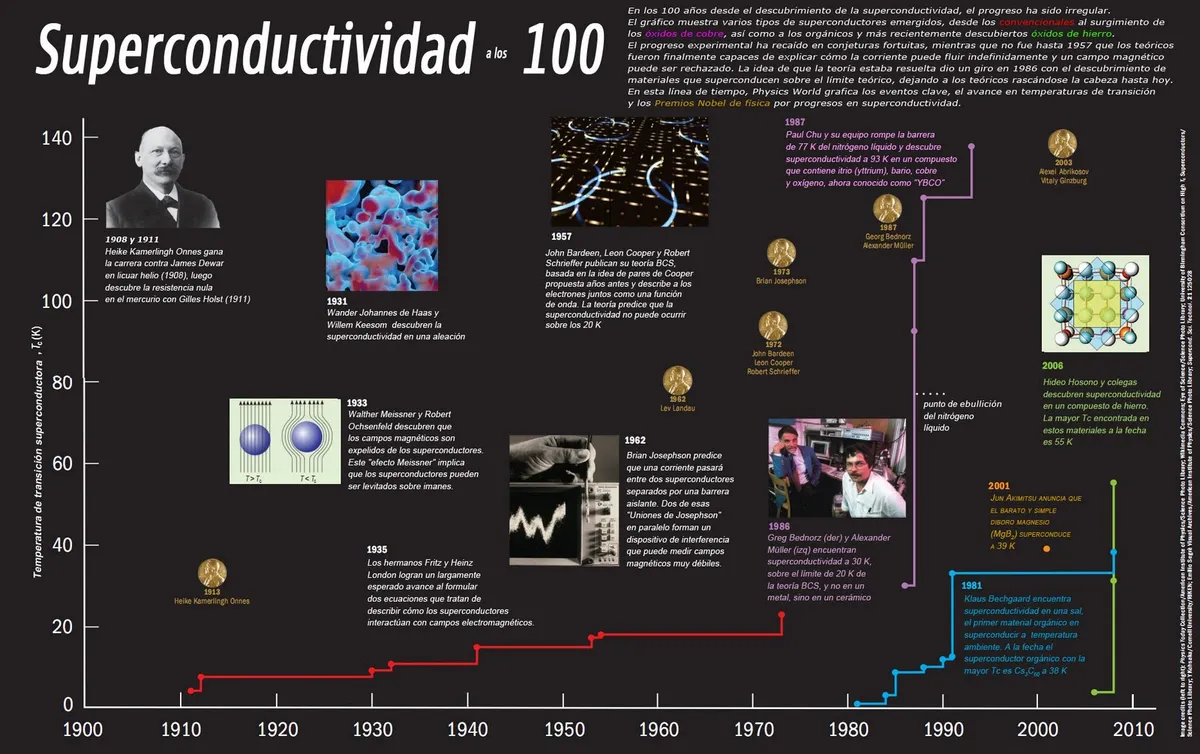
Onnes, together with his colleague Gilles Holst, discovered superconductivity, that rare phenomenon of condensed matter physics, upon finding that the resistance of mercury, cooled to a temperature below 4.2 K, fell practically to zero.
But it was not until last year that the precise date of the discovery and the phrase—which means 'mercury close to zero'—were revealed thanks to the detective work of Peter Kes from Leiden University.
In the last century, the elucidation of the structure of DNA and other discoveries could be cataloged as the most important. Among them will surely be superconductivity and superconductors.
As in other stories of science, the finding was somewhat serendipitous, as they did not set out to find that electrical resistance could be absent under certain conditions. But a race had indeed been established between Heike Kamerlingh Onnes and the British physicist James Dewar to try to reach a temperature of absolute zero by liquefying gases. Onnes managed to liquefy helium by cooling it to 4.2 K, for which he received the Nobel Prize in 1913.
But the researchers did not want to achieve this feat for its own sake alone; they were interested in how the properties of materials, especially their electrical conductivity, would change under cryogenic conditions, based on the conjectures and experiments of J. J. Thomson and Lord Kelvin that electricity involves the flow of small, discrete, charged particles.
What would happen to the resistance of a metal immersed in Onnes's liquid helium? Physicists had three main hypotheses: that the resistance would continuously decrease toward zero; that a critical value would be reached; or that the electrons would ultimately be captured, leading to infinite resistance.
But to find out, they first needed a very pure metal sample.
Gilles Holst, a researcher at Onnes's Institute in Leiden, thought it would be possible to obtain such a sample by repeatedly distilling liquid mercury to remove impurities. It was then suggested to put the mercury in a capillary tube and immerse it in liquid helium. And so it was in April 1911. It is said that it was the 8th, but Onnes's notebook leaves room for doubt.
In the celebration of the centenary of the discovery, we would do well to remember not only Onnes, but also Gerrit Flim, Gilles Holst and Cornelius Dorsman who were involved in the experiments.
Dirk van Delft and Peter Kes published a reconstruction of the events last year based on some of Onnes's notebooks.
If electrical resistivity decays to almost zero, does the same happen with the magnetic field?
Walter Meissner and Robert Ochsenfeld discovered in 1933 that the magnetic field is completely canceled inside the superconducting material. The Meissner-Ochsenfeld effect was later explained by the brothers Fritz and Heinz London.
Superapplications are sought
The level of impact of scientific discoveries on society is variable. Perhaps the most striking in this case is magnetic levitation applied to the maglev trains of Japan's Yamanashi line.
Superconducting cables and films can transport electricity without the losses we have in traditional copper cables.
Magnetic resonance imaging has become one of the most used medical diagnostic tools in the world and uses supercooled magnets. Particle accelerators like the LHC make use of enormous magnets cooled with liquid helium, there are motors in which the rotors are replaced by superconducting materials, and SQUIDs, devices used to measure magnetic fields that could be used to detect some kind of dark matter, or quantum computers, in carbon nanotubes, are some of the applications of superconductivity.
Argentina does not resist
Research in physics in our country has not neglected the study of this phenomenon. It is worth citing at least two cases of professionals recognized in the field: Dr. Francisco de la Cruz, who received two mentions and a platinum award from the Konex Foundation (in 1993 and 2003) and Professor Daniel Domínguez, recipient of the Gaviola Award from the National Academy of Sciences in 2005.
The first will give a talk this Friday at the Instituto Balseiro-Centro Atómico Bariloche, precisely about the discovery of superconductivity.
That research center received a grant between 1987 and 1997 to support research in superconductivity. A report on this can be read on the Fundación Balseiro website.
Special issue of Physics World
The acclaimed physics magazine has made a special issue on superconductivity available to the public. You can read about it on the publication's blog.
What we tell here is only a very limited synthesis of a rich history of experimentation that I invite the public to discover in greater depth through the extensive existing bibliography.
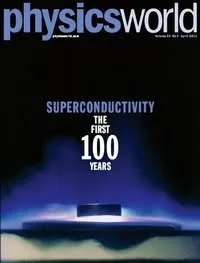
Superconductor Glossary
Cooper pair: In 1956 Leon Cooper showed that an attraction between electrons in a metal can cause a state of electron parity, behaving as if they were attracted, despite having charges of the same sign, due to the interaction in a lattice of positive ions of the metal.
BCS theory: Based on Cooper pairs, in 1957, John Bardeen, Leon Cooper and John Schrieffer proposed the theory that takes its name from the first letter of the three surnames. In 1972 they received the Nobel Prize in Physics for this contribution.
Josephson junctions: In 1962, Brian Josephson predicted that an electric current would appear between two superconductors separated by an insulator. For that work he received the Nobel Prize in physics in 1973.
SQUID: An English acronym meaning Superconducting Quantum Interference Devices. Developed from the concept of the Josephson junction, they allow the measurement of very small magnetic fields.
YBCO is the acronym for the English name Yttrium Barium Copper Oxide, which designates a ceramic material composed of oxides of yttrium, barium and copper with superconducting properties at relatively high temperatures (94 Kelvin).
High-temperature superconductors: those whose critical temperature is higher than the boiling temperature of nitrogen (that is, higher than 77 K). All of them are different oxides of copper, barium and yttrium (YBCO).
This type of superconductivity was discovered in 1986 by Karl Müller and Johannes Bednorz, who received the Nobel Prize in Physics in 1987.
There is still no theory that allows us to understand why this phenomenon occurs at those temperatures.
Note written for the XVIII Carnival of Physics, in this edition hosted by La aventura de la ciencia. To join and read the entries there is a social network on Ning.
Sources and related links
- The discovery of superconductivity
Physics Today - September 2010
Dirk van Delft, Leiden University, Netherlands
Peter Kes, Kamerlingh Onnes Laboratory
DOI: 10.1063/1.3490499 - Superconductivity, a very short introduction
Stephen Blundell
Oxford University Press, 229
ISBN 978–0–19–954090–7 - Physics World, Volume 24, number 4, April 2011: The first 100 years, by Matin Durrani pp 17; Fantastic five, pp 23.
About the images
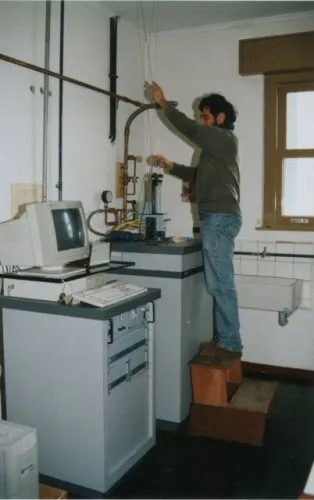
- SQUID magnetometer. Credit: Balseiro Foundation.
- Poster Superconductivity at 100 (left to right): Physics Today Collection/American Institute of Physics/Science Photo Library; Wikimedia Commons; Eye of Science/Science Photo Library; University of Birmingham Consortium on High Tc Superconductors/
Science Photo Library; Y Kohsaka/Cornell University/RIKEN; Emilio Segrè Visual Archives/American Institute of Physics/Science Photo Library; Supercond. Sci. Technol. 21 125028