It's not liquid water. It's not vapor. It's...SuperWater, to the rescue of humanity's waste. At least, that's how it seems, according to an experiment on the critical state of water, on the Space Station.
Let's do magic. We put water in a metal container. We put it over a heat source, for example, the flame of a burner. We wait a few minutes and voilà! The water turned into vapor!.
Eh, didn't you like it? It's not magic?
Of course. Everyone knows the boiling point, when a substance reaches a temperature such that its state changes from liquid to gas.
What if we do the same, but no longer with a liquid, but with a solid? No, it doesn't go to the gaseous state, but it liquefies, when the temperature reaches the melting point of that substance.
And we also have the freezing point.
But we already knew all this, right?
There's no mystery, no surprise...
And the critical point?
In physics it is the limit for which a volume of liquid is equal to that of an equal mass of vapor. The densities of the liquid and the vapor are equal.
In the case of water, the critical point occurs at a temperature and pressure of 374 ºC (647.29 K) and 228.5 bar (22.09 MPa, MegaPascals), respectively.
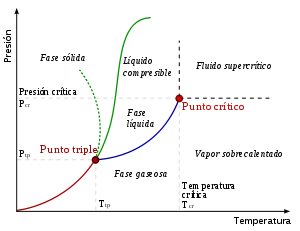
This phase transition can have various applications. There has been talk of the generation of biofuel precursors.
And precision is so important that molecular simulations are performed to calculate the phase equilibrium of complex systems.
But there are many other applications in research, among which I find particularly likable the one that allows the ecological treatment of garbage.
And, to make it even more cool, an experiment has been underway on the International Space Station.
Did I already grab your attention?
DECLIC
DECLIC is a facility to investigate the behavior of fluids at critical temperature in a micro-gravity environment on the ISS.
The name comes from Dispositif d’Etude de la Croissance et des LIquides Critiques.
Need I say it's a French experiment? It is developed by CNES, the French space studies center.
It was launched on 08/29/2009 aboard Discovery, was turned on two months later and in April of this year the first scientific results were published.
DECLIC uses the standard infrastructure offered by the EXPRESS rack in the Japanese JEM laboratory of the ISS.
There are three experiments or Inserts in DECLIC: ALI, for the study of fluids near the ambient critical point; HTI, to investigate fluids at high critical temperatures; and DSI, to probe the solidification of transparent materials.
First results
In April it was learned that under microgravity conditions, the value of the critical temperature of water is 373.995ºC.
In the HTI module scientists were able to monitor the changes in a bubble of water vapor surrounded by liquid water.
It is an ideal way, they say at CNES, to determine the precise point and temperature at which water changes state. "The disappearance of the bubble shows that the liquid and gaseous phases no longer coexist. In other words, it marks the transition to the supercritical state," explained Gabriel Pont.
Researchers are interested in supercritical water because not much is yet known about this intermediate state of matter, although it offers promises.
Burning the water
An example? Supercritical water is capable of dissolving and "burning" organic waste very efficiently, without emitting pollutants. This drop is already my superhero. Like Severina. (I suppose the arch-rival will be SpongeBob?)
"But before we can study this phenomenon of 'cold combustion', we must characterize the physical properties of water near its critical temperature. In the near future we will also study how salt behaves in supercritical water - a scenario found on the ocean floor along the system of ocean ridges," narrated Bernard Zappoli.
Here are two images of DECLIC.
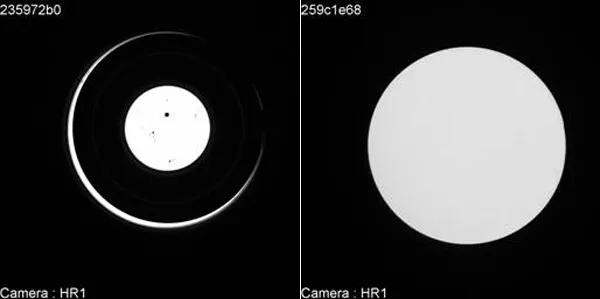
Credits: CNES/CEA/CNRS.
Organic waste could be "burned" in water in the critical state, obtaining carbon dioxide and water. If they are not organic, a deposit easy to filter is also obtained.
The convection problem
In the video shown below it is mentioned that the experiment is not performed on Earth and yes in orbit because "whirlpools form". It is the phenomenon of convection.
DECLIC video (subtitled)
http://www.youtube.com/watch?v=uuZL82dmi08
Note written for the XIII Carnival of Physics, in this edition hosted by Gravedad Cero. To join and read the entries there is a social network on Ning.
Sources and related links
About the images
- Critical Point image. Credit: Wikipedia.
- Drops image: DECLIC.