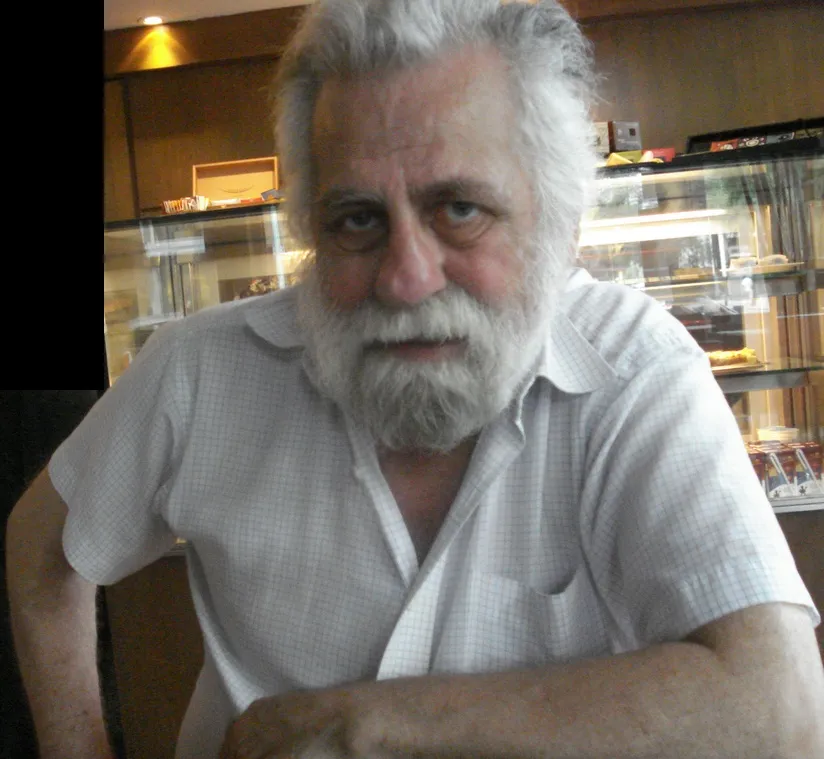
Interview with a Dr. in physics who is taking his first steps as a CONICET researcher, anticipating the Day of the Scientific Researcher in Argentina.
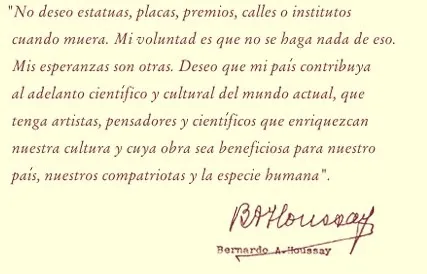
Bernardo Alberto Houssay was born on April 10 (in 1887). Besides winning the Nobel Prize in Medicine in 1947, Houssay was the pioneer of the exclusive dedication of researchers, of specialization, professionalism and the institutionalization of science. Thus, in 1958 CONICET was created, of which he was its first president.
That is why the date was declared in his honor "day of science and technology" and is therefore the day of the scientific researcher in Argentina.
But, what is it to be a scientific researcher?
To avoid falling into external and categorical definitions, let's ask. I invite you to a coffee chat:
-Can you tell me your name, age and studies?
-My name is Sergio Ferrari, I am 36 years old and I studied for a degree in physics at the Universidad Nacional de la Plata. I graduated with a degree in physics in the year 2001, September 13, 2001.
-The country was going through a difficult situation...
-Yes, thanks to that conflict in the country I was without a scholarship to do my doctorate for a year, which affected my career quite a bit.
-And then?
-Then I got a scholarship to do the doctorate, it only started in 2003, in La Plata, until I got my doctorate in the year 2007.
-Is it true that the researcher becomes one when they do the doctorate and not before?
-The undergraduate degree does not fully prepare you to be a researcher. Nor does the doctorate entirely, since later one must face other things that come after entering the career (bureaucracy, grants), but the doctoral preparation serves to have a good basis of what a researcher's life is like.
-But the thinking, what is called the "scientific method" is...
-The scientific method is there. There are subjects in the faculty that require writing reports. Still, the kind of problems one faces in the physics undergraduate degree, even in the preparation of the thesis, is inferior to the kind of problems encountered later in the doctorate.
Ferrari told me that he started researching in high-energy physics (like the ones done at CERN or Auger), but then he changed.
-And now?
-Due to a personal change, I changed my line and went to solid-state physics, something completely different.
-Let's say there are different branches of physics
-There are many branches: optics, fluid physics, many and I now moved to condensed matter, that is, everything that is solid, of any kind.
Now I am conducting experiments on powders of something very common, which is used in many places, which is zinc oxide that we dope, mix with small amounts of aluminum, indium and others. What we are looking for is a combination that is good for solar cells.
-Applied science?
-Well, it is science aiming at applied science, because at this moment we are not producing solar cells.
We then talked about the categories of CONICET scientific researcher. Sergio is an assistant researcher, but there are other categories like adjunto, independiente or principal.
-Is there any important difference in the tasks?
-No, what accessing other categories has is the possibility of directing thesis students, creating your own group, asking for funds for that group. As an assistant one is part of a group.
-So leadership capacity is important
-Advancing (in the CONICET scientific researcher career) implies having greater leadership possibilities. Also moving to a higher category (of researcher) implies of course a higher salary.
-The public's image does not relate leadership and science much, I think, rather it seems that the scientific is linked almost exclusively to mathematics...
-Not necessarily. There are careers that require mathematics to learn, but that do not use that tool so much.
-Physics does.
-Yes, anyway experimental physics is not working with mathematics. Things are being measured, nature is being investigated, results are obtained, they are analyzed and one tries to know why what happened happened.
-Leadership, which is linked to human relations and communication seems something distant from scientific work. Communication itself too.
-Communication is necessary from the beginning, from the start as a scientist when they are a graduate they already start with a thesis. That thesis is a communication to society, it is public. The doctoral thesis too. One goes to conferences, brings posters or gives oral presentations. It is something necessary for the community to know what was done, to gather points for CONICET. Then the works are published in a conference or in a journal.
-There is an English saying about scientific communication that says "publish or perish".
-Yes, it is a quite true saying.
-So there is specific knowledge. Also leadership, communication. As in other human activities, like a normal person.
-Yes, we scientists are human beings
-So when a physicist stirs their coffee they are not thinking about the Coriolis effect. In their personal life they are the same as any other person.
-At least in my case personal life is separate from the scientific one and I think the same happens to most. Except in particular moments of the research life where one can be very obsessed (or very close) to obtaining some result that is important, private life is separate from the scientific research work and things are not mixed....
In our personal life we can do rational things and other less rational ones
-For example?
-Arguing over unimportant things, celebrating a goal.
-But you don't believe in UFOs or read the horoscope?
-Well there are scientists who are religious...Each person, on matters of faith and other matters has their own ideas. It is something independent of being a scientist. Being a scientist is something else.
-And what is it to be a scientist?
-What characterizes a scientist, for me, is curiosity. A curiosity much stronger than in other people, very high. A search to know, to acquire knowledge. What happens if I do this or if I do that? It is the desire to know.
-In a particular way, because philosophers also have a desire to know, but in a different way.
-Desire to know with a method, with a basis called the scientific method, related to observation and experimentation.
-Everything else that we often put in the idea of being a scientist -the glasses, the gloves and the lab coat, the mad scientist who wants to dominate the world- are clichés.
-They're clichés. Within the profession there are people who are more mental than others, more introverted, there's everything.
-But I don't think there's any physicist who paints, for example...
-Well, I am a painter.
-I know. And how well you do it. How did it come about?
-It was a need to have an extra activity and I started studying in a watercolor workshop. There are scientists who sing in choirs, who do theater...
-So art is not incompatible with rational thought.
-Not at all. It's even healthy to have an activity that takes us out of the world of work and allows us to develop other aspects of our humanity. Our humanity is a rational part, but also with desires, art, etc.
-The media convey an idea of a stereotyped scientist. Is it like that or is what I'm saying also a cliché?
-I don't know how it is in general. Perhaps the media don't help in spreading the activities of scientists. They focus on some areas that are more in fashion, but they don't paint a good picture of what that activity really means. Because, well, the explanations could be a bit longer to bring them down to a more understandable level, but I think science communication is not enough. Still, I don't know if there is so much cliché.
We also chatted about the value of small moments, the satisfaction of finishing a task. And the pleasure of solving problems.
The conversation did not leave out the obstacles, which exist. The knowledge brought from high school can be far inferior to what is needed for university. Also other obstacles, like administrative ones, politics, internal group issues (#1). But for a high school student who wants to pursue a scientific career, these obstacles are perfectly surmountable if they put in effort and if they really like a career.
This Sunday, if there is anything to celebrate, it is this very human characteristic of curiosity, the thirst for knowledge. The human being, they say, is an animal that laughs. It also seems to be the only one that investigates.
But these final ideas were only mine because Sergio left the café where we met in a hurry. He didn't go to experiment with zinc oxide. His wife and his daughter, an eight-month-old baby, were waiting for him. And his watercolors.
Sergio Ferrari, besides being a Doctor in physics from UNLP and a CONICET researcher, is the author of the blog Un físico en la vida.
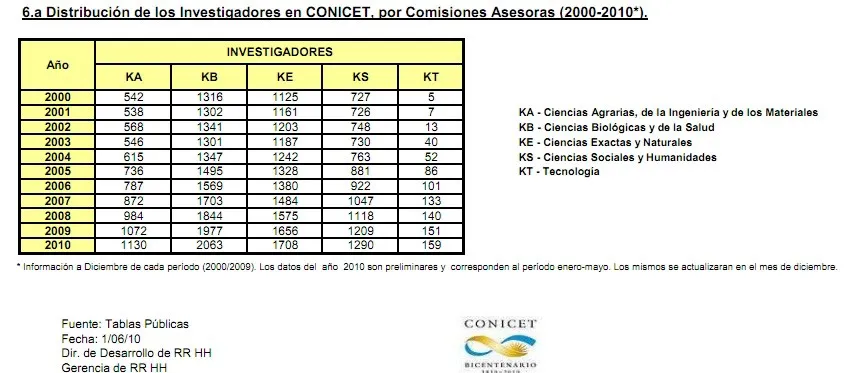
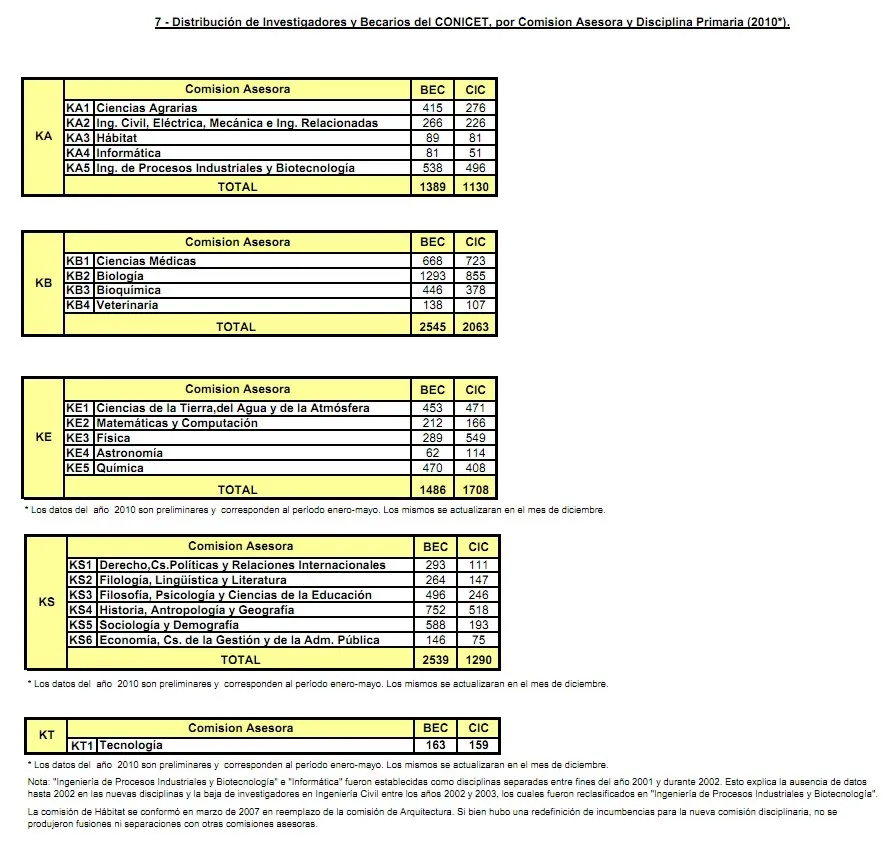
Argentine Research in Figures
CONICET 2010 Budget: $1,401,753,224
Researchers 2010 (January-May) 3095 women + 3255 men= 6350 divided into:
1596 (25.1%) assistants
2119 (33.4%) adjuncts
1630 (25.7%) independents
777 (12.2%) principals
228 (3.6%) superiors
25% are between 30 and 39 years old; 34% are between 40 and 49, 22% 50-59 and 18% over 60.
Distribution by advisory commissions and disciplines
Sources and related links
- APRIL 10: RESEARCHER'S DAY: Don Bernardo Houssay, Nobel Prize in medicine and founder of Conicet
- The scientific researcher career
- Scientific and technological researcher career - cicyt
- Note #1 (my addition, as an example that not everything is rosy): Scientific Researcher Day with protests
About the images
- Opening quote from Houssay.org.ar
- CONICET tables.