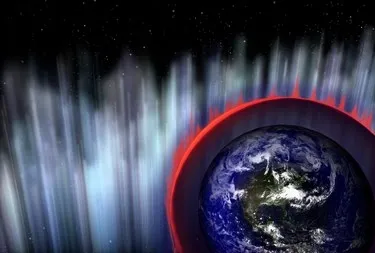
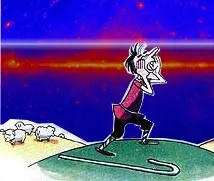
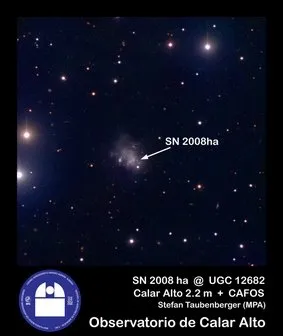
New data on long and short gamma-ray bursts were released last week from a very bright detection and a simulation.
On March 28, the Swift Burst Alert Telescope discovered a source from which a series of bright bursts were coming in the constellation Draco.
The satellite positioned the source, cataloged as GRB 110328A, and reported to astronomers.
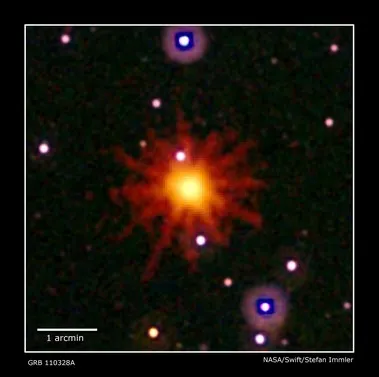
A GRB (acronym for Gamma-ray burst) is a gamma-ray burst. They are also called BRG for Gamma-ray Bursts. They are the brightest events in the universe and come in two "flavors": there are short and long ones (more than two seconds).
On other occasions, astronomers have been left stunned by similar events. In this case, what was surprising was its brightness, duration, and variability.
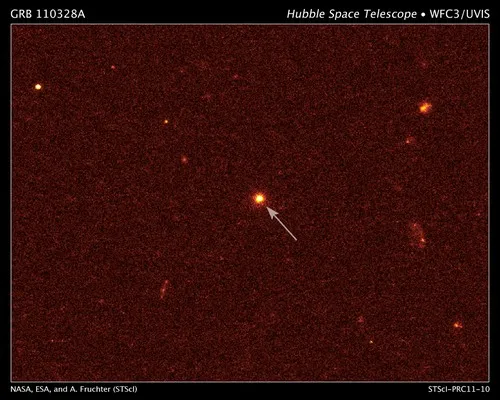
A dozen instruments began observing the object after the alert. A deep image taken by Hubble on April 4 determined the source of the explosion to be at the center of a galaxy, 3.8 billion light-years away.
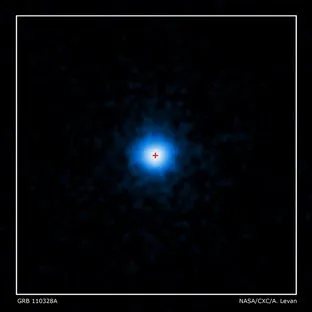
On the same day, with Chandra, a 4-hour exposure of the intriguing source was made. The image, which locates the X-ray object with much greater precision, shows that it indeed lies at the center of the galaxy observed by Hubble.
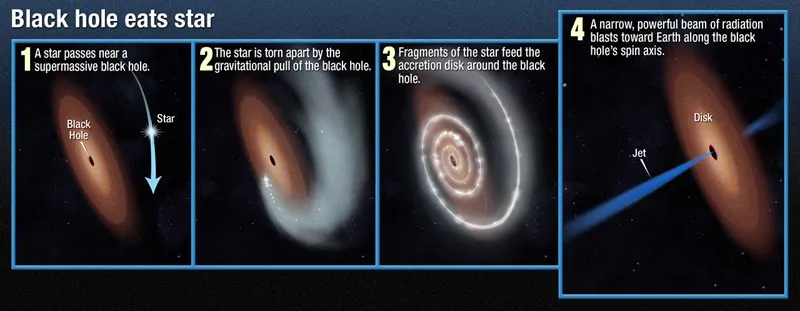
Most galaxies, including ours, have a central black hole. So astronomers glimpsed a cause-effect relationship. A star passing near the black hole would shine brightly. However, scientists have detected events like that before, but none showed the X-ray brightness and variability of this object. The source burst repeatedly and since April 3 its brightness increased fivefold.
What they think then, as indicated by Andrew Levan of the University of Warwick in the United Kingdom, is that the X-rays must come from a jet of matter that forms along the rotation axis of the black hole as the star falls into the disk of the massive object. If the jet points toward Earth, it will appear much brighter.
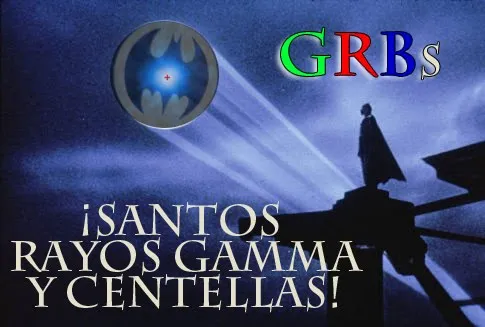
Imagine you look at the sky and see the Bat-Signal. And then, the searchlight turns and points directly at you. Would you now see the signal brighter?
To find out if it really is like that, more observations with Hubble are planned. Meanwhile, elsewhere in Gotham City of the Universe...
Short GRBs: we have them surrounded
To say that science knows exactly how something happens is to tell a lie. Always, always, there will be something left to know or determine with greater precision. But this does not mean that progress is not made in understanding how things happen.
With short GRBs (lasting less than two seconds), the search for how they are generated has been elusive. In principle, to study them, one must detect these bursts and determine their position. But very quickly. Until 2004 this was very complicated, but since then astronomers have had the Swift satellite which has the burst alert telescope. The same one that made the follow-up possible in the previous case.
The predominant theoretical model to explain short GRBs, until now, was that of two colliding neutron stars, explained Bruno Giacomazzo of the University of Maryland. A neutron star is what remains, the compressed core, of a star with an original mass of less than 30 times that of the Sun when it explodes as a supernova. Its matter reaches densities difficult to reproduce on Earth: a teaspoon of matter would weigh as much as the Himalayas.
So to try to know if the theoretical model is good, they decided to do a computer simulation. It began with a pair of neutron stars orbiting each other at a distance of 15 km. Each star had 1.5 times the mass of the Sun, but packed into a sphere 28 km in diameter and generating a magnetic field trillions of times stronger than our star.
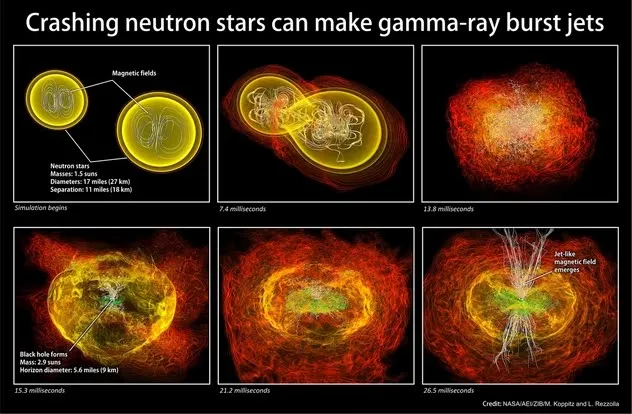
In 15 milliseconds the stars collided, merged, and transformed into a black hole of almost 3 times the mass of the Sun. In the following 11 milliseconds the gas swirling at very high speed continued amplifying the magnetic field until it became thousands of times stronger than the original. Gradually the magnetic field became more organized and formed a pair of channels along the rotation axis of the black hole. This is the necessary configuration to generate the ultra-fast particle jets or jets that produce short GRBs. At the end of the simulation, however, none of those channels had a flow of matter, but the researchers indicate that previous studies showed that under those conditions they would be generated.
The last word has not been said, but now the researchers have more confidence in the theoretical model. Since neutron stars would also generate gravitational waves, a detection of them would give greater strength to this and other astrophysical models. But these waves are also elusive. As if "they go away, they go away, the waves never return"...
Video: When neutron stars collide
http://www.youtube.com/watch?v=r4SneO21LRA
Studying these rare events is important because they are the most luminous events in the universe. Any Dark Knight would find it interesting.
Just to generate a useless curiosity: If we imagined short GRBs as a dot and long ones as a dash, what would a short GRB and, some time later (a space) a long one be telling us if we encoded them in Morse code?
And if they were tones (one long and one short) of the POST?
Sources and related links
- NASA Telescopes Join Forces to Observe Unprecedented Explosion
- GRB 110328A: Chandra Observes Extraordinary Event
- Breakthrough Study Confirms Cause Of Short Gamma-Ray Bursts
- The missing link: Merging neutron stars naturally produce jet-like structures and can power short Gamma-Ray Bursts
Luciano Rezzolla, Bruno Giacomazzo, Luca Baiotti, Jonathan Granot, Chryssa Kouveliotou, Miguel A. Aloy
ApJ 732 L6 DOI: 10.1088/2041-8205/732/1/L6
arXiv:1101.4298v2 [astro-ph.HE]
About the images
- Combination of images of Batman Signal. Credit: thebatmanlegends.blogspot.com and Chandra Image.
- Swift image. Credit: NASA, Swift, and S. Immler (NASA GSFC)
- Hubble image. Credit: NASA, ESA, and A. Fruchter (STScI)
- Chandra image. Credit: NASA/CXC/Warwick/A.Levan et al.
- Simulation images. Credit: NASA/AEI/ZIB/M. Koppitz and L. Rezzolla.
- Hubble illustration: NASA, ESA, and A. Feild (STScI)