Two researchers used data from NASA's Fermi telescope to indicate that there may possibly be evidence for dark matter. But the scientists are not part of the team that collected the data. Fermi will publish its analysis next week. This is possible due to the U.S. space agency's policy of releasing data to the public. The Fermi team members do not seem very pleased.
Lisa Goodenough of New York University and Dan Hooper of Fermilab used data from NASA's Fermi Gamma-ray Space Telescope and, after analyzing it, argue that it is consistent with a dark matter particle with a mass between 25 to 30 GeV (about 30 times heavier than the proton).
Regardless of whether the conclusions are correct or not, this data analysis has produced controversy among Fermi researchers, since the two researchers who published the preliminary paper (1) are not part of their team.
This is possible because NASA's policy is to release data to the public almost immediately. However, if the analysis is correct, it will perhaps be called the discovery of Goodenough and Hooper, and not the finding of the Fermi team.
That is, the data was made public before the telescope team performed its analysis, which opened the door for that study to be done by the two researchers who ultimately published the paper.
For Hooper, there is nothing wrong with this. As he told physicsworld.com, "most papers in my community are posted on arXiv before being accepted by a journal and this is no exception", and he explained the reason for sending articles to arXiv earlier by pointing out that "in the months that a review can take to be done, something important can happen regarding the state of the research and not sharing the progress immediately with the rest of the community can be counterproductive".
Julie McEnery, of Fermi, believes that her team's work does not compete with that of the researchers who published the paper, since a careful analysis will have a more lasting impact. She added that apparently groundbreaking results would be better published in peer-reviewed journals before their appearance on arXiv, an archive for electronic drafts of scientific articles.
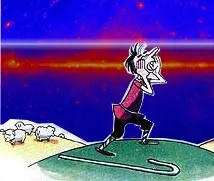
The danger, according to her, is that what happens in the tale of the boy who cried wolf will occur: "There is a danger that we will become confused with many results that may not be true and, at the same time, when something truly key and solid emerges, the scientific community will continue to be interested, but the media and the public perhaps will not."
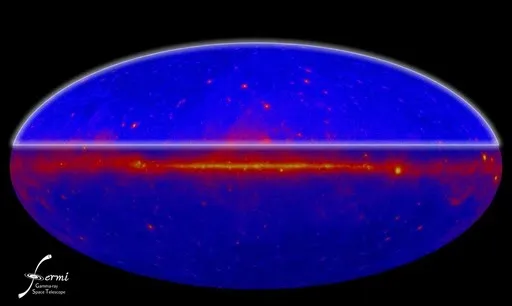
The Fermi team plans to present its analysis of the galactic center data next week. Meanwhile, other groups studying the same data have reached different conclusions. For example, physicsworld.com cites Gregory Dobler of Harvard University and colleagues (2), who attribute the gamma-ray signal to a phenomenon in which photons gain energy when interacting with matter (Inverse Compton Effect), as Sean Carroll explains on his blog.
A different stance regarding data release is that of Katherine Freese, an astrophysicist at the University of Michigan, who believes the data is public and there is nothing wrong with people trying to harvest from it what they can.
I suppose there's no need to ask Goodenough to know that she thinks her analysis is good enough...
The new Fermi data
During its first year of operations, Fermi mapped the sky with unprecedented sensitivity. It captured more than 1,000 gamma-ray sources, among which, on May 10 of this year, source GRB 090510 was found, which could reinforce Einstein's ideas about the speed of electromagnetic radiation, and GRB 090423, the most distant explosion ever observed. These new data were presented to the general public on October 28 in a press conference.
Sources and related links
- Physicsworld: Dark-matter paper raises questions over data sharing, by Jon Cartwright
- (1): Possible Evidence For Dark Matter Annihilation In The Inner Milky Way From The Fermi Gamma Ray Space Telescope
Lisa Goodenough, Dan Hooper
arXiv:0910.2998v1 - (2): The Fermi Haze: A Gamma-Ray Counterpart to the Microwave Haze
Gregory Dobler
arXiv:0910.4583v1
About the images
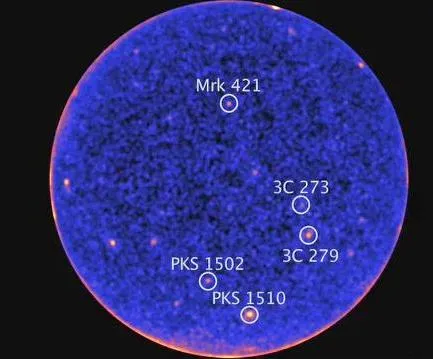
- Fermi sources map. Credit: NASA/DOE/Fermi LAT Collaboration
- Shepherd-Fermi combination. Fermi image from NASA. Shepherd Credit: EnCuentos.com