In a controversial study, astronomers from the University of Belfast proposed a new interpretation of a faint supernova discovered last year. It could be the connection between supernovae and gamma-ray bursts.
A group led by Dr. Stefano Valenti has studied the supernova SN2008ha. In the report they propose that the peculiar spectrum and faint luminosity of the supernova resemble much more the supernovae associated with the death of massive stars when their core collapses. In contrast, the astrophysical community's interpretation of the event is that the supernova came from a binary system with a white dwarf.
"SN2008ha is the most extreme example of a group of supernovae that show similar properties. Until now the community thought they were from white dwarf explosions, what we call Type Ia supernovae. (...) But we think that SN2008ha does not fit the picture and seems physically related to massive stars," explained Dr. Valenti.
Stephen Smartt, also from Queen's, added that "The implications are very important. If this is an explosion of a massive star, then it is the first one that fits the theoretical models of massive stars that lose their outer layers through their enormous pressure and then, perhaps, collapse into black holes".
The supernova was found in galaxy UGC12682 by Caroline Moore, a member of the Puckett Observatory supernova search team.
Faint supernovae, less energetic and luminous, but which possess as a characteristic an abundance of hydrogen, are known. In this case, however, that gas was not detected and its absence raises questions.
The phenomenon can be explained through two scenarios. In one, it is a binary system composed of a normal star and a white dwarf. The second would have "stolen" the outer layers from the first.
On the other hand, it is possible to think of a massive star that had expelled its outer layers and had collapsed, perhaps to form a black hole.
The discovery has implications for the connection between supernovae and long GRBs. Most of these bursts are associated primarily with energetic and luminous supernovae. However, there are at least two cases of long gamma-ray bursts without a bright supernova detected, so if there was any it must have been faint. This connection did not seem likely given that hydrogen-rich faint supernovae would prohibit the formation of the gamma-ray burst. This new interpretation opens the possibility of connecting faint supernovae (without hydrogen) with GRBs.
Sources and related links
- Queen's astronomers propose new supernovae interpretation
- Calar Alto: A new type of faint supernovae
- A low-energy core-collapse supernova without a hydrogen envelope
S. Valenti et al.
Nature 459, 674-677 (June 4, 2009)
DOI:10.1038/nature08023;
arXiv:0901.2074v2 - SN 2008ha: An Extremely Low Luminosity and Extremely Low Energy Supernova
Foley, Ryan J. et al.
arXiv:0902.2794v2 - TNG data help to discover a new class of very dim Supernovae
About the images
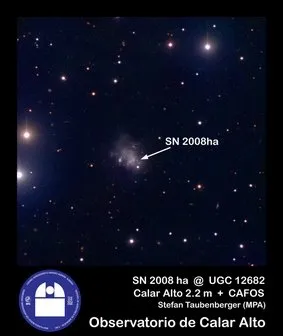
Color image of supernova SN 2008ha obtained on December 30, 2008 at the Calar Alto Observatory, with the 2.2 m Zeiss telescope and the CAFOS camera. It is a composite combination of images taken in the B, V and R bands. The supernova corresponds to the faint reddish point marked with an arrow. The center of the image is occupied by the rather irregular profile of the supernova's host galaxy, UGC 12682. Stefan Taubenberger, Max Planck Institute for Astrophysics.
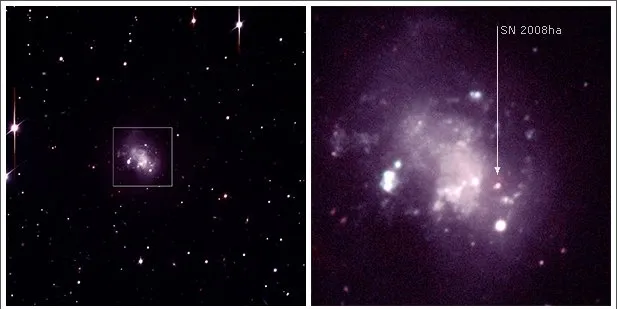
Left image: SN2008ha in UGC 12682. Right: close-up of the left image with indication of the supernova. Credit: Telescopio Nazionale Galileo. DOLORES.