A collection of links to music, images and videos that relate art and science. Today: An anaglyph from the Apollo 12 mission; Music by Ángel Domínguez; and the Space Shuttle: an award-winning video.

Images of the decade
1: Born to die in the cosmos
A dramatic game of life and death, of planetary survival, is taking place in a giant cloud of gas and dust 1,500 light-years from Earth. The good news is that the Hubble Space Telescope is giving astronomers the first visual evidence of the growth of the "basic building blocks" of planets within dust disks around dozens of stars in the giant Orion Nebula, the closest and largest "star factory" to Earth.
The bad news is that other observations suggest that any budding planet will have to try to "beat the clock" by forming before being evaporated by the radiation from the nebula's brightest star. Theta 1 Orionis C, the beautiful name of a stellar lady without modesty, is the central part of the Trapezium Cluster, visible with a small telescope.
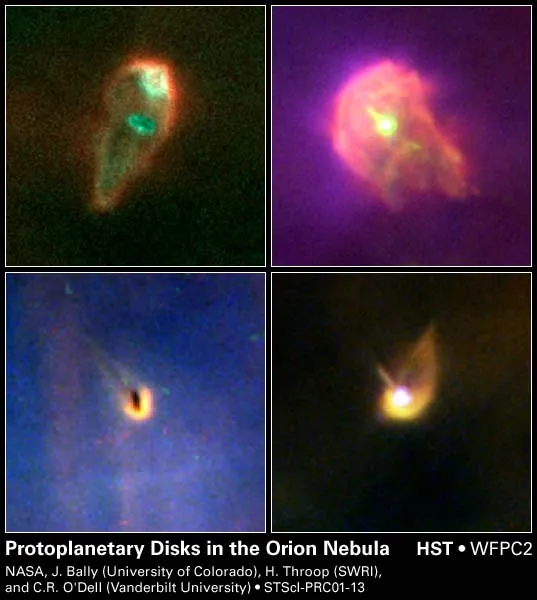
These four photos, taken by Hubble on 02-26-1998 and 01-11-1999, show disks around newborn stars in the Orion Nebula. These disks are seen flooded by the radiation from the region's brightest star. In these protoplanetary disks are the seeds of possible future planets.
The disks have diameters larger than the entire solar system and reside at the centers of cocoons or bubbles of gas. Those bubbles formed from material evaporated from the surface of the disks. Evidence collected with Hubble suggests that dust grains are forming larger particles. But those particles might not have time to grow due to the relentless "hurricane" of ultraviolet radiation from Theta 1 Orionis C.
In the image, top left, the protoplanetary disk is green, near the center. The star's radiation is heating the disk, causing the matter to dissipate, like steam evaporating from a boiling water surface.
The image was published on HubbleSite on April 26, 2001.
Credits: NASA, ESA, J. Bally (University of Colorado, Boulder), H. Throop (Southwest Research Institute, Boulder), and C. O'Dell (Vanderbilt University)
2: Gallery of galaxies
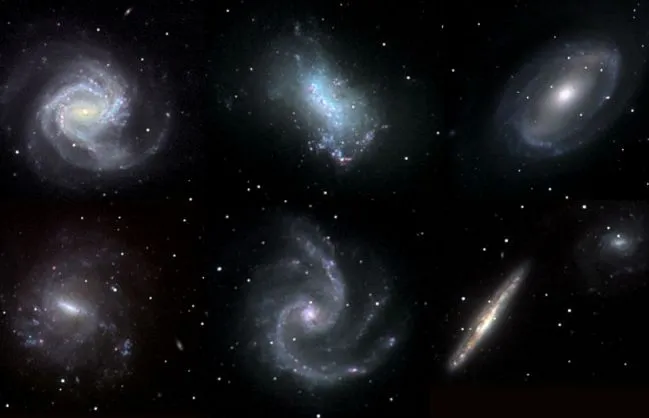
A tempting assortment of island universes: from top left to bottom right are the beautiful, but distant galaxies M61, NGC 4449, NGC 4725, NGC 5068, NGC 5247 and NGC 5775/5774. Most are spirals (which one isn't?).
The photo was the Astronomy Picture of the Day (APOD) for April 27, 2001. Also on Observatorio.
Credit: Adam Block (KPNO Visitor Program), NOAO, NSF
3: Apollo 12: Stereo View near Surveyor Crater
Astronaut Pete Conrad on the lunar surface, near the southern rim of Surveyor Crater in November 1969. With anaglyph glasses (red-blue glasses) we can see the magnificent desolation of the Ocean of Storms.
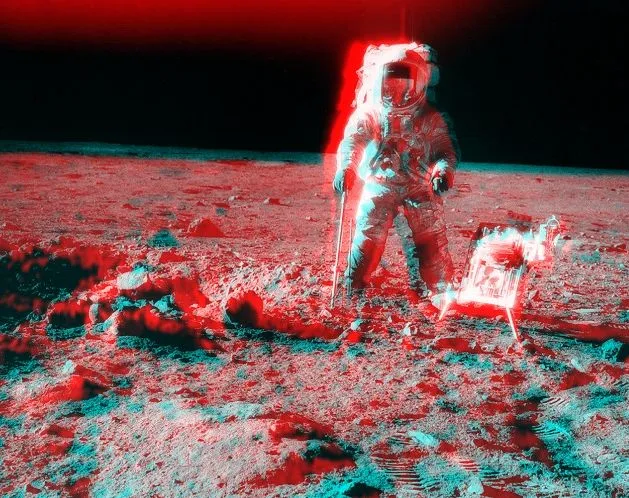
How was this photo made?
While Conrad was collecting rocks, his companion Al Bean (Alan Bean, self-proclaimed as "the only artist who walked on the Moon") took two images (cataloged as AS12-49-7318 and AS12-49-7319). For the first he stood on his right foot and for the second on his left. By coloring the first in blue and the other in red, this anaglyph was achieved when combined.
The photo was the Astronomy Picture of the Day April 21, 2001. And on Observatorio.
Credits: Apollo 12, NASA; Stereo Image by Jerry Bonnell
Note:
We can access the transcript of the astronauts' conversation during that mission at the Apollo 12 Lunar Surface Journal, with transcripts corrected and commented by Eric M. Jones.
I point the link directly to the moment the images were produced:
http://history.nasa.gov/alsj/a12/a12.halo.html#1334337
It is noted there that Ulli Lotzman (Ulrich Lotzmann) created anaglyphs with that pair of images, which can be seen at http://history.nasa.gov/alsj/a12/a12-7318-9st.html.
From the Apollo 12 Lunar Surface Journal we can access the two images that form the anaglyph: AS12-49-7318 and AS12-49-7319.


Note that in one of the images the famous "crosses" appear, sometimes called "crosshairs". The lunar conspiracy theorists think this is evidence that the 6 moon landings did not happen.
They are, in fact, crosses (also known as fiducials) "that were engraved on each exposure and serve to determine the angular distances between objects in the field of view. These reticle lines are dark and are printed on the film itself. Objects that reflect a lot of light cause overexposure on the films, saturating the area of the crosses and, therefore, erasing the corresponding part of the cross," text taken from La conspiración lunar, ¡vaya timo!, p. 77, a magnificent book by Eugenio Fernández Aguilar and published by Laetoli editorial.
Space Music
Today: Ángel Domínguez
I discovered Ángel's music on SoundCloud. I searched for information about him, found his profile and contacted him. Through that page I learned that he works in translation, as well as layout and design. Also, on his Proz profile he says he was born in 1975 in beautiful Pamplona and moved to Almería when he was three years old.
Although he is not dedicated to music, the tracks he has published seem wonderful to me. In an email contact he told me he has "a couple of musical ideas I want to shape, so in the next few months hopefully you'll be able to hear more things from me".
The songs that can be heard below are part of the set Génesis and, apparently, were created for an astronomy project in Almería in 1998. Domínguez promised to give me details about it, but he also told me he was tangled up in a project, so I didn't insist again.
If you liked Ángel's tracks, give me a second to tell you there is more.
First of all, it should be said that among the tracks of the previous set there is not one that we can indeed listen to on Ángel's Soundcloud page (and I invite you to visit the site), but which has a different origin and is called Hind. I mention it because it is a delightful track.
As with the other songs, it is possible to download the files. When playing this last track on the PC, the mp3 tags (id3 tags) indicate that the name of the composition is "Las manos de la escritora". When I asked the author, he told me that "it's the name of a song I composed for my girl, more than 12 years ago now, and it had that title".
Wait, I have a science fiction bonus.
Also on Soundcloud there is another audio file, which is not a song, but a story. It is "Luz roja", a text by Ángel Domínguez, broadcast in May 2005 on the radio program "La Rosa de los Vientos", by Juan Antonio Cebrián.
I, being an announcer, was fascinated by the voice of the professional who brings the oral story to life. I mentioned it to Ángel, who pointed out: "By the way, Paco de León (the announcer) presents a very interesting science program on Onda Cero Radio; it's called Partiendo de Cero".
http://www.ondacero.es/OndaCero/Partiendo-de-cero/P_2167332
I invite you to listen to the story in question here.
Synopsis: a pilot shot down after a confrontation with an alien race crashes on a planet inhabited by primitive beings.
Video: Luz Roja, by Ángel Domínguez (La Rosa de los Vientos)
Luz Roja, by Ángel Domínguez (La Rosa de los Vientos) from Ángel Domínguez on Vimeo.
To learn more about Ángel Domínguez, visit http://flavors.me/ahe
Science in motion
Today: The space shuttle: day and night
NASA's annual Videographer of the Year award is designed to recognize and reward achievements in promoting NASA's documentation goals and is administered by the Marshall Space Flight Center with cooperation from Internet Archive and nasaimages.org.
There are two categories: documentation and production. The award winners for the 2010 productions included this video by Brian Karr and the experimental imaging lab:
Video: SpaceShuttle: Day And Night
http://www.archive.org/details/SpaceShuttleDayAndNight
More information at NASA Images
To access previous editions of this section, consult the Multimedia Selection Series.