A collection of links to music, images and videos that relate art and science. Today: Special Edition El Bolsón. Images, sounds and videos made by astronomy enthusiasts from southern Argentina.

Images of the decade
In the music and video sections I will talk about artists from El Bolsón, which is why it seemed appropriate to extend the pattern of place of origin to the image section. From Astronomía Bolsón, in its images section, we can see this photograph taken with a CANON A510 digital camera: Waning quarter moon (right side illuminated)
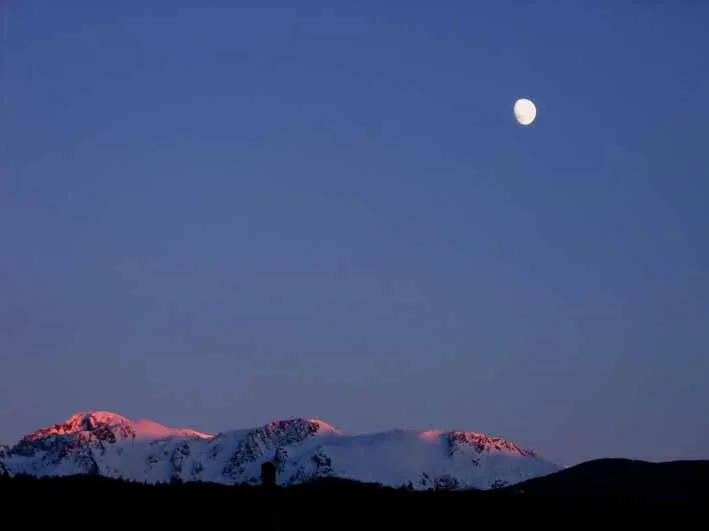
The first thing that happens to me when I see the photo is to admire the natural beauty of southern Argentina. It's breathtaking. But then, I recover and ask myself: why do the mountain peaks look reddish? Where is the Sun? The Southern Cross and the South Celestial Pole There are many crosses in the sky. It is possible to glimpse in the stars many that together with others configure that general shape, but the constellation Crux is the only one. It is easy to identify, however, by its two "pointers": Alpha and Beta Centauri. If we imagine the stars of this constellation as a cross and extend the major axis, we will see over the hours that the axis seems to point to the same area of the sky. Saying it is one thing. Observing it is much better. And drawing it is fascinating. At Astronomía Bolsón there is a record of observations of the sky made by kids, with the proper guidance of the teachers. A sample of these records is this drawing:
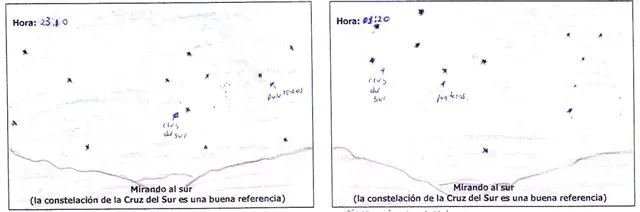
This drawing is a document. It does not have the same precision as a National ID, associated with a single person, because this observation could have been made by many people, but not on any date, time and place. If we know it was made from El Bolsón, and we have the times there (23:10 and 1:20), is it possible to know what night the observation was made? If you have a planetarium program you could locate the El Bolsón region or, failing that, San Carlos de Bariloche (about 125 km away), change the date and see which night best matches the drawing. If this diagram had been drawn, say, on November 8, 2010, at what time the following night would we have the same star positions? And a month later, on December 8? And a year later, what day would they be in the same position? The stars rise 4 minutes earlier each night. If you don't know, you might wonder why. If the difference in one night is 4 minutes, how much difference will there be in 30 nights? This new value will be the monthly difference. What then will be the annual one? Image credit: Astronomía Bolsón, a site I invite you to visit to learn about its activities.
Space Music
Today: Ensamble Circular This group is led by Ulises Labaronnie, a multimedia artist who since 1994 has presented works that include music, image, texts and installations. His works have been used in film, theater, literary presentations, choreographies, documentaries, cable TV, exhibitions, etc. Among other events, his music was heard at Experimenta 2000, Museo de la Casa Rosada (2003), EarthDance (Chile, 2004), Septiembre Musical Tucumán (2006), also in this year he presented a musical work made purely and exclusively with sounds from space at the 2nd Patagonian Biennial of Electroacoustic Music in San Martín de los Andes, World Music Cycle (Escuela Moderna de Música, Chile), he represented Río Negro in audiovisual matters at the Pertenencias Cycle organized by the Fondo Nacional de las Artes (2007) and the music of this DVD at the Biblioteca Nacional (2009) in the setting of the Exhibition "Lecturas del Cielo". He has currently composed the music for the film "Laberintos de Hielo" by Miguel A. Rossi and the Universidad FASTA of Bariloche. He gave lectures on multimedia art in Jujuy, Salta, Tucumán, Neuquén, Río Negro in Music schools between 2003 and 2009. On October 9, 2008, in El Bolsón, he performed a concert with images of Enceladus simultaneously with the Cassini spacecraft flyby of this moon of Saturn. Following this event he has given several concerts and presentations with SPACE MUSIC and images of DISTANT WORLDS. These events received graphic support and educational multimedia material from the Cassini Mission to Saturn - NASA - Jet Propulsion Laboratory (JPL). The DVD was presented at the Encuentro de Jóvenes Astrónomos held in El Bolsón in October 2009. The author, together with his avant-garde art group Ensamble Circular, has been regularly performing concerts combining music and visual arts for 11 consecutive years.
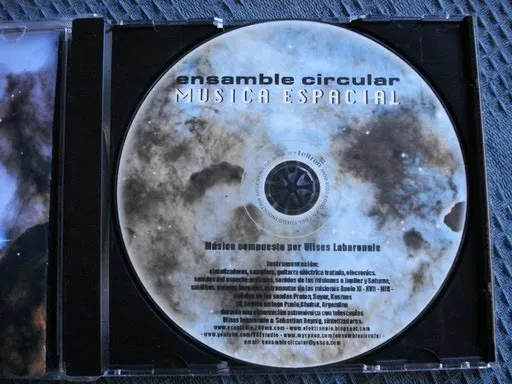
The music of Ulises and Ensamble Circular can be purchased by contacting them. To obtain more information about his work you can visit his blog Elektronnie. However, part of his production is available to listen to on Archive.org: a collection of music by Ensamble Circular. What I show above is a listing of some of the tracks hosted there, but there is much more by Ensamble Circular to enjoy, following the previous link. Ensamble Circular does not only do what we could call "space music". I emphasize that type of music because I suppose it will be of interest to the reader of this blog. But besides gathering his space music on a CD, Ensamble Circular has also produced a fabulous DVD: "Encuentros con mundos distantes". There we go.
Science in motion
Encuentros con mundos distantes is music and videos with updated images from interplanetary missions. It is a DVD not only because of the medium, but also because of the format. It is not a data disc, but a DVD with its corresponding menu. This DVD contains 15 videos, a total of 77 minutes in duration, and contains videos of Solar System objects: The Sun, the planets and Trans-Neptunian Objects. It has educational subtitles with information about each object and more additional data in the Science Menu. It presents material sent especially by Cassini Mission to Saturn, from NASA's Jet Propulsion Laboratory.
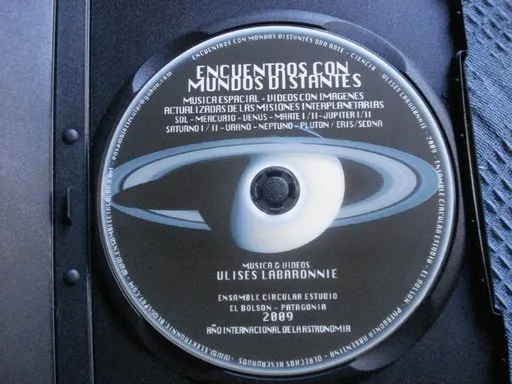
The DVD was declared of cultural, educational and social interest by the legislature of Río Negro Expdte. No. 626/2009 and by the Deliberative Council of El Bolsón (Decl. No. 011/09). It was endorsed by the Grupo Astronómico Osiris of El Bolsón. The work of Ulises Labaronnie and Ensamble Circular Although Ulises Labaronnie seems to lead Ensamble Circular, I must not fail to mention the participation of its other members: Sebastian Heynig, Ezequiel Rosso, Patricia Pilgrim. Everything said so far can be known simply by browsing the blog Elektronnie. But although it is possible and valid to recommend a work without knowing it completely, I did not want to stay with that. On the other hand, the reader will know that in this Sunday section I usually indicate works without copyright (copy left) so that everyone can enjoy them. Although, as noted, it is possible to know the music and some videos of the work of Ensamble Circular on the internet, I wanted to make the complete material available to readers. For these two reasons, I contacted Ulises and as a result I have in my possession two complete sets of his work related to space music. That is why I can give my personal opinion of both the CD and the DVD: they are unmissable. The sounds are ideal for setting the atmosphere for events, documentaries or other kinds of audiovisual productions; and the DVD is also fabulous as educational material. Both works were sent to me by Correo Argentino and their presentation is as professional as their content:
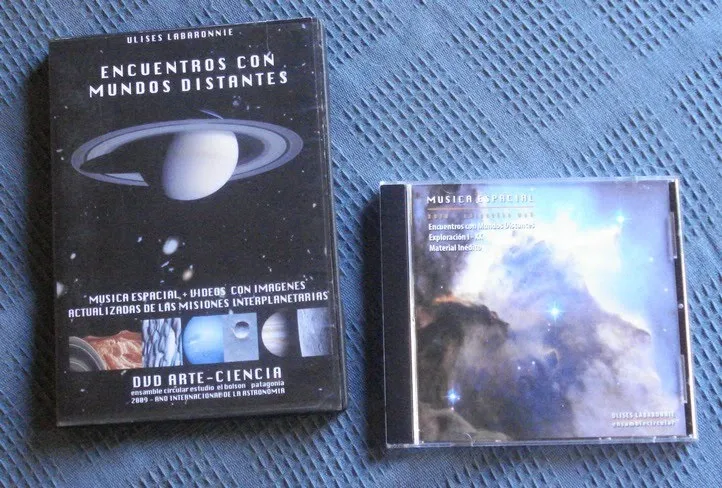
One CD/DVD set is already part of my personal collection. But another set plus a CD will be made available to the readers of this blog in a few months. Soon the blog will celebrate its first five years and I will hold a giveaway on that occasion. The content to be given away I am acquiring. But I can already say that part of the giveaway will be a CD/DVD set from Ensamble Circular. I invite you then to get to know the production of Ulises Labaronnie and Ensamble Circular from the blog Elektronnie. It is possible, as Ulises told me, that the Second Meeting of Young Astronomers will take place in October in Buenos Aires. On that occasion we may have the presence of Ensamble Circular and it may be possible to experience the audiovisual live. Note #1: The embedded track listing above was made possible thanks to the free player Dewplayer and also to Daniel Fernández's guide on its use.
To access previous editions of this section, consult the Serie Selección Multimedia.