For movie stars, their age is a well-kept secret. In space, the real stars seem never to age, like a cosmic Dorian Gray. How can we know their age?
"A star's rotation slows down over time, like a top on a table, and can be used as a clock to determine its age," says astronomer Soren Meibom of the Harvard-Smithsonian Center for Astrophysics (CfA).
Knowing a star's age is important for many astronomical studies and, in particular, for the search for planets. With the recent harvest of exoplanets from the Kepler mission, astronomers have found almost two thousand planets orbiting other stars.
"Ultimately we need to know the ages of the stars and their planets to determine whether life could have evolved on those distant worlds. The older the planet, the more time life would have had to begin. And stars and planets form together, if we know the age of the stars, we'll know that of the planets too," explains the researcher.
Knowing the age of stars is easy when they lie in a cluster of hundreds of stars formed at the same time. Astronomers have known for decades that if they plot the colors and brightnesses of stars in a cluster (the famous H-R diagram), the pattern they see can be used to tell the cluster's age. But it only works for clusters.
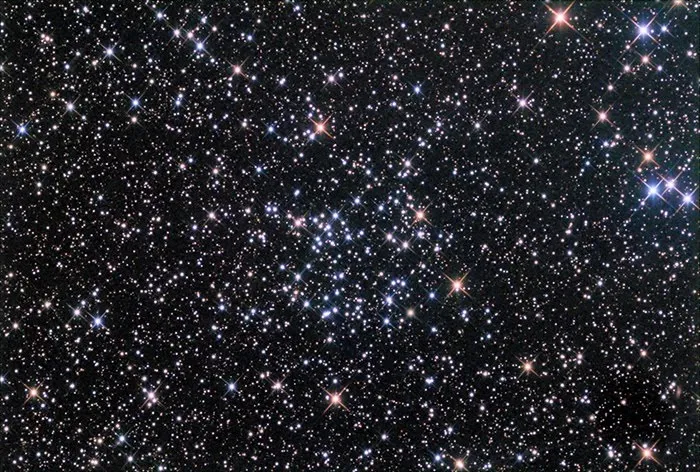
Using the capabilities of the Kepler space telescope, Meibom and his collaborators measured the rotation rate of the members of an open cluster called NGC 6811 about 3,000 light-years away, in the constellation Cygnus (the swan), with about 70 member stars whose average age is estimated between 700 and 1,000 million years.
If the relationship between stellar rotation and age can be established by studying star clusters, then by measuring the rotation period of any star it can be used to derive its age, in a technique known as gyrochronology. For it to work, astronomers must first calibrate this new "clock."
The idea is not too new. Already in the 1970s something similar was suggested about the relationship between rotation and the ages of stars(1). More recently, Sydney Barnes, of Lowell Observatory, did work in 2007 reviewing the known methods to assess their feasibility and develop them better (2).
How it's done
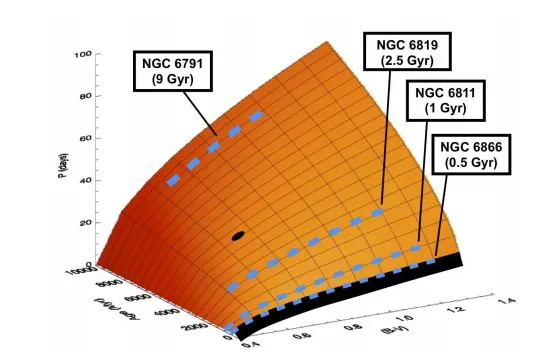
To begin they started with stars in clusters with known ages. By measuring the rotation of those stars, they can learn what rotation rate to expect for that age. By measuring rotation in clusters of different ages, they know how age and rotation are related.
To measure a star's rotation, astronomers focus on the small brightness changes caused by dark areas on the stellar surface, the equivalent of the spots on our Sun.
But to extend this relationship to NGC 6811, Meibom and his team had to face a Herculean task. They spent four years filtering out stars that seemed to belong to the cluster by being in the same direction, but which are not part of the grouping. Once they established which stars were part of the cluster, they used Kepler data to determine how fast those stars were rotating. In their work they present the rotation periods of 71 stars.
They found rotation periods between 1 and 11 days, compared to the 30 days of our Sun, and found a strong relationship between stellar mass and rotation period. The results confirm gyrochronology as a promising method for determining the ages of isolated stars.
The group now plans to study other, older clusters, to continue calibrating this astral clock, but it will become increasingly difficult because older stars rotate more slowly and have fewer spots.
Moral: If rotation slows down with age, let's go dancing!
Sources and related links
- The Kepler Cluster Study: Stellar Rotation in NGC6811
Søren Meibom et al. 2011 ApJ 733 L9
DOI: 10.1088/2041-8205/733/1/L9
arXiv:1104.2912v1 [astro-ph.SR] - (1) Time Scales for CA II Emission Decay, Rotational Braking, and Lithium Depletion
Skumanich, A.
Astrophysical Journal, vol. 171, p.565
1972ApJ...171..565S - (2)Ages for Illustrative Field Stars Using Gyrochronology: Viability, Limitations, and Errors
Sydney A. Barnes 2007 ApJ 669 1167
DOI: 10.1086/519295
arXiv:0704.3068v2 [astro-ph] - CfA: How to Learn a Star's True Age and at NASA Kepler (where you can see Meibom's presentation at the AAS 218 Meeting).
- Astronomy: NGC 6811 - open cluster in Cygnus
About the images
- Image of NGC 6811, by Anthony Ayiomamitis, at Astronomy.
- Fig.1: from Søren Meibom et al. 2011 ApJ 733 L9.