A collection of links to music, images and videos that relate art and science. Today: NGC 1512 and M82; Cumular commotion and The places you've been; Space Superheroes; and Solitons.

Images of the decade
A galaxy in vivid colors
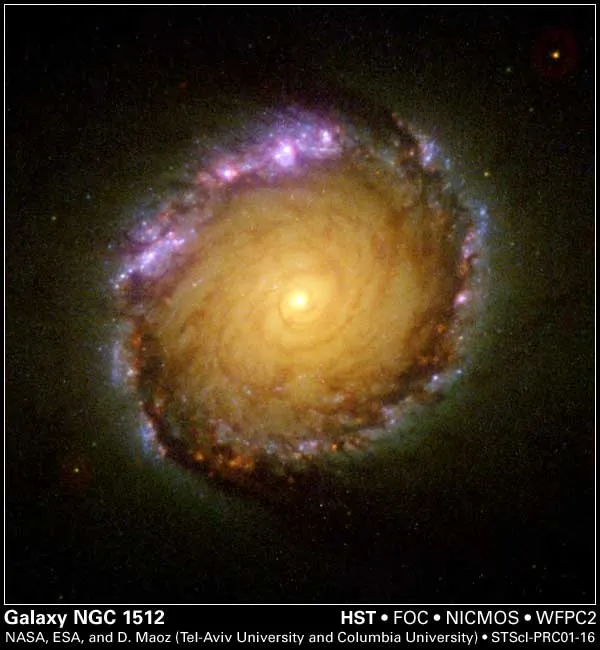
In this view of the center of the magnificent barred spiral galaxy NGC 1512, the Hubble telescope reveals an incredible circle 2,400 light-years in diameter of newborn star clusters. Astronomers believe the giant bar, which is too diffuse to be seen in this image, carries gas to the inner ring where massive stars are forming in numerous star clusters. Located 30 million light-years away, NGC 1512 is a neighbor of the Milky Way.
The image was made public by HubbleSite on May 31, 2001.
From the link above or from SpaceTelescope you can access a set of images in different wavelengths:
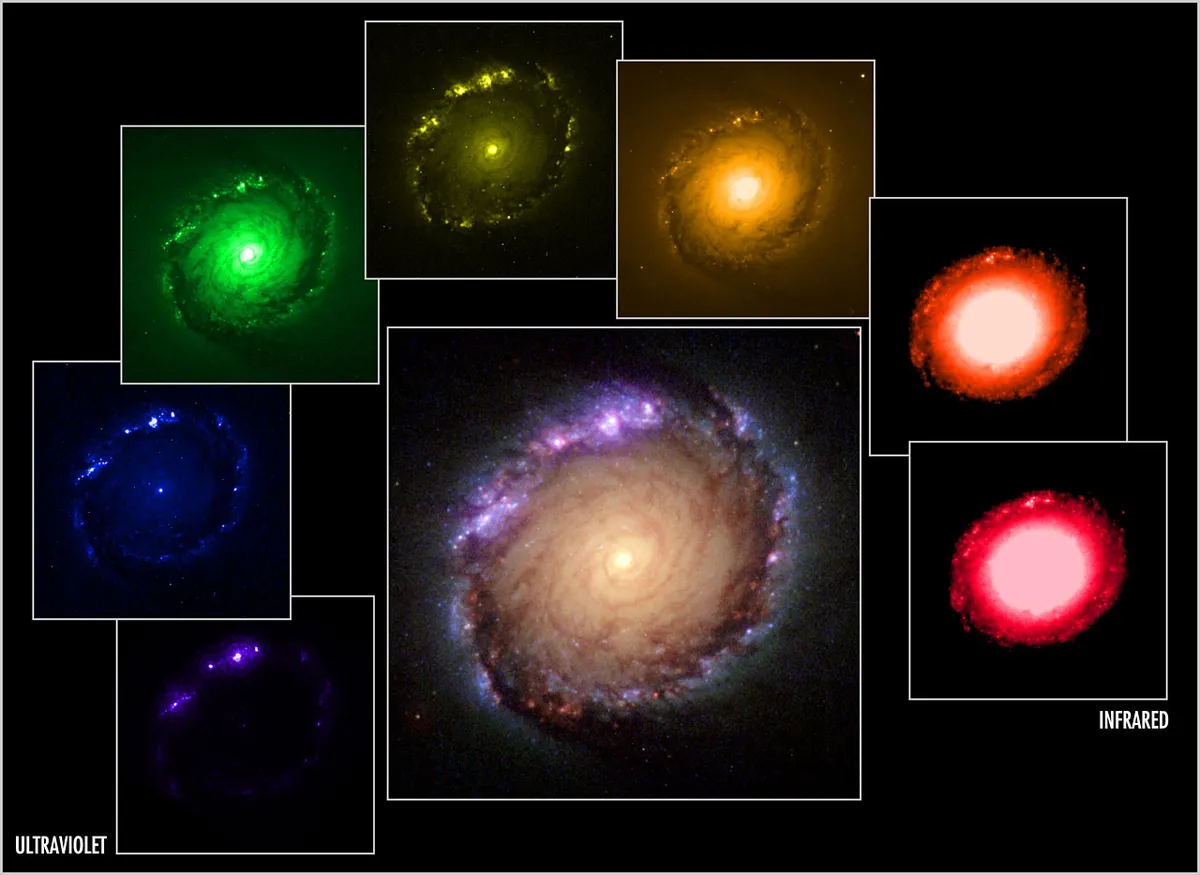
and also to this other one:
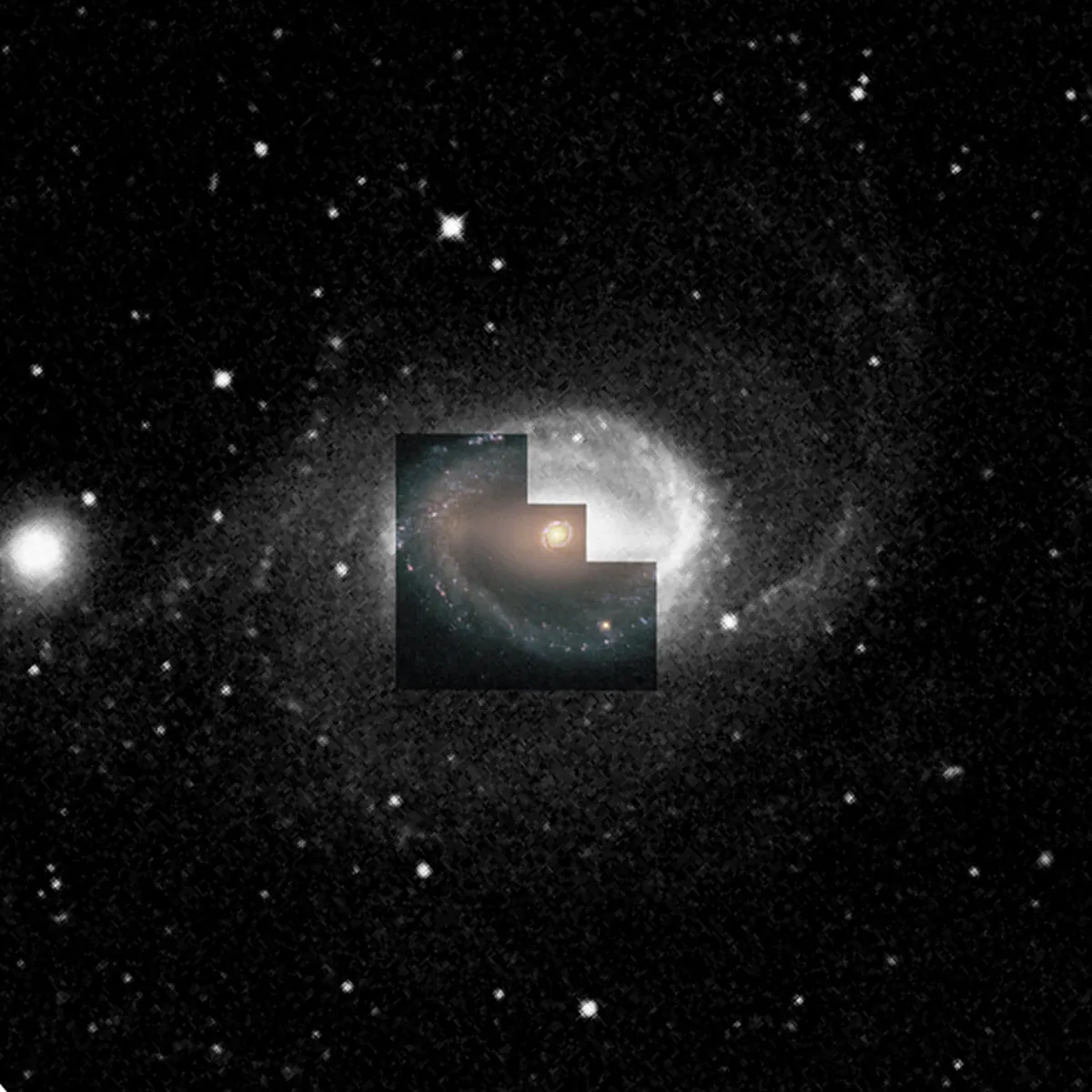
This is an overlay of an image taken from the ground (0.15 degrees wide) and shows where Hubble pointed its cameras. The horizontal bar is now visible, as well as the outer ring of star formation.
Credits: NASA, ESA, and D. Maoz (Tel-Aviv University and Columbia University)
M82: a starburst galaxy with ultraluminous X-ray sources
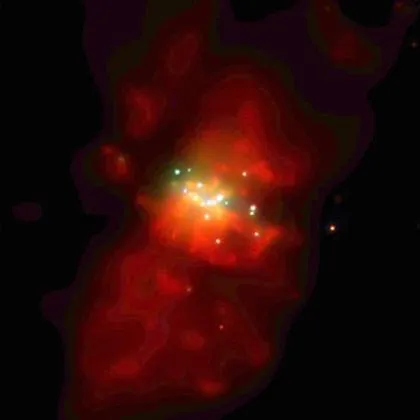
This Chandra image is colored to highlight a population of ultraluminous point sources in X-rays in M82, a starburst galaxy 11 million light-years from Earth. In the image red represents the low-energy band, green the intermediate, and blue the highest. The white and yellow sources are those that emit significant amounts of low and high energy X-rays. The ultraluminous sources, which emit tens to hundreds of times the X-ray energy of similar sources in our galaxy, are thought to be either massive black holes or to be radiating energy towards Earth. The most powerful source is the one near the center of the image.
Observations of the Cigar galaxy and other starburst galaxies suggest that the origin of the ultraluminous sources is related to the star formation rate triggered by a collision with another galaxy. Astronomers suspect M82 had a close encounter with M81.
The reddish glow in the image is caused by gas at many millions of degrees in the central region of M82.
The image was presented by Chandra on June 01, 2001.
Credit: NASA/SAO/G.Fabbiano et al.
See M82 on GoogleSky.
Images of the week
Cumular commotion
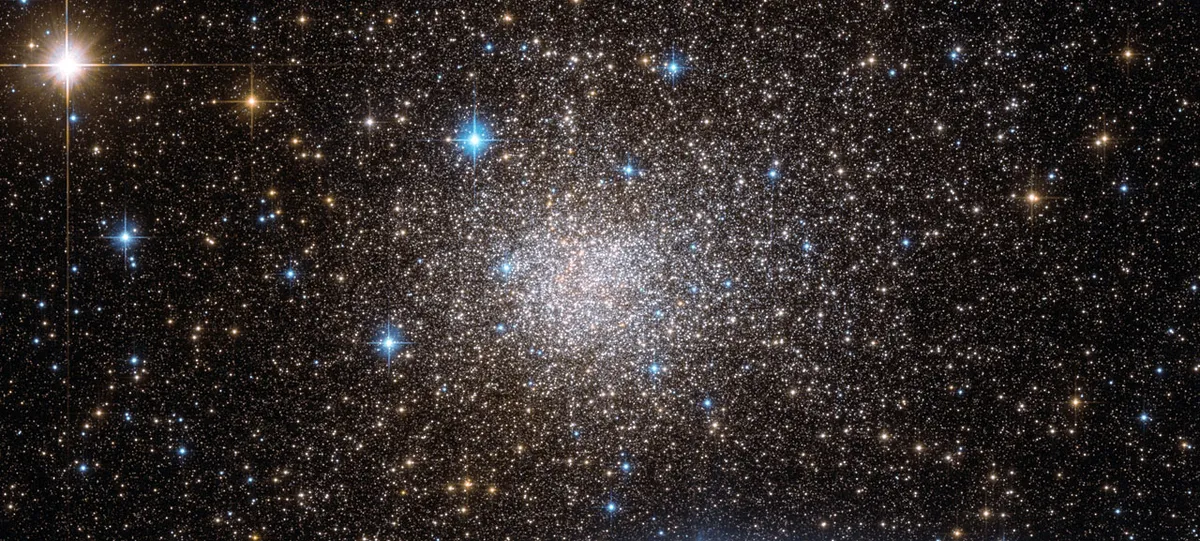
This Hubble image shows us the old globular cluster Terzan 5, 18,000 light-years away from Earth. It has a very dense core and, therefore, one of the highest stellar collision rates. Astronomers say there are two age groups in the cluster: 6 and 12 billion years old. It is hypothesized that the younger ones were stolen from a dwarf galaxy. In fact, it is pointed out that it is not a genuine globular cluster, which has some relation to what is a galaxy?
It was the Space Telescope's image of the week, released on May 23, 2011 and from the spacetelescope site we can download it in several available sizes.
It is one of the six clusters discovered by the Armenian-French astronomer Agop Terzan.
Credit: ESA/Hubble & NASA
The places you've been
Imagine that you were able to track every place you've been in your entire life and then plot that on a map. (Something that iPhone users could do, although they wouldn't surpass, they say!)
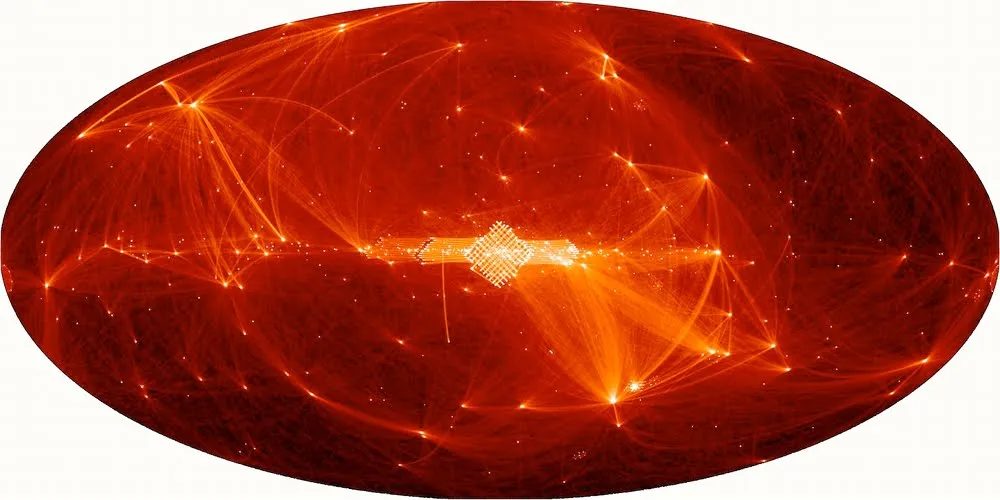
If you were lucky you would find that you spent most of your life visiting the most interesting sites. That's what this map is for the Rossi X-ray Timing Explorer, known among its friends as RXTE, which is not Spanish radio and television. It is a satellite dedicated to exploring the variable X-ray sky. The top image is the representation of the places in the universe observed by the probe from January 2001 to December 2010, in galactic coordinates. The bright areas are where it spent more time and the individual dots, like those in the central part, are those regions of particular interest that RXTE spent more time observing. The curves are the paths the satellite took to go from one of those regions to another.
It was the high energy astrophysics image of the week (HEARSAC) published on May 23, 2011.
Credit: Craig Markwardt, Jean Swank, Tod Strohmayer, Evan Smith, Divya Pereira; NASA
Space Music
Today: IML - Space Superheroes
I have already commented in this section about Intercontinental Music Lab (IML). As its name indicates, it is made up of people from different parts of the world. On their website you can see which people participate and click on each one to see on a map where they are from. The list includes Maria Bennassar, from Blueberry Hill, who participated in a work later than the one I will comment on today.
Since 2008 IML has produced six albums, all thematic: they started with one about science, followed by another about the sea and the third was about space. Those three form the Superheroes trilogy.
As always, the tracks separately or all together can be listened to and/or downloaded for free from Jamendo, as well as from the Intercontinental Music Lab site. The site also contains the lyrics (in English) of each song and who participated in its production.
Note for the curious: what does the title of the ninth track mean?
Science in motion
Today: Solitons
Says Wikipedia: A soliton is a solitary wave that propagates without deforming in a nonlinear medium. It is found in physical phenomena as a solution to nonlinear differential equations.
Solitons from carolune on Vimeo.
To access previous editions of this section, consult the Multimedia Selection Series.