For this orbit jump, you'll need speakers or headphones to listen to sounds from the universe, but also from dinosaurs, whales, or storms. A jump with vibes.
When we access a website, we might delve into another world, as if jumping from Earth to Mars. Perhaps we come into contact with another point of view, as if observing the planet from 36,000 km high. And maybe we gain energy by colliding with some data that enlightens us.
Thus arises Orbit Jump, which after such an introduction is nothing more than a link recommendation.
Spacesounds.com is a website that has existed for a decade. Created by Scott McNulty, a veteran in technology and marketing. He developed campaigns for Coca-Cola, IBM, and Sony, among others. He launched a virtual storage company, wxrld. He has an MBA from the University of Connecticut, is a member of the Frisbee Foundation (in honor of Richard Frisbee, a 14-year-old boy who died of leukemia), and the creator of Spacesounds.com and the developer of BIOPTid.
(Not to be confused with other people with the same name, for example the famous geek nicknamed Blankbaby).
The art direction and site design are the product of Tom Rzonca's work, with collaboration from Jason Carey, J. Stanley Productions, NASA, SETI@home, UC Berkeley, and Richie Evans.
The site
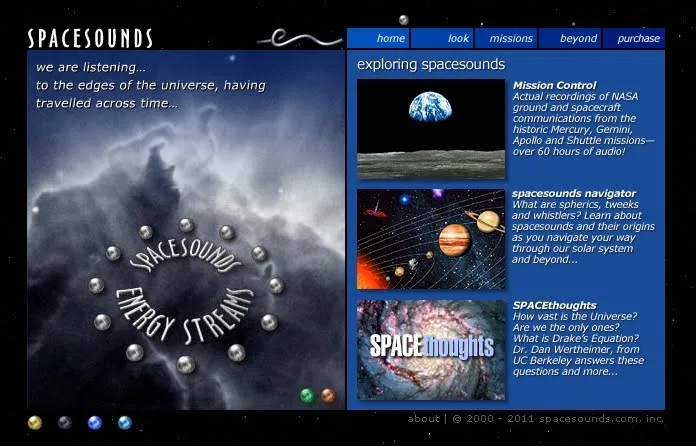
From the home page, after the introduction, we can hear space sounds by clicking on the silver spheres: a black hole, Ganymede's magnetosphere, big bang remnants, Saturn's rings and more (details on each below).
It's good to know that on the sound pages we'll find a green sphere and an orange one. The orange one is a "stop", it serves to stop the audio. And the green one is a "play", it serves to continue listening.
The site has four tabs. From Look we can see images created by David Palermo.
From Missions we can listen to audio from the Mercury, Gemini, Apollo, Voyager, Pioneer, Skylab, STS space missions.
In Beyond we can download an application (for Windows and Mac), as well as a wallpaper (in two sizes).
From the last tab you can purchase the audio material on CD.
If we download the application, called "Spacesounds navigator" (space sounds navigator) we get a compressed file, zip. When we unzip it we get another compressed file (navigator_win.exe, in the case of Windows). When we run it (with a double click) it will decompress and generate folders among which is the file "spacesounds navigator.exe". When we run it we'll see a Macromedia Flash player 6 player with the solar system, and beyond, a black hole and two pulsars. By clicking on each object we can listen to the corresponding sounds on our PC, without being connected to the internet.
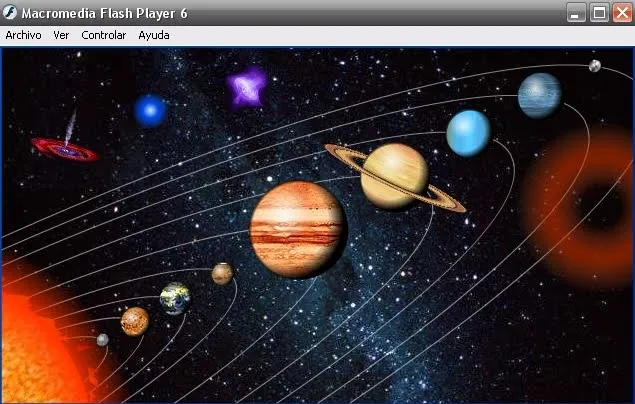
The sounds of space
Some of the sounds that can be heard deserve some detail about what they are. Below I indicate which sound corresponds to each sphere on the home page, for those who don't know English.
The home page shows twelve silver spheres distributed in a circular shape. We could compare each sphere to the hour on a clock.
Hour zero would correspond to the sound source of a black hole: GRS 1915+105. In the link, in Spanish, data about the object is given, although it is noted that it is 8,100 light-years away, but it would be at 40,000 light-years, according to Chandra.
At one o'clock on our imaginary clock we have the sound of the magnetosphere of Ganymede, Jupiter's largest satellite.
At two, we have the sounds of "Cosmic Debris". Although it sounds alien, they are sounds generated by radio, TV, and cell phone signals, plus spacecraft noise, received by radio telescopes.
The sphere that says Spherics, Tweeks and Whistlers (at 3) are atmospheric sounds heard at low frequencies (3 to 30 KHz). To learn more see: Dynamic Spectra.
At four we have what is captured by radio telescopes such as the background radiation, considered a relic of the big bang.
At five and six, the sounds of two gas giants in the solar system: Saturn's rings and Jupiter's magnetosphere.
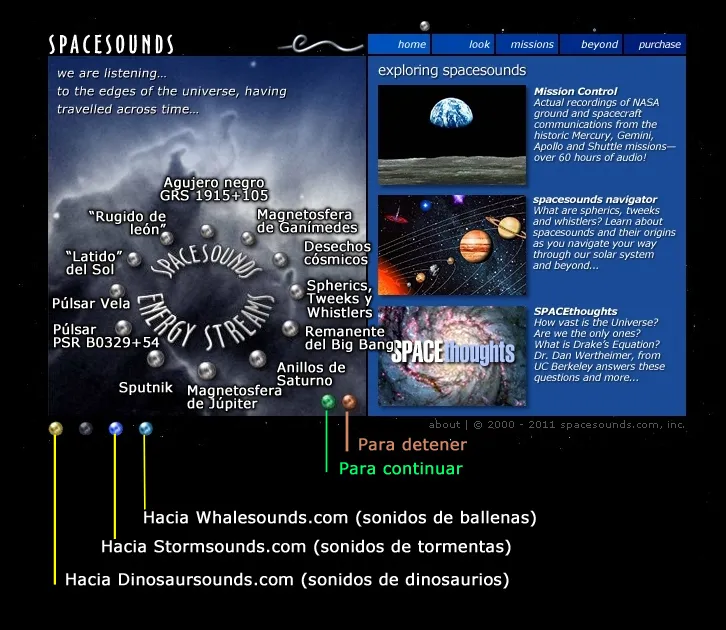
At seven we have the sound of Sputnik, launched on October 4, 1957 by the Russians.
At eight, PSR B0329+54, a pulsar or neutron star. At nine, another pulsar, PSR B0833-45, The Vela Pulsar. More can be read about both at:
Seti.cl-The fascinating sound of a pulsar.
At ten, the "heartbeat" of the sun: Helioseismologists are "listening" to the Sun using the MDI instrument (Michelson Doppler Imager) aboard the SOHO spacecraft. More at: The sounds of the Sun, by Teodoro Roca Cortés.
You can also listen to the "Lion's Roar" (at eleven) which is radio emissions in the magnetosphere, named for the resemblance between the sound of those emissions and the roar of a big cat.
And more sounds
From the lower left corner we can access other sites by the same creator: sounds of dinosaurs, storms, and whales, are the three links that appear there, through the colored spheres (yellow, blue, and light blue).
Sources and related links
- Spacesounds.com
About the images
- Fig. 1 and 2: Screenshots of Spacesounds. Credit: Scott McNulty