A collection of links to music, images and videos relating art and science. Today: An Acropoclipse, Orange eclipsed Moon near the Lagoon; A cosmic fried egg and a lunar rainbow. Music from the Kronos Quartet: Sun Rings; and an animation: OGODEIDIDIT!

Images of the decade
A cosmic fried egg
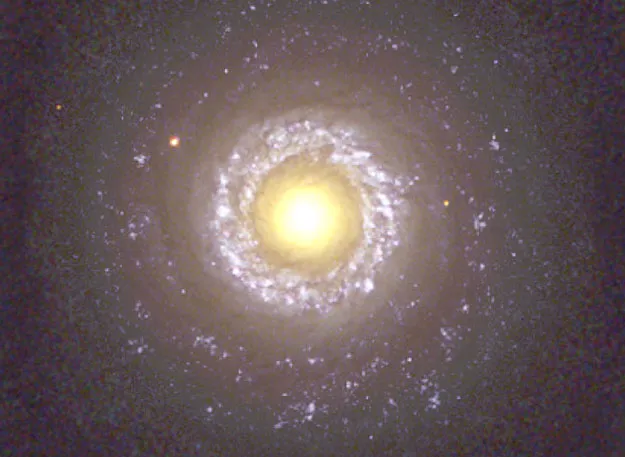
Ahh...there's nothing less glamorous, but tastier, than dipping bread in the yolk of a fried egg. But here the yolk is about 3,000 light-years in diameter. Imagine how big the piece of bread should be!
If we let it sit for a while, the fried egg gets cold and it's not the same. In this case we would have to travel 72 million years (provided we do it at the speed of light) to reach this appetizing galaxy NGC 7742 in the constellation Pegasus.
NGC 7742 is a Seyfert galaxy, a spiral with an active nucleus where a black hole surely resides, like the one we would get in our liver if we swallowed such a fry-up!
It was the Astronomy Picture of the Day (APOD) on July 1, 2001.
Credit: Hubble Heritage Team(AURA/STScI/NASA)
Also on Observatorio.
A lunar rainbow
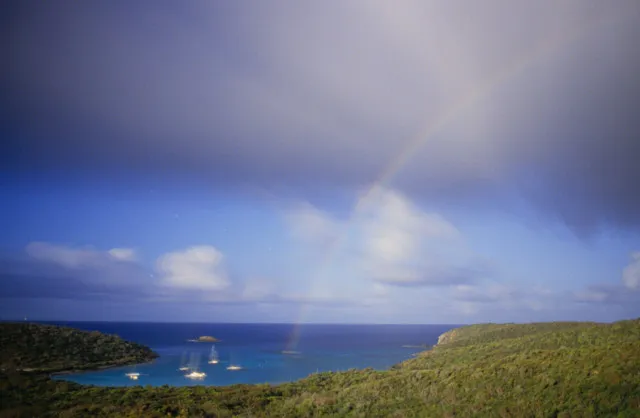
This image was taken at night. I don't ask you to just believe me: it is possible to explain the difference between your concept of "night" and what your eyes see in the photograph.
Matt BenDaniel took this image with his Olympus camera from Concordia, St. John, in Salt Pond Bay, Virgin Islands, on February 8, 2001 at 20:00 AST, 24:00 UTC, 21:00 Argentina time. That is, at night, well after twilight.
There was a rain shower in that place, which moved to the southeast. The full Moon, to the northwest, was reflected in the raindrops and created a lunar rainbow or moonbow. "To my eyes the moonbow appeared very diffuse in color. If you look very carefully you will see a second and very diffuse moonbow; it is better seen in a print," notes the author.
Why does the shot look like it was daytime? The full Moon reflects sunlight, its same spectrum. The human eye does not perceive colors well with low light levels, but the camera does. The shot needed a 30-second exposure, during which the sailboats on the left moved, so they appear blurry. With a bit of attention we will see some stars, towards the center, on the left.
According to BenDaniel, where the moonbow ends there is a reef, which he went to snorkel the next day. He didn't find a pot of gold.
It was the Astronomy Picture of the Day on July 4, 2001.
Credit: Matt BenDaniel
Also on Observatorio.
Images of the week
Eclipse over the Acropolis
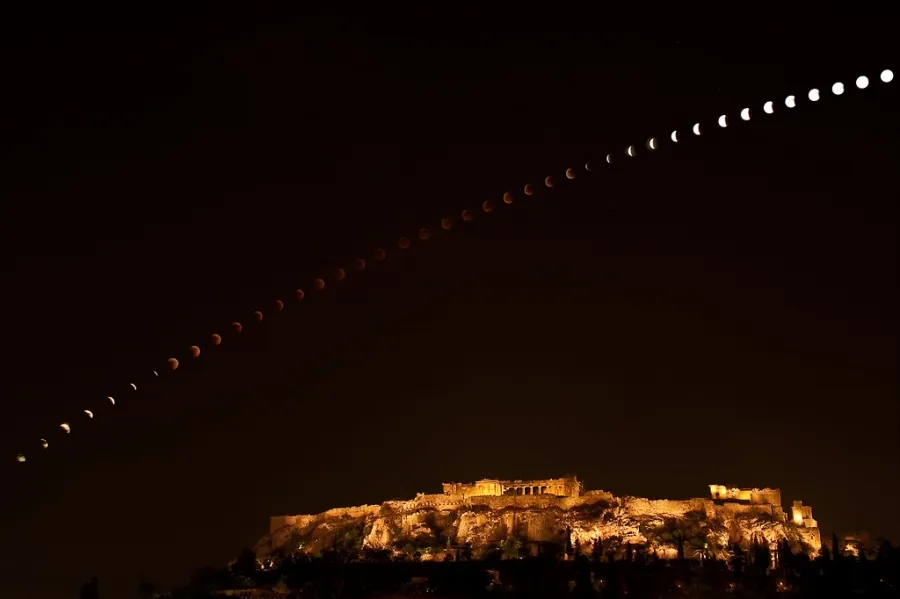
The total duration of the past lunar eclipse on June 15, which lasted 100 minutes, is covered in this composite made with a sequence of regular exposures as the lunar disk arcs over the Acropolis in Athens. Greek astronomer Elias Politis also made a video, which with the right music, is a true lunar poem.
It was the Astronomy Picture of the Day June 25 on APOD.
Credit: Elias Politis.
http://www.youtube.com/watch?v=kOXR1ga1UlE
The eclipse floats near the Lagoon
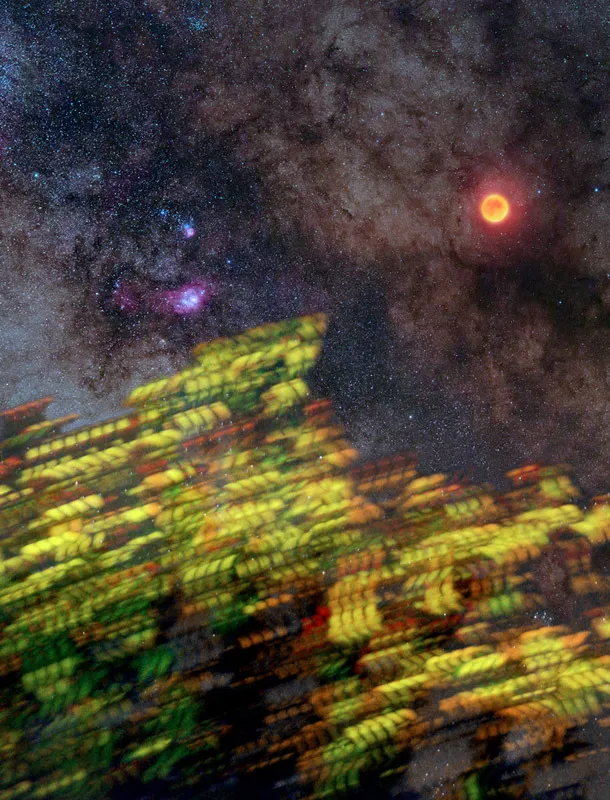
Astronomer Phil Plait shared this image of the orange Moon that took on that color by reflecting sunlight filtered through Earth's atmosphere, while appearing as a neighbor to the Lagoon Nebula (Messier 8). I recommend to see M8 to open the image of the Moon (clicking the photo opens it separately, large) and at the same time view the image of M8 (following the link to ESO).
But that's not all. The bluish-reddish Trifid Nebula is also seen in the photograph. The Moon was in the constellation Ophiuchus, near Sagittarius, towards the galactic center.
The photographer, Emil Ianov, combined five two-minute exposures at the deepest part of the eclipse to create this beauty that leaves us speechless.
In the comments, Plait notes that the tree would be about 10 meters away, which makes the Moon 40 million times farther away than the tree...but the Lagoon Nebula, at 4,000 light-years away, is 100 billion times farther away than that!!
It was the Amateur Astronomy Picture of the Day June 27, 2011.
Credit: Emil Ianov
Space Music
Kronos Quartet: Sun Rings
The multimedia production Sun Rings is based on sounds from space collected by Professor Don Gurnett of the University of Iowa over 40 years. The musical portion was composed by Terry Riley and performed by the Kronos Quartet, accompanied by a visual production created by Willie Williams.
For the start of the International Year of Astronomy they performed at the UNESCO building in Paris.
For those more interested, there is a series of videos (in English) of a lecture about this presentation, in Iowa.
Science in motion
"OGODEIDIDIT!", Bruno Gradaschi
OGODEIDIDIT ! from alobotomia on Vimeo.
Idea and Realization: Bruno Gradaschi.
Music and Sound: Ignacio García Montero.
Produced in Lanús, Argentina, 2011, by Alobotomia.
Alobotomia.blogspot.com.
Videos at: Vimeo.com/Alobotomia
Seen on Axxón.
To access previous editions of this section, consult the Multimedia Selection Series.