They say the skies of Chile are among the best in the world. That the Paranal Observatory, of ESO, has an incredible view. You can't do desktop observational astronomy, but if we can't travel, better to take a virtual -360º- tour of those infinite skies.
When we access a website, it's possible we delve into another world, as if jumping from Earth to Mars. Perhaps we come into contact with another point of view, as if observing the planet from 36,000 km high. And maybe we gain energy by colliding with some data that illuminates us.
Thus arises Orbital Jump which after such a presentation is nothing more than a link recommendation.
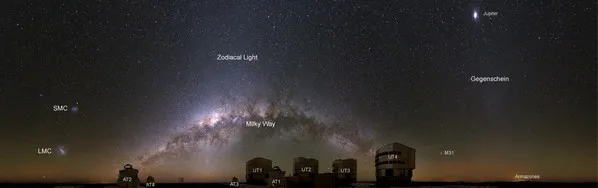
The following link is to the website of Stéphane Guisard where there are three views of the 8 and 1.8 meter telescopes of the Very Large Telescope under the Milky Way. The Magellanic Clouds are visible, on the left. And not only those other satellite galaxies of ours, but a fantastic larger neighbor: M31, to the right of UT4.
The 8.2-meter telescopes are called at Paranal as Unit Telescopes or UT. Each one also has a name in the Mapuche language (Mapudungun):
ANTU (UT1; The Sun),
KUEYEN (UT2; The Moon),
MELIPAL (UT3; The Southern Cross), and
YEPUN (UT4; Venus, as the evening star).
There are also four smaller, 1.8-meter telescopes, which are auxiliary. They are the ATs.
In the first image we will see these technical marvels under the natural marvels. This first shot is "zoomeable" if you'll allow the term. It is possible to zoom in or out of the image.
Below we will have the same shot but with annotations (in English).
The notes point to the Magellanic Clouds (SMC, LMC), the UT telescopes, the ATs, M31, Jupiter.
Between UT3 and UT4, when we zoom in, we can see the North America Nebula (NGC 7000) in Cygnus.
Additionally, two phenomena that are more difficult to see in dark skies can be observed:
Gegenschein is a night glow in the ecliptic visible on the side opposite the Sun. It is similar to Zodiacal Light, the other phenomenon visible in the photo. In both cases the light of these phenomena is produced by the scattering of sunlight in dust particles.
Finally we will have a 360º panorama of the place that we can explore with the mouse.
As I mentioned before, it is a page from the site of Stéphane Guisard. The rest of the content is equally recommendable.
Stéphane is an optical engineer at the VLT, in Chile since 1994. He is also an amateur astronomer and a photographer of the kind that deserves a statue.
Let's jump then to The Skies of Chile.