It is the acronym of an initiative to search for young transiting exoplanets in open clusters, through a network of telescopes around the world.

The Young Exoplanet Transit Initiative (YETI) project is a survey that searches for giant planets in...open clusters. The collaboration conducts observations with a network of telescopes around the world so it can monitor a field of view continuously for one to two weeks. The distribution of the instruments allows the group to detect planets with a wider range of orbital periods than would be possible with a single instrument at a fixed longitude, although bad weather and other obstacles still interfere). However, it has a drawback: combining different observations with multiple telescopes and detectors under different atmospheric conditions.
View YETI on a larger map
Searching in abominable places
Why do they search in open clusters? There are two main reasons:
Most exoplanets discovered to date are several billion years old. That means the planets are "old" enough to have migrated from their original formation sites. But if YETI can detect planets around young stars (up to 100 million years old), those planets would still be in the process of formation and would not have migrated very far from their birth sites. This would allow investigation of how planets form and migrate during their early stages of existence.
Furthermore, the ages of stars in a cluster are more precise than those estimated for stars in isolated fields. Since all stars in a cluster are assumed to have been born at the same time, astronomers can use color-magnitude (HR) diagrams to determine their age.
The idea is to observe ten clusters, each for two or three years and no more than two clusters per year, so the initiative should last at least a decade.
As is logical, the initiative will also report other variability phenomena.
The collaboration has already observed two clusters, Trumpler 37 (IC 1396, where the monstrous Elephant's Trunk is) and 25 Ori, for two years and they plan to observe more in the future to investigate if there is a relationship between the transit rate as a function of the cluster's age, its density, metallicity and other variables.
The selection made by the collaboration led by Ralph Nehäuser (Ph.D. in Astronomy at the University of Jena, Germany) contains clusters at distances between 50 and 1000 pc, with stars of magnitudes between 10 and 16.5, which have not been targets of other surveys and with declinations appropriate for the instrument network.
Background
The same authors point out in the introductory paper of their project two previous searches for young planets: CoRoT in NGC 2264 and the MONITOR project.
The European satellite with its 30 cm mirror monitored the young cluster NGC 2264 for 24 days in March 2008. That cluster is about 3 million years old at about 760 pc.
That cluster will not be observed by YETI.
The other project, MONITOR, seeks to observe ten clusters up to 200 million years old also to detect transiting planets, but so far they have not detected any.
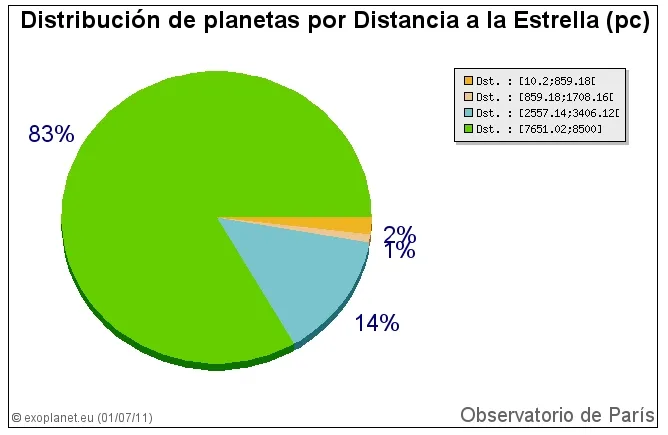
According to The Extrasolar Planets Encyclopaedia, of the 564 planets detected around other stars, 141 correspond to transits.
Sources and related links
- Young Exoplanet Transit Initiative (YETI)
R. Neuhäuser et al. 2011
Accepted by Astronomische Nachrichten
arXiv:1106.4244v1 [astro-ph.SR] - YETI: Abominable Snowman or Exoplanet Transit Survey?
About the images
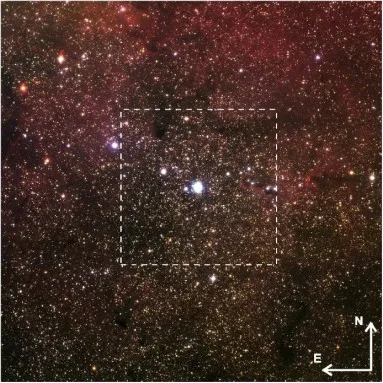
- The initial image contains an image of IC 1396. "Is there a monster in IC 1396? Known sometimes as the Elephant's Trunk Nebula, it is possible that some parts of the gas and dust clouds in this star-forming region appear to take on a monstrous, almost human shape," they said in the Astronomy Picture of the Day for March 25, 2002.
Credit: Jean-Charles Cuillandre (CFHT), Hawaiian Starlight, CFHT
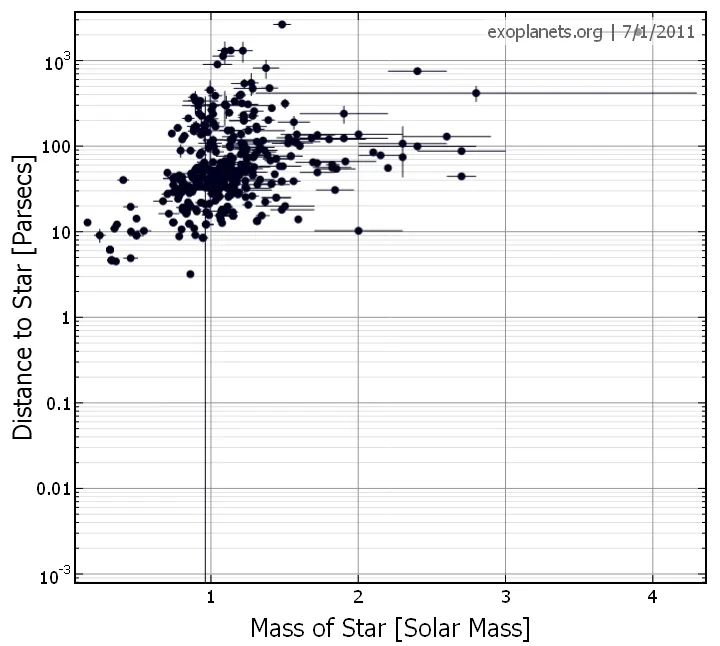
More at El Sofista. The image of the abominable snowman is from Cafepress. - Chart 1: Credit to Exoplanets.org, Dr. Jason Wright, Dr. Geoff Marcy, and the California Planet Survey consortium.
- Chart 2: The Extrasolar Planets Encyclopaedia, by Jean Schneider.