The universe never ceases to surprise us. Two rare gems are added to the gallery of strange exoplanets.
THE DARKEST PLANET
TrES-2b orbits a star GSC 03549-02811 (of 11th magnitude) at 700 light-years, in the direction of Draco. It would be, according to astronomers, the darkest exoplanet known to date as it would reflect less than 1 percent of the light from its star, making it blacker than coal.
"TrES-2b is considerably less reflective than black acrylic paint," said David Kipping of the Harvard-Smithsonian Center for Astrophysics (CfA) and lead author of a paper accepted in MNRAS.
In our Solar System, Jupiter is wrapped in bright ammonia clouds that reflect more than a third of the sunlight that reaches it. In contrast, TrES-2b lacks those clouds due to its high temperature.
The planet gets its name from the TrES survey, an acronym for Trans-Atlantic Exoplanet Survey.
TrES-2b orbits its star at a distance of almost 5 million kilometers, so the intense light from the star heats the planet to a temperature above 980º C.
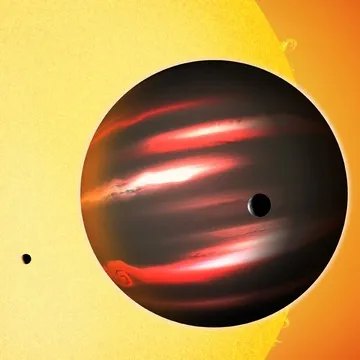
"It's not clear what causes the planet to be so extraordinarily black," said co-author David Spiegel of Princeton. But he also noted that "it's not completely black. It's so hot that it emits a faint reddish glow, like an ember."
Kipping and Spiegel determined the reflectivity of the exotic extrasolar planet using data from NASA's Kepler mission. The team monitored the brightness of the system as the planet orbited the star. TrES-2b always shows the same face to its star, like the Moon and Earth, and just like our satellite the planet shows phases as it orbits. That causes the total brightness of the star plus the planet to vary.
"By combining Kepler's precision with observations of more than 50 orbits, we detected the smallest change in brightness of an exoplanet: only 6 parts per million," explained Kipping.
THE DIAMOND "PLANET"
Astronomers think they have found what was once a massive star, transformed into a small diamond planet.
The finding, reported in Science, was made by the team led by Professor Matthew Bailes of Swinburne University in Melbourne.
The researchers detected a pulsar using the CSIRO radio telescope and continued the observations with the Lovell radio telescope and one of the Keck telescopes.
Pulsars are small stars, about 20 km in diameter, that emit a pulse of radio waves. As the star rotates, the pulse sweeps past Earth repeatedly and radio telescopes can detect a regular pattern of radio pulses.
In this case, the pulsar PSR J1719-1438, astronomers noticed that the arrival times of the pulses were systematically modulated. They concluded it was due to the gravitational pull of a small companion planet orbiting the pulsar in a binary system.
Both are part of our galaxy and lie 4,000 light-years away in the direction of Serpens.
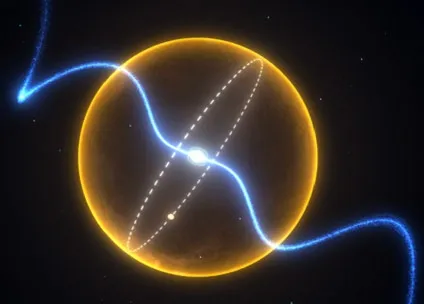
Thanks to the modulations, the researchers believe the planet orbits the pulsar in two hours, 10 minutes and that the distance between the objects is 600,000 km - slightly less than the radius of the Sun.
The companion would be small, though about five times larger than Earth, about 60,000 km and would be so close to the pulsar that if it were any larger it would be torn apart by the gravity of the dense object.
But despite its size, about half the diameter of Jupiter, the exoplanet would have more mass than the gas giant in our solar system. "The high density of the planet provides clues about its origin," said Bailes. According to the paper, the object would have a density of 23 grams per cubic meter. Carbon compressed to this high density would literally be converted into its crystalline form: diamond. But these measurements are highly dependent on the planet's orbital inclination, so if the data vary with future observations, the estimated mass of the planet will also vary.
The team thinks the "diamond planet" is the remnant of what would once have been a massive star.
J1719-1438 is a millisecond pulsar. It rotates incredibly more than 10,000 times per minute (175 times per second) and has a mass 1.4 times that of the Sun, though in only 20 km in diameter. About 70% of pulsars of this type have some company. Astronomers suggest that the companion star transformed an ancient pulsar into a fast-rotating one by transferring matter to it. Thus, the star would have become a white dwarf.
"We know some other systems, called ultra-compact low-mass X-ray binaries, that are likely to evolve according to this scenario and could represent the progenitors of this pulsar," explained Andrea Possenti, Director of INAF.
But as both objects are too close, the researchers think the white dwarf would have lost much of its mass. "This remnant is probably composed of carbon and oxygen, because a star made of lighter elements such as hydrogen and helium would be too large to fit the measured orbital times," said Dr. Michael Keith of CSIRO.
The density implies that this material must be crystalline, that is, a large part of the star would be similar to diamond.
"The final fate of the binary is determined by mass and orbital period. The rarity of millisecond pulsars with planetary-mass companions implies that the production of these 'exotic planets' is the exception rather than the rule," said Dr. Benjamin Stappers from the University of Manchester.
The team found the pulsar among nearly 200,000 Gigabytes (wtf!) of data, using special codes on supercomputers at Swinburne, the University of Manchester, and the Cagliari-INAF Observatory.
Video: A Diamond "Planet," around a pulsar.
Music by The Beatles and Charly García.
http://www.youtube.com/watch?v=0c2wfscRQsc
The discovery was made during a systematic search for pulsars across the entire sky. "This is the largest and most sensitive survey of its kind ever undertaken. We expect to find exciting things and it's good to see it happening. There's more to come," promised Professor Michael Kramer, director of the Max Planck Institute for Radio Astronomy, whose Effelsberg radio telescope participated in the survey.
The question arising from this research is linked to communication and ideas: is it a planet or a white dwarf?
As reported by SkyandTelescope, Sara Seager from MIT noted that "If the mass is less than 13 Jupiter masses, the exoplanet scientific community would certainly agree it's a planet."
If the discovery of asteroids raised the need to revise the definition of planet in the solar system, the appearance of strange new exoplanets could prompt future revisions of the term.
Faced with such discoveries, which seem made by a girl with kaleidoscope eyes, one is left speechless, not knowing what to say. Silence has action, the sanest is the most delirious.
I want some reason, I don't want a madman!, the reader will say.
Well then, Imagine yourself in a boat on a river, with tangerine trees and marmalade skies.
Sources and related links
- CfA: Alien World is Blacker than Coal
- Detection of visible light from the darkest world
David M. Kipping, David S. Spiegel. arXiv:1108.2297v2 - Swinburne: A planet made of diamond
- Transformation of a Star into a Planet in a Millisecond Pulsar Binary
M. Bailes et al. Science DOI: 10.1126/science.1208890
About the images
- Fig. 1: Illustration by David A. Aguilar (CfA)
- Fig. 2: Illustration by Swinburne Astronomy Productions, Swinburne University of Technology