In the search for our counterparts, we might get a surprise. A review of the cosmic twins of Earth, the Solar System and the Milky Way.
Hundreds of exoplanets are already known. Some are truly strange worlds, while others could be described as "familiar," as they share some characteristics similar to this Earth we inhabit.
But there is not only a search for an Earth Twin, but also for Solar Systems similar to ours: the "right" combination of rocky and gaseous planets, in number, sizes and distances that "match" the known configuration.
And we have even gone further, to search for a "twin galaxy".
What I propose to the reader is a brief tour of these searches, which have been in the news these days and will be again in the future, as we probe what ideas lie behind these cosmic inquiries.
THE SEARCH FOR EXOPLANETS, IN TROUBLE
Among the most important missions related to the search for exoplanets, undoubtedly, is the Kepler Mission, launched in 2009. Until 2012, the project has a secure future. Originally, the mission was to last between 3.5 and 6 years. But the estimates are growing. Jon Jenkins, from the SETI Institute and Chief of Data Analysis for Kepler, indicated that "We need an eight-year mission to achieve our goal of understanding if there are other worlds like Earth".
The problem is that the pressures on the U.S. budget do not provide certainty about the extension that missions like this one may need, just as is happening with Hubble's successor, the James Webb Space Telescope.
As of February of this year, Kepler found 1,235 exoplanet candidates, of which 20 would be confirmed (plus another three, found by team members, but using ground-based telescopes).
But, Houston, we have a problem. The extension, which was already foreseen as necessary initially, is now becoming essential. According to an article published in July, scientist Ron Gilliland, from the Space Telescope Science Institute, and colleagues, point out a noise dilemma. The signal of an Earth analog is a drop in a star's luminosity of around 85 parts per million, over several hours, during which a planet passes in front of its star. A transit.
Before the satellite's launch, the team assumed that Sun-like stars, as seen from the spacecraft, would be similar to the star we are accustomed to, with luminosities fluctuating in a range close to 10 parts per million or PPM (a variation of 0.001%) during the 6 and a half hours of integration.
What does this mean?
The mission is designed to observe over 100,000 stars continuously, looking for changes in their brightness, perhaps caused by the transit of a planet. Since they want to find planets like ours, that is, in what is known as the Habitable Zone - a region where it is possible to find water in liquid state, meaning neither too close nor too far from the star in question - the time between transits is about a year. To detect a reliable sequence, four transits are required, so the mission needs a duration of at least 3.5 years.
The instrument is a special telescope, a photometer almost a meter in diameter, which measures the amount of light received. It has an enormous field of view: 105 square degrees, comparable to the area of our hand with the arm extended.
The system design is such that the combined differential photometric precision in a 6.5-hour integration is less than 20 ppm.
But Gilliland and his colleagues found that the noise in Kepler's data is greater than expected, caused not so much by instrumentation problems or errors, but intrinsic to the brightness of the stars themselves.
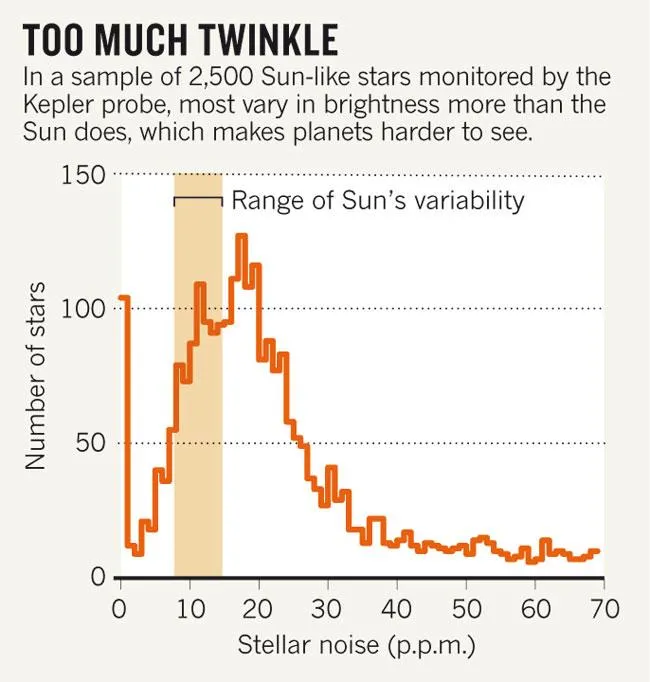
In a sample of 2,500 stars like our Sun monitored by the Kepler probe, most vary in brightness more than the Sun does, which makes planets more difficult to detect.
The Y axis contains the number of stars, the X axis the stellar "noise" (PPM).
The light band corresponds to the range of variability of our Sun.
Sunspots would be the culprits. They form when magnetic activity creates areas on a star's surface that are temporarily cooler and darker than the rest, affecting the star's overall brightness. The scientist suspects that such activity is greater among Sun-like stars in Kepler's field than in our own Sun, probably because those stars are younger. Those stars have "more energy," like we used to have in our adolescence. Throughout stellar life, stars fade, not in the sense of a planet's transit, but their life fades, their rotation speed, their magnetic activity. When they are younger, on the other hand, the magnetic fields have more vigor.
The researcher suggests that about half of the stars in Kepler's field are younger than our Sun, although theoretical predictions had estimated it would be two-thirds. If this were the case, "it would be a big surprise," the researcher indicated, with implications beyond the mission.
But, whatever the origin of the noise in Kepler's data, Gilliland says the mission would need to detect twice as many transits as planned, on average 6, per planet, to be sure that a drop in stellar luminosity is due to an object the size of our space home.
And that leads to the need for eight years to achieve the goal of finding twin Earths.
The process could be accelerated if planets with a diameter no less than 1.2 times that of our world were sought, but they would no longer be "twins".
HARPS ALSO SEARCHES FOR EXOPLANETS
Another major project underway is HARPS, an acronym that in Spanish means "High Accuracy Radial velocity Planet Searcher".
Recently, HD85512b was found with that survey, a planet very similar to ours: at 36 light-years away, it has a mass 3.6 times that of Earth (0.011 the mass of Jupiter), with a semi-major axis (distance to its star) of 0.26 Astronomical Units and an orbital period of 58 days.
And is that good?
The planet would be, compared to our solar system, a little farther from the Sun than Venus, so it would receive much more energy from the Sun than Earth, which is farther away.
For comparison, Earth is at 1 Astronomical Unit from the Sun.
However, Lisa Kaltenegger from the Harvard-Smithsonian Center for Astrophysics calculated that a cloud cover of at least 50% would reflect enough energy into space, preventing overheating.
The researcher will be part of a panel, along with Italian scientist Dr. Francesco Pepe (Geneva Observatory), on Monday, at an ESO press conference. "Significant" results from HARPS are expected. It is possible, perhaps, that they will announce that "the search is over". But nothing ends. It's science.
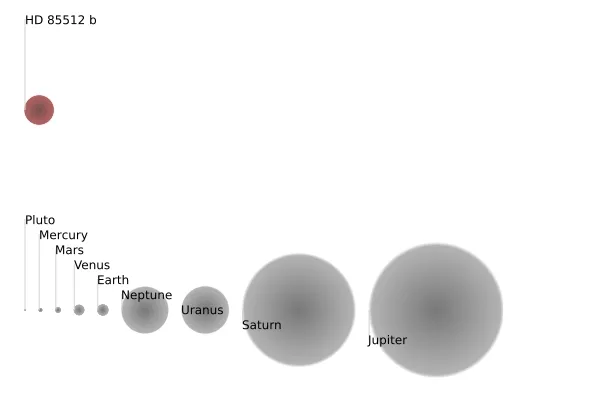
COMPARING WORLDS AND SYSTEMS
It is possible, for the curious, to search among the planets detected so far, the one that most resembles our world. We might not take into account all the necessary variables, but some important ones:
Mass: as it has been easier, until now, to find larger planets, the mass of an exoplanet is usually indicated in relation to the mass of Jupiter. Therefore, the value to look for is approximately 0.0032 Jupiter masses, a value close to Earth's mass (5.9736 x 1024 compared to the gas giant (1.9 x 1027).
The distance, as I said before, is the semi-major axis, which is equal to 1 AU in the case of Earth. What researchers call the "habitable zone" is, certainly, debatable, but if we are looking for something similar to home, we would have to find similar values: between 0.8 and 1.2, for example.
We could proceed with other parameters like the orbital period (the time the planet takes to revolve around its star) which in the case of our world is easily known (or is it?) and other more "technical" ones, like eccentricity and inclination.
To do that we could make use of online catalogs:
The Encyclopedia of Planets
The NASA/IPAC/NExScI database
Planet Quest
But I add a simpler and more illustrative source: The Visual Exoplanet Catalogue.
You will see there that the catalog (not necessarily complete) is shown as a table with columns. The "Selected fields" option allows you to change the fields to display, so as to show those we want, for example the ones cited above. With the update button the table view will be refreshed and it will then be easy, by clicking the little arrows in the first row, to sort the data in ascending/descending order.
We will notice that the smaller the world in mass, the closer it is to its star. While among the planets found so far, those whose distance is comparable to that of the Earth-Sun system are larger objects.
But we can also search for stellar systems that may resemble our Solar System. In the Multiplanetary Systems option we will find data on that.
By clicking, in any case, on a planet, we will get data on it and a graph below. If the planet is in the "habitable zone", it will appear in a green-colored region.
Let the curious reader search for the HD 20794 system. You will see that several planets were found there. Do they resemble the inner Solar System?
A SUMMER IN SEARCH OF THE GALACTIC TWIN
The galactic twin could well be a strange combination between the fantastic twins and the Galactic Hawks. Less comical was the work done by student Tim Buckman from Portsmouth Grammar School, who spent 6 weeks with Karen Masters, from the University of Portsmouth, looking for a twin of our galaxy.
Here we see an artistic illustration of what the Milky Way is like.
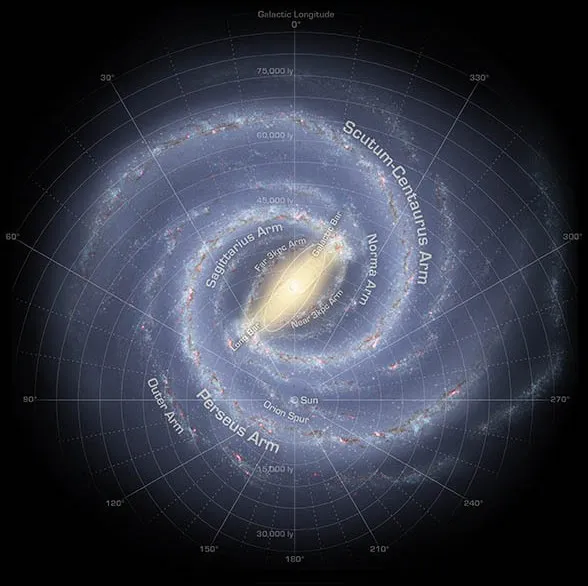
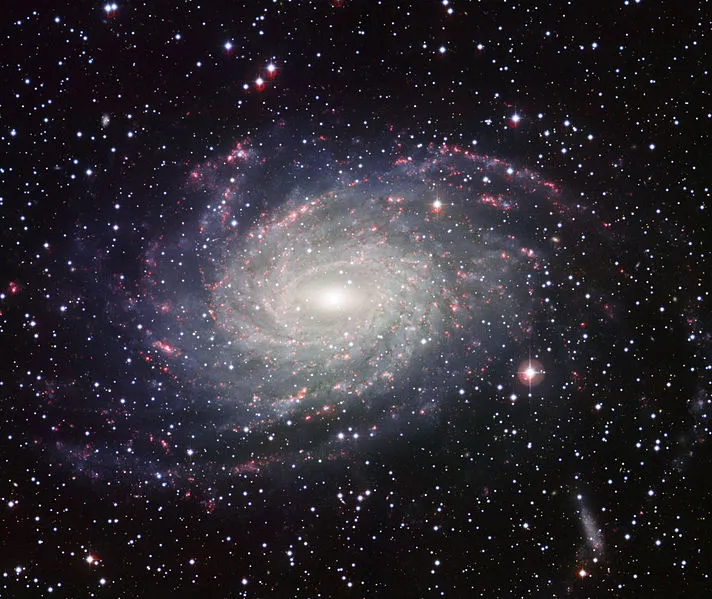
The Milky Way has its characteristics: it is a spiral galaxy with two to four spiral arms, a central bulge and a bar in the center. Recently the European Southern Observatory showed an image of what, according to them, would be a replica of our galaxy. NGC 6744 resembles it in the number of arms, the bulge and perhaps a small central bar. But there is a problem: it is twice the size and, logically, it is also not compatible in mass.
That is where the Galaxy Zoo Project could help. With almost 450,000 volunteers, it allows classifying galaxies from the Sloan Digital Sky Survey. By filtering among those that had characteristics, i.e., not elliptical (and were observed face-on and not edge-on), they arrived at 17,500 galaxies. Then, they filtered again by mass, number of arms, mass and a bar and found only 9 that fit the criterion.
The one that most resembles the previous illustration is shown below.
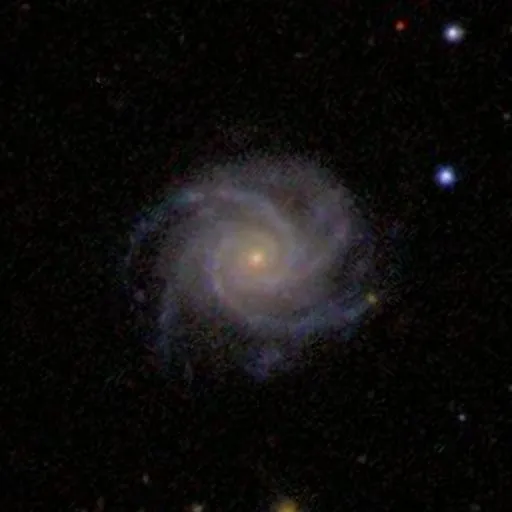
Does it look similar? It is difficult to visualize a central bar.
Ah, this beautiful collection of stars, gas and dust, perhaps hosts its stellar systems and its planets. Perhaps one like ours.
The galaxy has the very nice and easy-to-remember name of SDSS J084931.02+391234.9.
Is it known where it is located to search for it with a telescope?
Well, the name contains its coordinates, Right Ascension and Declination, in hexadecimal: 08:49:31.02,+39:12:34.99.
In the link we will see that the z value (corresponding to the cosmological redshift) is 0.041. Which would be equivalent to a comoving distance of 173 Mpc or 564 million light-years, according to the calculation by Wolfram Alpha. (You can also use the Ned Wright calculator)
The same object is part of the PGC catalog under the entry 24800.
We can also observe the galaxy on Wikisky.
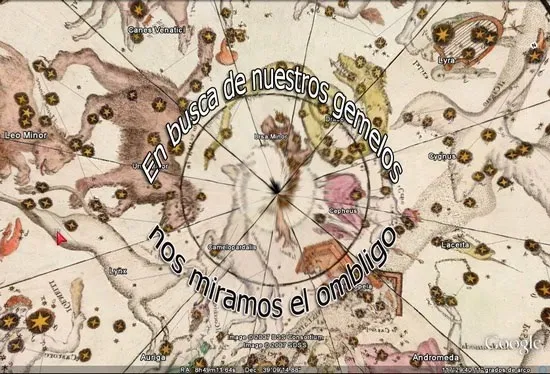
Fact: This galaxy is located in the constellation of Lynx. Those who know the sky and the boundaries of the 88 official constellations will know that very close by is the constellation of...Gemini, as can be seen in the first image of the post.
THE BLACK SWAN: WHAT ARE WE LOOKING FOR?
It is logical that we look for Earths similar to our own. We have only this single example of what we could call "Life." Therefore, if the characteristics of this world allowed for the emergence of life, it is possible that similar worlds are also a replica, at least potentially, in this other very significant sense: the evolution of species.
Nassim Nicholas Taleb, a former stock trader, published the work “The Black Swan: The Impact of the Highly Improbable” in which he addresses some problems related to our way of thinking and statistics.
Roughly: if we live in the Northern Hemisphere, we would think that all swans are white. Our experience, however, is misleading. In Australia there are black swans. It's a problem of induction. Today I see a white swan, here's another, there's another. I add up a large number of particular observations (all white swans) and conclude that probably all swans are white. As soon as I travel to the land of kangaroos, bam, I run headlong into reality.
In some measure, the idea overlaps with serendipity.
So, despite strict inductive logic, it is possible that in the search for extrasolar worlds we also encounter black swans. In fact, in the Swan there is something very dark.
COSMIC IRONIES
If we wanted to travel to these distant "twin" worlds, we would ironically face the Twin Paradox. More: these other worlds, systems and galaxies have been observed and detected with... well, with something like twins, Galileo's binoculars. And the strangest thing is that the idea of twin individuals stipulates the idea of beings born from the same egg.
Well, in some way it is possible that this is the case and everything that exists has a common origin, like the Big Bang. But the truth is that distant worlds and stellar systems, distant galaxies do not share with our neighborhood the same origin regarding molecular clouds.
What we are doing, in a way, is looking for ourselves. Not only do we not want to be the only ones, but we also wish to find true "pairs."
The day we find another world like ours, perhaps we will not be able to travel there, but maybe we can send them a message. If we asked them in which constellation they see us, perhaps they would answer: in the one of the navel.
Note written for the XXIII Carnival of Physics, in this edition hosted by Astrophysics and Physics. To join and read the entries there is a social network on Ning.
Sources and related links
- Nature: Jumpy stars slow hunt for other Earths
- Kepler Mission Stellar and Instrument Noise Properties
Ronald L. Gilliland et al.
arXiv:1107.5207v1 [astro-ph.SR] - NatGeo: New Planet May Be Among Most Earthlike—Weather Permitting
- The Black Swan by Nassim Nicholas Taleb
- Galaxy Zoo: A Summer Spent Finding Our Galactic Twin
About the images
- Fig. 1. Credit: R. L. Gilliland et al.
- Fig 2: Credit: Hanno Rein/exoplanet.hanno-rein.de
- Fig. 3: JPL/Robert Hurt. From Spitzer.
- Fig. 4: NGC 6744. Credit: ESO
- Fig. 5: SDSS J084931.02+391234.9. Credit: SDSS.
- Initial image: It is a screenshot of Google Earth-Sky, with the constellations illustrated. On the right you see the constellation Cygnus. On the left, Gemini and Lynx. The mouse pointer points to MCG+07-18-053, that is, PGC 024800. Credit: Google Earth.