The Tronador II rocket-launcher will be built in the Buenos Aires town of Punta Indio.
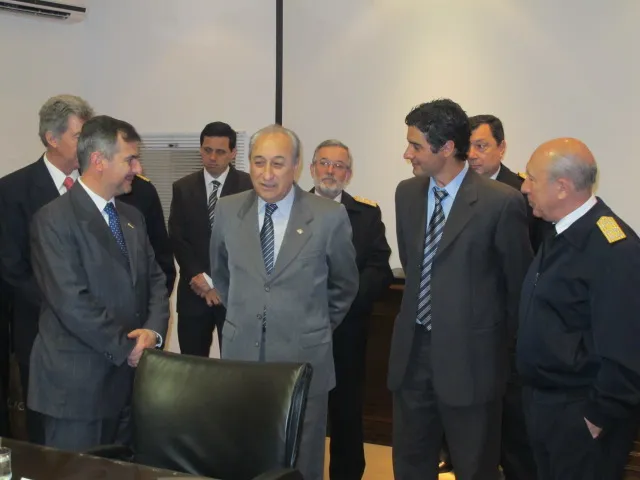
On Thursday, October 13, at the headquarters of the Ministry of Defense of the Nation, the head of that portfolio, Arturo Puricelli; the Chief of the Navy, Admiral Jorge Godoy; the Executive Director of the National Commission for Space Activities, Conrado Varotto; and the Dean of the Faculty of Engineering of the National University of La Plata, Marcos Actis; signed an agreement to build the Tronador II satellite-launching rocket in the Buenos Aires town of Punta Indio.
Also participating were the General Auditor of the Nation, Daniel Reposo, and the candidate for Mayor of Punta Indio for the Frente para la Victoria, Hernán Izurieta.
It will be the first time in history that Argentina will build a satellite-launching rocket, something that will put the country at the forefront of global space development since currently there are only six countries or international agencies with these capabilities: Ukraine – Russia, Japan, China, France – European Union, India and the U.S.
By mid-2012, professionals from the Department of Aeronautics of the Faculty of Engineering of the National University of La Plata will begin conducting the first tests on the initial prototypes of the Tronador II. The preliminary work will be carried out at the Punta Indio Air Base. The goal is for the definitive vehicle to be ready by 2013.
The platform for space launches will be located at the Puerto Belgrano military base in Bahía Blanca, as a substantial part of the National Space Plan announced by the Government.
What is going to be done in Punta Indio?
In the agreement signed yesterday, the Navy partially cedes the use of Hangar No. 7 of the Punta Indio Naval Air Base (BAPI), located in the city of Verónica, province of Buenos Aires.
Work will be done on all previous testing stages of the prototypes, until reaching the definitive Tronador II, a structure about 34 meters high (in other terms, as tall as a 10-story building) that will have the capacity to place satellites of "segmented architecture" into orbit.
The preliminary design of the Tronador II structure is already complete because the electronics and engines are being worked on separately. The role of the Punta Indio Base will therefore be decisive when the team approaches the final model, as the definitive parts will be assembled there, using the hangars.
The Tronador II is a vehicle capable of placing a 250-kilogram satellite into orbit at 600 kilometers altitude, in an orbit that goes from north to south so it can pass over Argentina twice a day.
http://www.youtube.com/watch?v=dyF3-LYt6xk
At the event, the Minister of Defense of the Nation, Arturo Puricelli, stated that "the country has great and high hopes for space development and considered it vital to advance in the capacity to access space through our own development."
He added that "in airspace control in 2025, those who do not have satellites to control and provide security for air navigation will have to request that service from the central countries... I harbor the secret hope that Argentina, Brazil and South America will be able to control their airspace with their own satellites that provide security for air traffic."
"The objective of this agreement is to provide from the Navy the possibility for CONAE to have a suitable location to develop the project for generating a satellite launcher," said Puricelli. And he added: "It is one more step for Argentina to have its own satellites and not have to request their services from other countries in the future."
For his part, the Executive Director of CONAE, Conrado Varotto, emphasized the "opportunity to be able to develop a launcher by taking advantage of pre-existing infrastructure and maintained that with the construction of the Tronador II the country is at the cutting edge and places itself beyond the frontier."
The head of the Navy, Admiral Jorge Godoy, highlighted "the participation of different institutions and actors in the development of the Tronador II, among them SIGEN and the Faculty of Engineering of the National University of La Plata."
Finally, the General Auditor of the Nation, Daniel Reposo, emphasized that "the joint work among all state agencies is restoring the pride of being part of a country that is more just and sovereign, in addition to guaranteeing better management of public policies."
Sources and related links
- S.Prensa: Defense granted a site to advance in the creation of a satellite launcher.
- Télam: "Argentina has great hopes for space development"
- Min.Def.: Puricelli Presided Over Signing Of Agreement Between The Navy and The National Commission For Space Activities.
About the images
- In the foreground of the image, from left to right: Daniel Reposo (General Auditor of the Nation), Arturo Puricelli (Minister of Defense), Hernán Izurieta (Mayor of Punta Indio) and Admiral Jorge Godoy (Chief of the Navy). Credit: SIGEN.