A collection of links to music, images and videos relating art and science. Today: The perfect Martian storm and The creeping nebula; Music: Plano Proyectivo; Video: women and astronomy.

Images of the decade
The perfect Martian storm
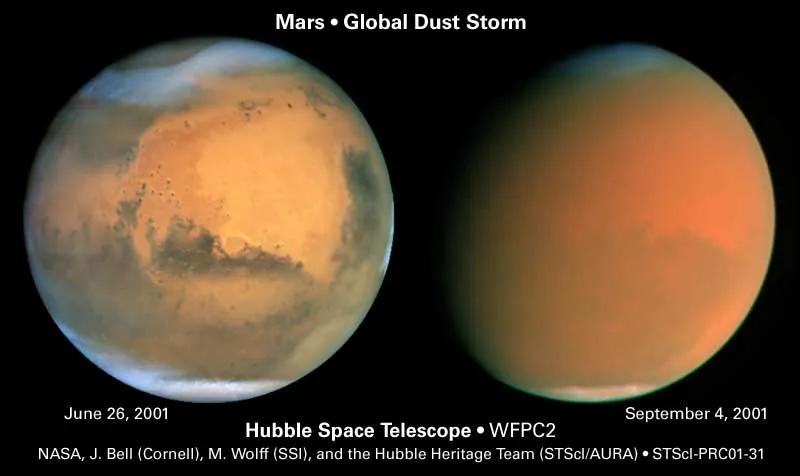
A great dust storm was detected by astronomers through the Mars Global Surveyor (MGS) and Hubble, a decade ago.
Scientists photographed the entire red planet daily with the MGS camera, which allowed them to determine the location of the dust and see how it migrated and interacted with other weather phenomena in the Martian atmosphere.
The images show the situation on Mars on June 26 and September 4, 2001. At that time, Mars at opposition, was 68 million kilometers from Earth.
The image was released on October 11, 2001 via HubbleSite.
Credit: NASA, James Bell (Cornell Univ.), Michael Wolff (Space Science Inst.), and The Hubble Heritage Team (STScI/AURA)
Images of the week
The creeping nebula
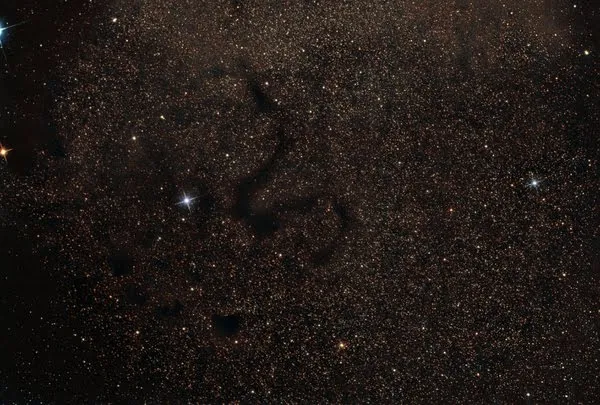
The Snake Nebula is entry 72 in Barnard's Catalogue of dark nebulae (B72, Snake Nebula)
It is located in Ophiuchus, the serpent-bearer and, curiously for the human mind, has a serpentine silhouette.
The image was taken by Omar Mangini (Nebula1) from Buenos Aires with his 150 F5 Newtonian Reflector + Modified Cooled Canon EOS 350D + CLS-CCD Clip filter for 2 hours 31 minutes (Subs between 90 and 180 seconds ISO 1600).
It was chosen as the Amateur Astronomical Picture of the Day (AAPOD) for October 11, 2011.
Credit: Omar Mangini.
Space Music
Today: Plano Proyectivo
This is a project by Orlando Moreira, who says he likes coffee, astronomy, poetry and music.
Many of his albums have references to astronomy and I will talk about him here on several occasions. For example, his trilogy Post cards of the universe contains tracks with star names.
Here I share the first album, but in successive occasions I will also recommend the others in that series and other equally good productions.
We can listen to Orlando's music on SoundCloud and also learn more on Tumblr.
Post cards of the Universe by planoprojetivo
If the reader is curious, they might try to answer the following:
Would it be possible to make a sky map showing all the stars from the tracks on this album? Do they have anything in common?
Well, if you use planetarium software, like Stellarium, you might find it difficult, right?
But you can make a galactic map. Now on that map it could be fun to see where the stars from the tracks on this album are. Will those stars form a "meta constellation" with some special shape? I leave it for your recreation. I had fun for a while.

Science in motion
Women and astronomy
Earlier we talked about "serpents" in the cosmos. They are, of course, silhouettes we imagine, not real. There are, however, those who firmly believe that a serpent tempted Eve to eat the forbidden fruit.
Women have had and have a leading role in astronomy, even in times when they were discriminated against much more than today. Despite those cultural barriers, they have contributed invaluable knowledge. Here, a lecture on the role of women in astronomy by Luz Ángela Cubides, an astronomer at the Florida Institute of Technology, as part of Ciencia en bicicleta from Parque Explora.
To access previous editions of this section, consult the Multimedia Selection Series.