On October 4, 1957, Sputnik 1 was launched and the Space Age began. What will be the future of space exploration? Perhaps we should first look at the past.
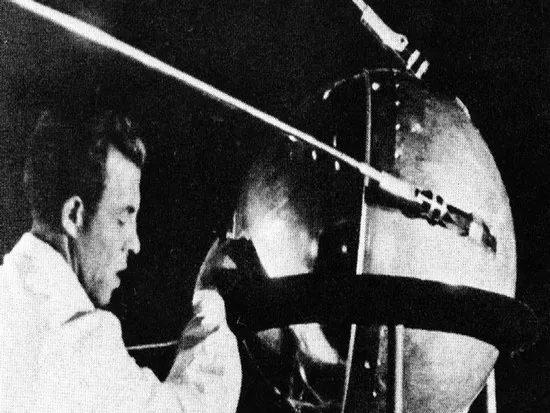
The image below is the one selected by NASA for its daily gallery.
The historic shot shows a technician putting the finishing touches on Sputnik 1, humanity's first artificial satellite. The pressurized aluminum sphere had five primary objectives: to test the method of placing a satellite into Earth orbit, to provide information on the density of the atmosphere, to test radio and optical methods for satellite tracking, to determine the effects of radio wave propagation through the atmosphere, and to test the pressurization principles used in satellites.
In virtue of this date, International Space Week is celebrated. Fifty-five countries are participating, among which are Argentina, Brazil, Colombia, Mexico, Uruguay, Venezuela.
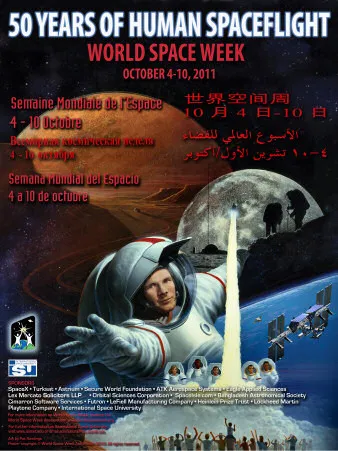
In the case of Argentina, the Achernar Association will hold two events in Mar del Plata, on October 8 and 9.
The calendar of all events can be consulted at WorldSpaceWeek.
The future of space exploration
A symposium held in Orlando, Florida, between September 30 and October 2, called 100 Year Starship (100YSS), covered a variety of topics related to the next century of space exploration.

Two of the main questions that might arise are Where to go? and How to get there?
The discussions from that weekend meeting, sponsored by DARPA (the Defense Advanced Research Projects Agency of the United States), took some steps to try to elucidate what it would take to launch a mission to another star system within a century.
It's not that they are about to build a ship, but rather "planting the seeds for an organization." Seeds that can bear scientific-technological fruits, as well as business models, that make possible that dream of creating a long-range space mission. This study began in the Northern Hemisphere autumn of last year and will end on November 11 of this year.
Technology
Whatever destination is chosen for a long journey, transportation will be needed. And covering enormous distances requires thinking about many things, among them: fuel needed to go and return (or at least to arrive) and a speed that enables the crew to arrive alive at its destination. They are not simple tasks if we think about distances to other star systems and speeds that humanity has achieved until now.
We don't have to start from scratch: The British Interplanetary Society has studied concepts for interstellar travel, as has the Tau Zero Foundation with its Project Icarus, which we talked about here previously.
They won't be the only problems to face, since the crew will have to survive while the journey lasts, their health must be adequate, food will be required, a breathable environment, communications.
In all these aspects, an interdisciplinary group of researchers from different branches of the sciences should intervene, but undoubtedly physicists will step firmly.
Beyond the recent claim of hyper-velocity neutrinos, it seems difficult to even travel at 20% of the speed of light (c). In fact, Project Icarus aims to design a ship that reaches 15% of that theoretical limit established in Special Relativity.
It's not little. But, at that rate, the farthest Icarus could reach in a century would be...
Let's do the math:
1 light-year (ly)= 0.946*10^13 km (9,460,000,000,000 km)
and 15% of c= 300,000*0.15 =>45,000 km/s
In a century it will be:
45,000 multiplied by 60 (seconds)*60(minutes)*24(hours)*365(years)*100(century)
That is: 45000*60*60*24*365*100=1.42*10^14 (1,419,120,000,000 km)
By rule of three:
If 9,460,000,000,000 km is 1 light-year and I travel for 1,419,120,000,000 km, how many light-years will that be?
...about 15 light-years of distance.
Destination
If that were an achievable limit, where to go?
In principle we could think of reaching a star system that has known planets.
If we trusted the accuracy of the information provided by the List of nearest stars on Wikipedia we would find 38 star systems. Since many are binary or multiple systems, the total number of available stars climbs to almost 60. But not all of them have planets, as far as we know. It's possible they do and haven't been detected, of course.
A candidate system could be Epsilon Eridani, at 10.5 light-years away. It is a star similar to ours, though less luminous. And in 2000 a planet was discovered around it, Epsilon Eridani b, a giant 1.2 times the mass of Jupiter and farther from its star than Earth is from the Sun (three times the distance).
What are the atmospheres of those planets like and the physics of the host stars? How to travel, how to survive, how to achieve high speeds in achievable times?
These are questions that the sciences will have to answer as they have done until now and as they have never done before. And, I repeat, physics will be one of the main protagonists when it comes to discussions and innovative proposals.
Look at the past to avoid repeating it
In 8 days we will commemorate (I avoid the verb "celebrate") what is called here "Day of the Race," the discovery of America.
Columbus and company can perfectly be considered "explorers of new worlds." But here, on this side of the Atlantic, we who inhabit this "New World" know very well that behind possible endeavors of discovery there were also commercial ends and abhorrent methods that our native peoples have paid for with their lives. Apart from the fact that even today their descendants continue to suffer society's ignorance of their demands.
If science is to discover and the latter is to conquer and finally that leads to slaughter, then, through nuances of synonymy, science is bathed in blood.
We cannot look to the future without first looking at the past. Without considering the rights of citizens and even more, of living beings, be they humans, animals, plants, extrasolar planets.
Just as I am a firm defender of the search for scientific knowledge, I also have strong convictions regarding the moral attitude of the researcher and of society as a whole.
May in these hundred years that lie ahead there be science, physics, to be able to travel ever faster. To discover other worlds. Which will be new to us, but not therefore younger. Just as the American Continent is not more recent than Europe.
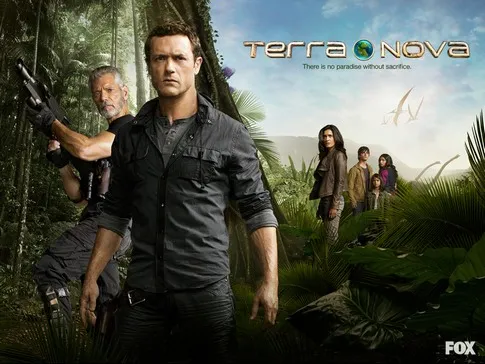
Almost like in the series that premiered yesterday in Argentina, in which Terra Nova is nothing more than the same Earth in another time, the New Worlds should be treated as we would want to be treated ourselves, even if they are farther away.
Is it possible?
Note written for the XXIV Carnival of Physics, in this edition hosted by this blog. To join and read the entries there is a social network on Ning.
Activities of COCAdE
The Comisión Casildense del Espacio carries out permanent outreach activities on astronomy and related sciences. They inform us that the Institution has received, as a legacy, a collection of thematic postage stamps dedicated to astronomy and astrophysics. They will be sorted, classified, and prepared for subsequent public exhibition at a location to be designated.
Also announced is the presentation in that city of important visitors of great international scientific level for next Tuesday, October 11, they are: Dr. Conrado Varotto, Executive and Technical Director of the Comisión Nacional de Actividades Espaciales, CONAE; Eng. Fernando Hisas, responsible for SIASGE, Sistema Italo – Argentino de Satélites para beneficio de la Sociedad, Gestión de Emergencia, Desarrollo Económico; Lic. Alberto Ridner, Manager of Technological Management and Lucía Kocar responsible for the Programa 2Mp.
They will be presented at 18 hours at the Teatro Dante Alighieri.
The topic: Plan Nacional Espacial, this activity has the sponsorship of the Secretaría de Cultura y Educación of the Municipalidad de Casilda.-
Furthermore, other activities are being organized, among them and together with Esc. Nº 3100 Michelangelo Buonaroti, a Café Científico for October 21, from 19 hours at the Del Pueblo Café, in which Dr. in Geological Sciences Ernesto Brunetto will be presented, who will develop the topic: “Terremotos”.-
Next October 29, the “Segundo Star Party Ciudad de Casilda – 90 Aniversario de La Voz del Pueblo” will take place from 19 hours, at the sports grounds of the Agrupación Aeromodelista Casilda, Bv. Argentino 2 Km from Ruta Nacional Nº 33 in a southeast direction. It will begin with a talk about the Sun, by Astronomy Amateur Hugo Missio, from the staff of the Observatorio Astronómico Municipal de Rosario.-
On November 20, the Jornadas Galileanas 2011 will begin, with the presence of members of the CODE and the LIADA from the city of Santa Fe, starting activities at 19 hours, at the Plaza de los Mástiles.-
Also, outreach members of COCAdE were for the fourth time in the town of Arequito and for the second time at the Parroquia Nuestra. Sra. del Rosario, invited by the Sr. Párroco, to develop various astronomy topics and observations.-
On October 04, a delegation from the Institution also traveled to the town of Cruz Alta in Córdoba, where astronomy topics were presented and observations were carried out, at the Colegio Santa Juana de Arco.-
Next December 05, the summer film cycle will begin at the Plaza de los mástiles. We remind you that all these events are free of charge.
In due time we will provide information about other activities being planned.
From here, a strong greeting to the people of COCAdE, whose efforts are carried out all year round and not only during World Space Week. Congratulations!
Hello Frank
Frank Caldeiro (12-6-1958 /3-10-2009), our remembrance two years after your passing. Farewell.
Sources and related links
- Space.com: Astronomers Debate Where 1st Interstellar Starship Should Visit
- The 100-Year Starship: US Agencies Ponder Interstellar Travel
- THE 100 YEAR PLAN FOR SPACE TRAVEL
About the images
- Sputnik 1 photo. Credit: NASA/Asif A. Siddiqi
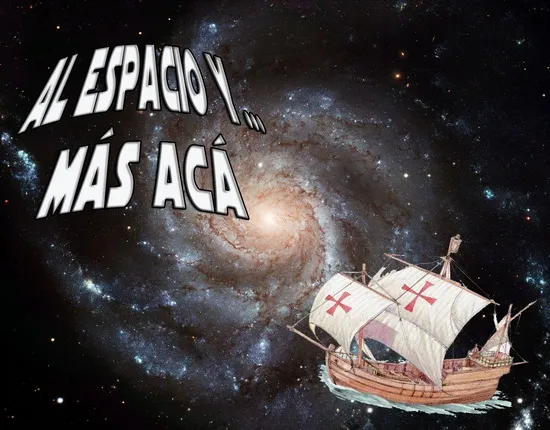
- Combination of images from: Ship drawing from Marineinsight.com and M101 by Hubble, Credit: NASA, ESA, K. Kuntz (JHU), F. Bresolin (University of Hawaii), J. Trauger (Jet Propulsion Lab), J. Mould (NOAO), Y.-H. Chu (University of Illinois, Urbana), and STScI
- World Space Week logo. Credit: WorldSpaceWeek
- Terra Nova image. Credit: Fox.