A collection of links to music, images and videos relating art and science. Today: Images of Sedna, Quasars and mirage, Rosette Nebula, Messier 9. Music by Red Dwarf. Video of animated Cantinflas about Einstein.

Images of the decade
The most distant object in the Solar System
Although in this section I usually indicate images published almost a decade ago, in this case I will make an exception, since the image was released on March 15, 2004 on Spitzer (almost 8 years ago).
On November 14, 2003 Dr. Mike Brown along with other researchers detected the object they called Sedna after the Inuit goddess of the sea. A few months later NASA announced the discovery of the most remote object in the Solar System.
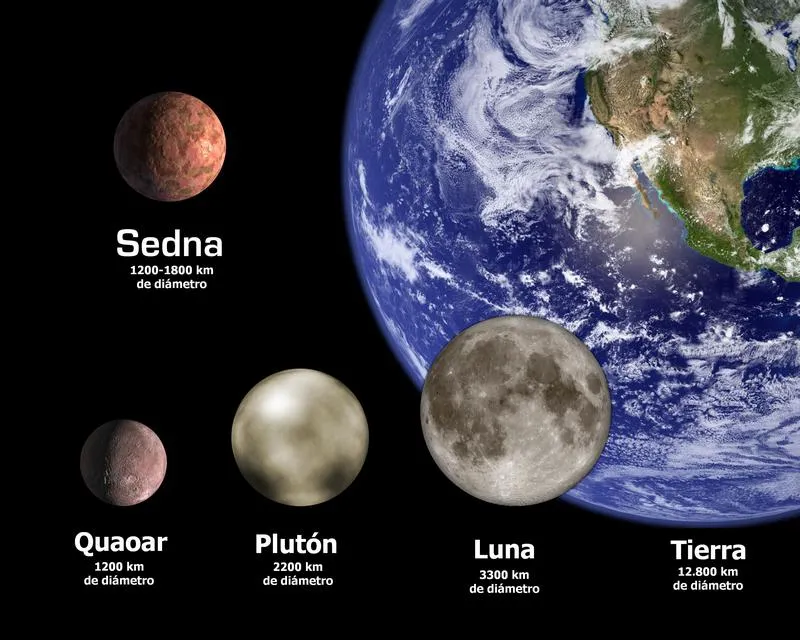
This discovery was one of those that put the definition of "Planet" under discussion, which a couple of years later the IAU would modify. Sedna is thought to be an inner object of the so-called "Oort Cloud". Its diameter is estimated between 1200 and 1800 km, while Pluto has a diameter of about 2400 km (approximate).
The initial image is a comparison of the diameter of some Solar System objects, based on the illustration by NASA/JPL with labels in Spanish (approximate values).
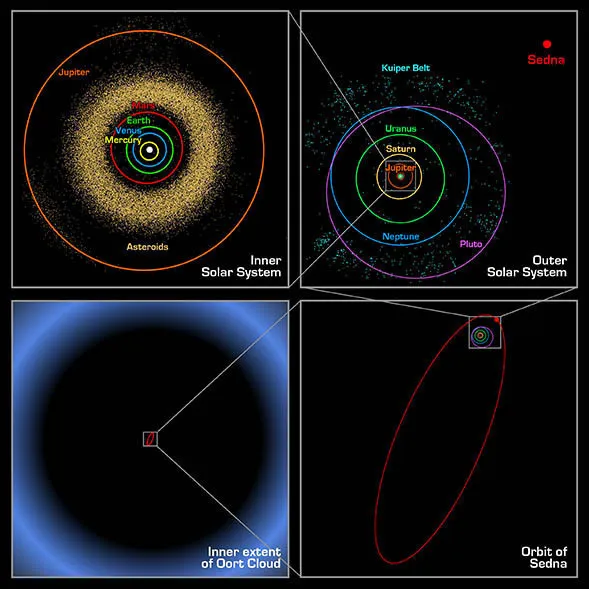
The second image shows four illustrations: the inner solar system, the outer solar system, the inner Oort cloud, and the orbit of Sedna.
Credit: NASA/JPL.
Quasars and mirage
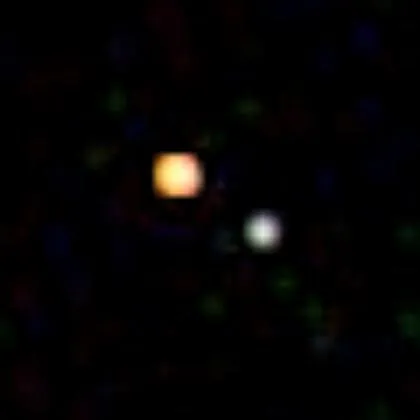
This Chandra image of twin quasars Q2345+007 A and B shows that they are not identical and that they could have been created from the merger of galaxies.
When galaxies collide, the flow of gas into the supermassive black holes of each galaxy is greater, which could result in a pair of quasars. The light from this pair began its journey to Earth 11 billion years ago!
Detecting that this duo is such was important because often when encountering the possible detection of two objects, astronomers know that it could well be an optical illusion. The image of a single quasar can appear double because its light, while traveling to Earth, was bent by some massive object like a galaxy, producing a gravitational lens.
That's what was thought to be happening with Q2345+007 A, B. It was thought to be a single quasar and that it looked double due to that optical illusion. However, no massive object that could act as a lens was found. So speculation arose about the possibility of a "dark cluster", invisible to optical telescopes. That's why Chandra and its power in X-rays were used. The NASA Observatory did not detect any "dark" cluster, but it did show that the light spectra of both objects were very different, supporting the idea that, in reality, they were two objects and not just a mirage.
Image credit: NASA/SAO/CXC/P.Green et al.
Released on Chandra on March 13, 2002.
Images of the week
A rose in the sky
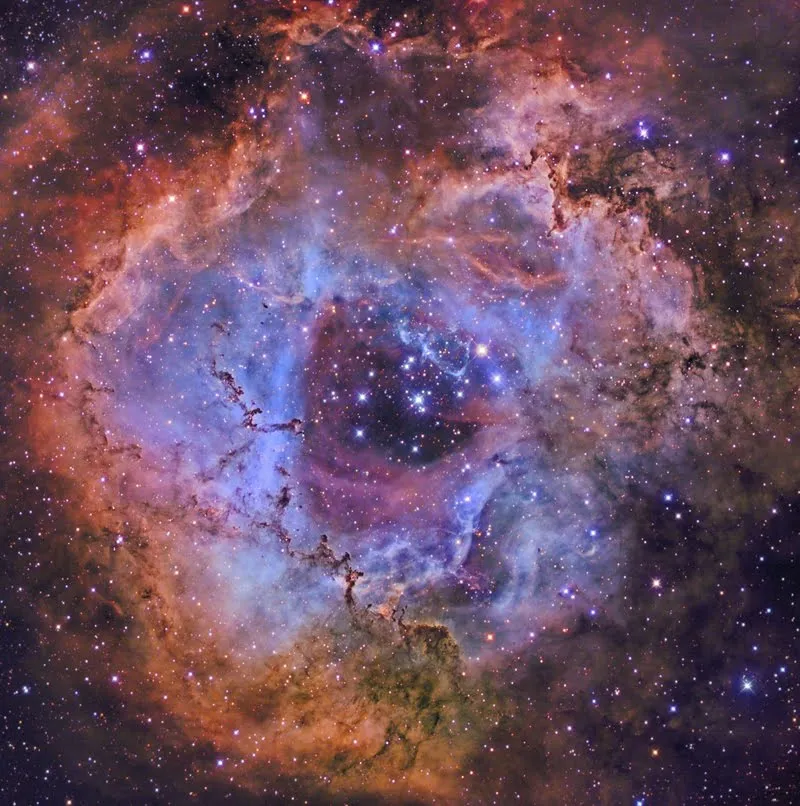
This formidable image of the Rosette Nebula was taken by astrophotographer Michael Sidonio (Strongmike) from Newcastle, Australia on 2-1-2012 with a pair of filters from a polluted sky with an Orion Optics AG12 (a 300mm Newtonian on the primary and 1140mm focal length. You can see on Strongmike's page some photos of the magnificent equipment.
It was the Amateur Astronomical Picture of the Day (AAPOD) March 15, 2012.
The jewels of Messier 9
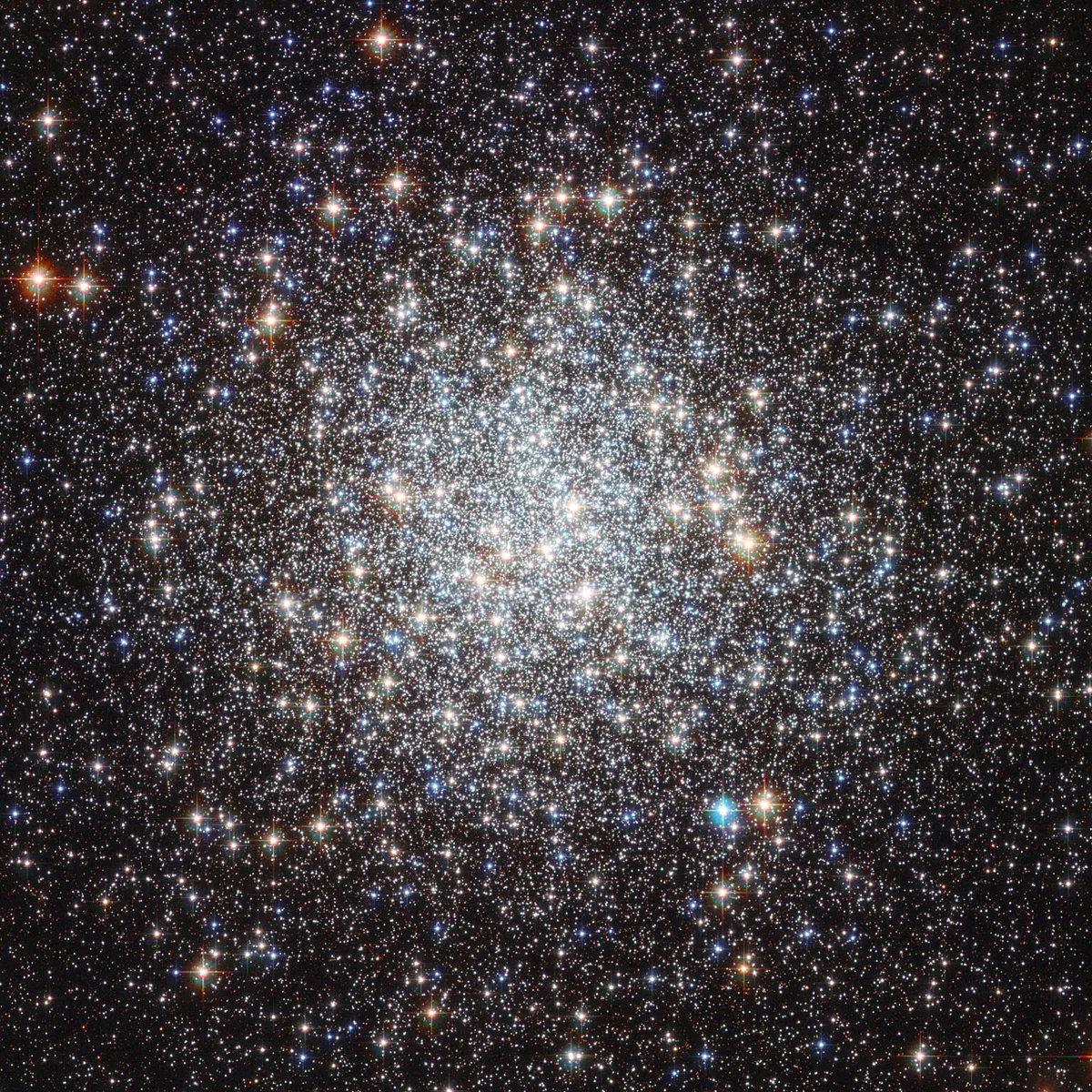
Hubble took the most detailed image of the globular cluster Messier 9, close to the center of the Galaxy, about 25,000 light-years from Earth. Hubble managed to individualize about 250,000 stars in the crowded center of the cluster and show us their different colors.
Released on SpaceTelescope and HubbleSite on March 16, 2012.
Credit: NASA & ESA
Space Music
Sedna by Red Dwarf
Red Dwarf is the artistic name of the Spaniard (from Vigo) Pablo Castro Fernández who last year published on Jamendo his album You're not, but the Sun is (also available on ReverbNation) which contains in its eight tracks songs with names of Solar System objects. The last track is Sedna, which I share here with you:
Animated science
Einstein in Cantinflas Animado
Albert Einstein was born on March 14 (of 1879). I didn't want to let the date pass without an audiovisual, didactic and even artistic reminder.
I propose three approaches to the great German physicist. First, this video of "Cantinflas Animado" about Einstein:
http://youtu.be/zG5mFGviHVI
Secondly, the Prayer of Einstein, by the Colombian William Ospina in the voice of María García Esperón, from her blog, La Luna del Dragón.
To a part of the youth, especially the girls, they might like this song by Kelly Clarkson titled "Einstein" (Dumb + Dumb = You) which is part of her work Stronger. On DirecLyrics you can find the lyrics (in English) and the video.
To access previous editions of this section, consult the Multimedia Selection Series. The series attempts to show that the immensity of the universe can be perceived in different ways. I choose some of the images from a decade ago -so they don't fall into oblivion- and from the current week that ends, as well as sounds/music and videos that are artistic forms of expression with content related to astronomy and related sciences.