A collection of links to music, images and videos that relate art and science. Today: Images of Three quasars seen by Chandra; The monster of IC 1396; Hubble observes a "Flying Saucer"; IC 1795 from Spain. Music by Newton Rocks, from Chile. And a video by Trevor Corrigan: "Moon Unit: Zappa".

Images of the decade
Chandra finds black holes
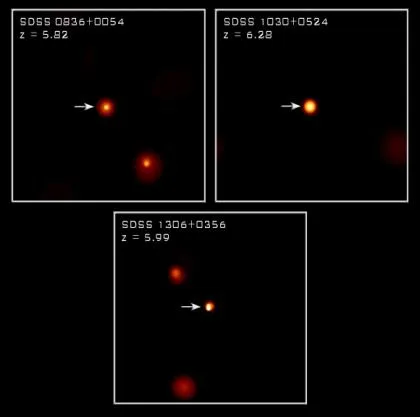
The Chandra X-ray Observatory observed the three most distant quasars and found that they are prodigious producers of X-rays. This indicates that the supermassive black holes that generate them are there when the universe was one billion years old.
The three quasars were discovered at optical wavelengths by the SSDS and lie 13 billion light-years away from Earth.
The research team led by Niel Brandt (Penn State University) made the observations on January 29, 2002 and made them public. The idea was to compare those three quasars with older ones and they concluded they were similar. Another team reached similar conclusions, which could well be synthesized as "the most notable thing about these quasars might be that they are not notable", according to the words of Smita Mathur (Ohio State University) leader of the other team.
However, another group led by Jill Bechtold (Arizona) compared the quasars with a broader sample and concluded that the younger ones radiated a lower percentage of energy in X-rays. The quasars referred to in these studies were SDSS 1306+0356, SDSS 0836+0054 and SDSS 1030+0524 (with 528 of March 2002.
Credits: NASA/CXC/PSU/N.Brandt et al.
The monster of IC 1396
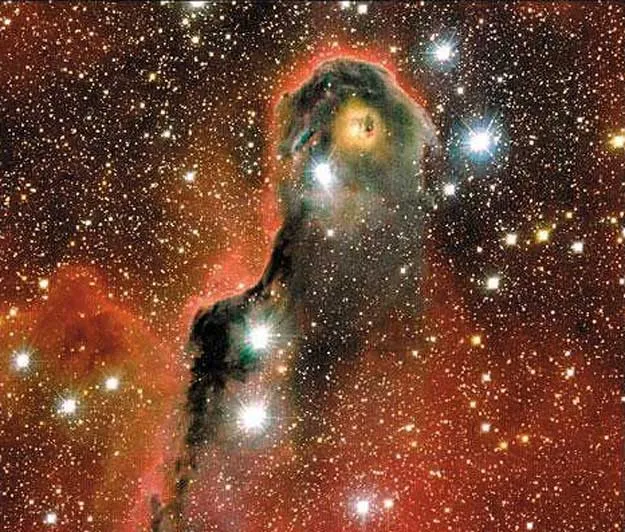
It is known as the Elephant's Trunk Nebula. It is a region of gas and dust where stars are forming. There, almost 3,000 light-years away, lies a system (type O) called HD 206267, as well as HD 239710, a blue variable that illuminates the "trunk".
The energetic light from these stars is "devouring" the dust of the dark cometary globule at the top of the image. IC 1396 is such a rich and extensive region that this image does not allow for an idea of its whole, so I invite the reader to look at other photographs of the area like this one from Nightsky.at.
Credits & Copyright: Jean-Charles Cuillyre (CFHT), Hawaiian Starlight, CHFT.
It was NASA's Astronomy Picture of the Day (APOD) of March 25, 2002. Also in Observatory.
Images of the week
Hubble sees a flying saucer
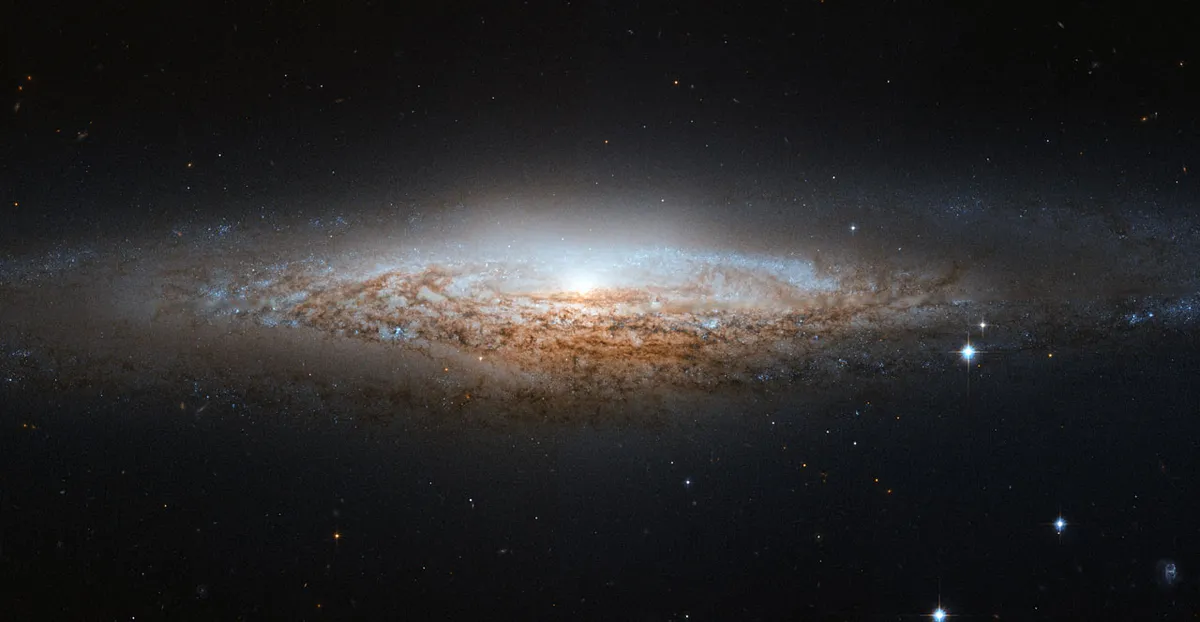
NGC 2693 is also known as the UFO Galaxy because of the way we perceive it from Earth. It is an almost edge-on spiral 25 million light-years away towards Lynx.
It was the Hubble Space Telescope Image of the Week.
Credits: ESA/NASA Hubble.
IC 1795
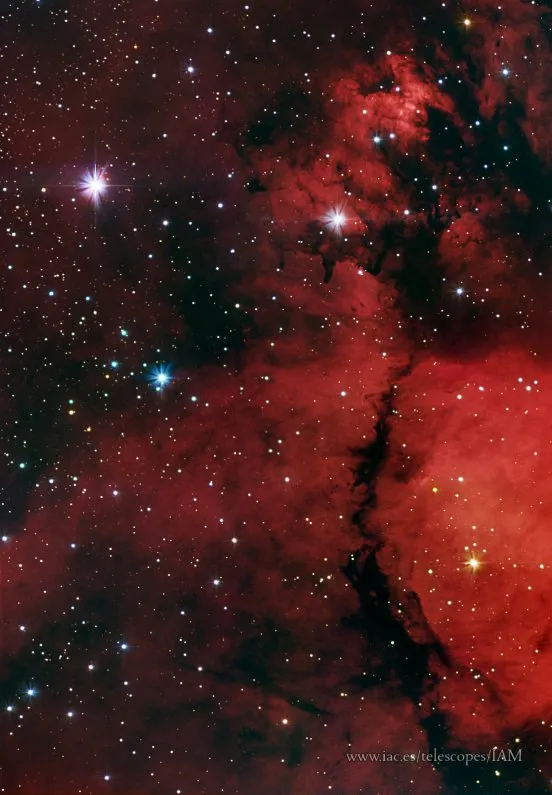
IC 1795 is a huge HII region composed of clouds of gas and dust where new stars are forming. The OB association of young stars within IC 1795 ionizes the HII regions of this gigantic molecular cloud complex known as W3.
The image was taken from the Teide Observatory by Pablo Rodríguez-Gil and Pablo Bonet. It is the Image of the Month of the IAC, a site where there is more data on this beautiful photographic record.

Space Music
Julio QuiRock@Quasar
Julio QuiRock is the author of Newton Rocks. On his blog he tells us that he is Chilean, born in 1984, a computer engineer, interested in "nerdy" topics and his debut work as a musician is Quasar, "an album full of what I am", he points out.
The work can be downloaded in full from Newton Rocks, and it is also possible to listen to and download the 10 tracks that compose it from SoundCloud.
The first track on the album is "int main(){", computer programming syntax that alludes to an introduction that, in this case, refers to Raymond Kurzweil and more specifically to the computer scientist's participation in "I've got a secret".
The fourth track refers to a number, as any "nerd" will quickly see and know what calculation to do. The number alludes to an emoticon.
The album features collaborations from the Chilean singer-songwriters Deplasticoverde, Dadalu and Fakuta.
Animated Science
Moon Unit: Zappa
This short film titled "Moon Unit: Zappa" is a production by Trevor Corrigan in which an object, reminiscent of Kubrick's "2001", was used as the protagonist, as well as footage from NASA.
To access previous editions of this section, consult the Multimedia Selection Series. The series attempts to show that the immensity of the universe can be perceived in different ways. I choose some images from a decade ago -so they don't fall into oblivion- and from the current week that ends, as well as sounds/music and videos that are artistic forms of expression with content related to astronomy and related sciences.