A collection of links to music, images and videos that relate art and science. Today: Images of LL Orionis, southern skies, NGC 1483; M35-NGC 2158. Music: RamRom-Mirar al cielo. Video: The art of Ana Kozel.

Images of the decade
A bow in Orion
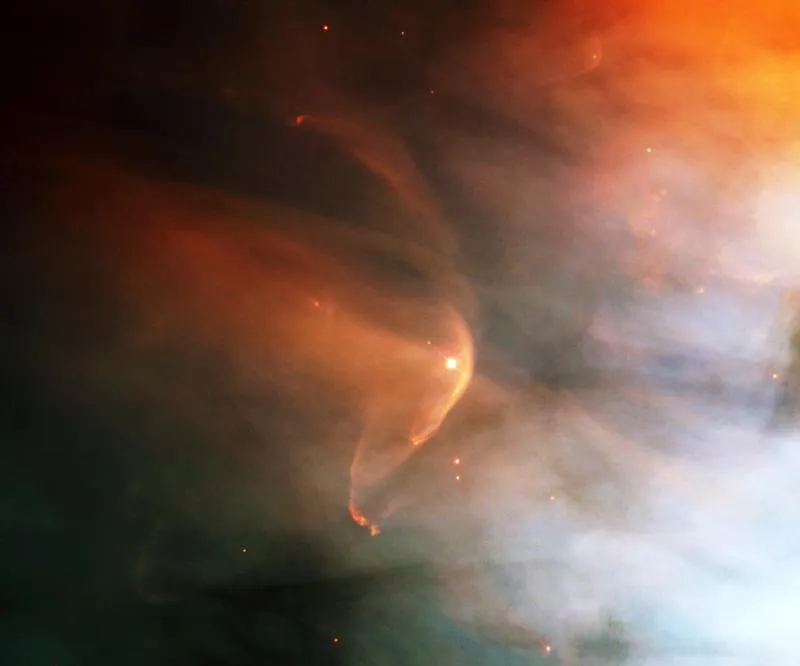
With the Hubble Space Telescope, astronomers can find cosmic treasures like the one residing in the nearby and intense star-forming region known as the Great Nebula in Orion. One of the jewels is the bow shock around the very young star LL Orionis.
The arc-shaped structure perceived in the image is a bow shock, so called because it resembles the crescent-shaped wave that forms when a boat moves through water. In space this occurs when two streams of gas collide. In this case the star LL Ori emits strong solar winds -which is a stream of charged particles at high speed. That material collides with the slower-moving gas from the center of the Nebula (bottom right), where the Trapezium is located.
LL Orionis is a T-Tauri star located 1,500 light-years away.
Credit: NASA and The Hubble Heritage Team (STScI/AURA) - C. R. O'Dell (Vanderbilt University)
The image was recorded in 1995 and was released on HubbleSite on March 6, 2002.
A glimpse of the southern sky
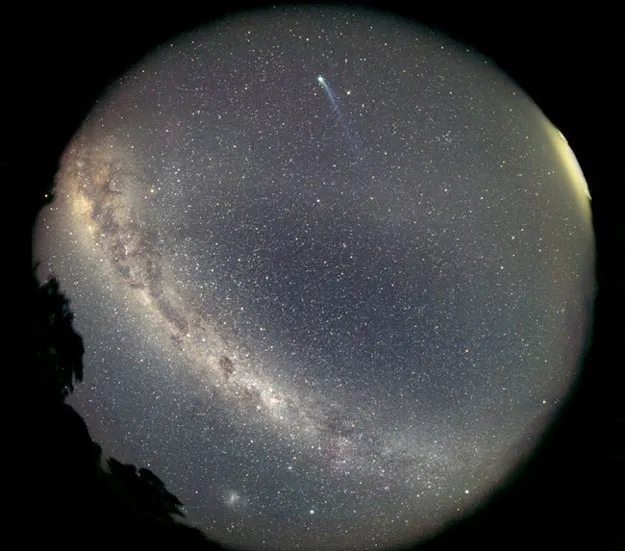
On March 22, 1996, a Galaxy and a comet shared the southern sky.
They were captured together, from horizon to horizon, on the night of Loomberah, New South Wales, Australia by astronomer Gordon Garradd.
Garradd used a homemade camera with a fisheye lens, resulting in a circular photo with a 200-degree field of view.
Along with the bright stars of our Galaxy, the Large Magellanic Cloud can be distinguished, bottom left.
The tail of comet Hyakutake is also visible, which can be seen at the top of the image, near the bright star Arcturus.
The bright lights of the nearby city of Tamworth are distinguishable near the northwest horizon (right in the image).
Credit and Copyright: Gordon Garradd.
It was NASA's Astronomy Picture of the Day (APOD) for February 10, 2002. Also on Observatorio.
Images of the week
Hubble finds El Dorado
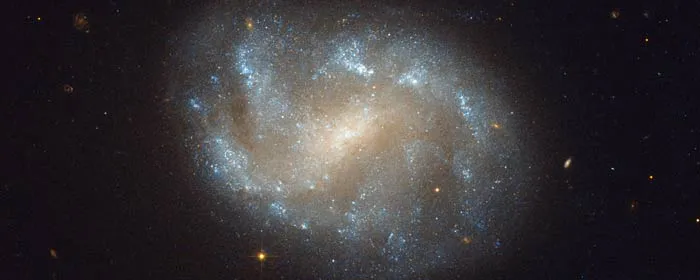
This Hubble image is of the galaxy NGC 1483, a barred spiral in the constellation Dorado, the dolphin.
In this constellation lie the galaxies of the Dorado Group, which comprises about 70 galaxies about 62 million light-years away. It is a much larger group than our Local Group.
NGC 1483, also cataloged as ESO 201-7, is located about 15 Mpc (about 50 million light-years) away.
It was the Hubble Space Telescope Image of the Week.
The sky in blue and gold
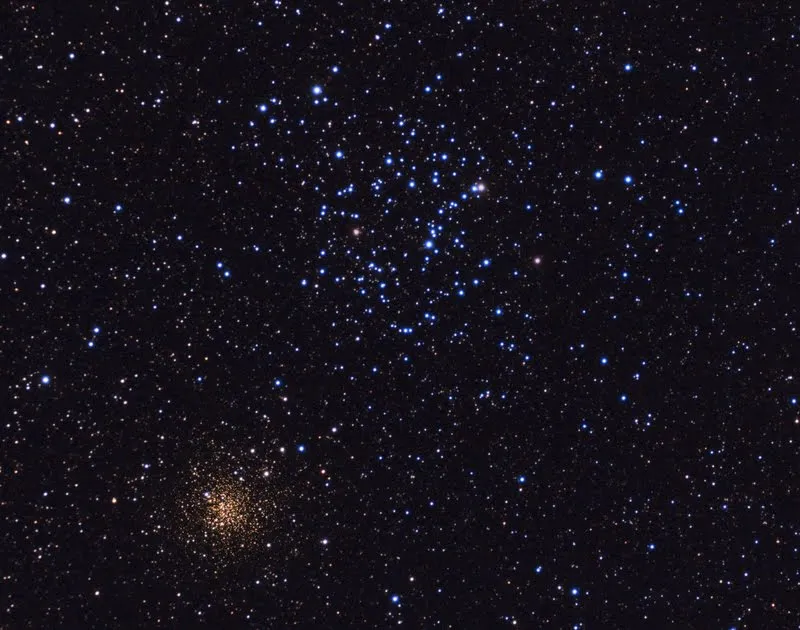
This fabulous image of the clusters M35 and NGC 2158 was taken from Almería, Spain.
Both are open clusters in Gemini. The first at about 2,800 light-years is a bluish and diffuse cluster; while the second at 16,000 light-years from Earth and almost 10 times older than the former is very compact, so much so that it looks like a globular cluster.
The image was obtained with a Meade apo series 5000 127/952 and ccd by Juanjo Muñoz Padua from Senes on November 26, 2011 and was the Amateur Astronomy Picture of the Day (AAPOD) March 10, 2012.
It can be compared with another image -appeared in APOD- with a professional telescope, the CFHT.
Space Music
RamRom: Mirar al cielo
RamRom is Ramón Romeu, his solo project. It's a shorter name and has a direct relationship with his other passion, computing. It's probably not very artistic, sounds weird and isn't very commercial, which doesn't worry him at all.
RamRom composes the music and lyrics of all his songs alone without help from any other musician. He also records, mixes and produces himself in his EsCaPe (Small Home Studio)
As he says on his website, RamRom is a singer-songwriter who wants to sound like a band...but without a band.
In 2009 he released his work Mirar al cielo. The eponymous track is the one I share here today. The lyrics of the song can be read on RamRom's blog.
Space art
There are several artists in the world who dedicate themselves to drawing and painting cosmic/astronomical motifs. Some more "realistic", others more "abstract".
In Argentina, Ana Kozel is a reference artist in the so-called "spatialism".
To access previous editions of this section, consult the Multimedia Selection Series. The series attempts to show that the immensity of the universe can be perceived in different ways. I choose some of the images from a decade ago -so they don't fall into oblivion- and from the current week that ends, as well as sounds/music and videos that are artistic forms of expression and with content related to astronomy and related sciences.