A collection of links to music, images, and videos that relate art and science. Today: Images of M31 and Ikeya-Zhang; the Snake Nebula; The Pleiades; and M70. Music by Dzibaob. Video: Dreaming the universe.

Images of the decade
The galaxy and the comet
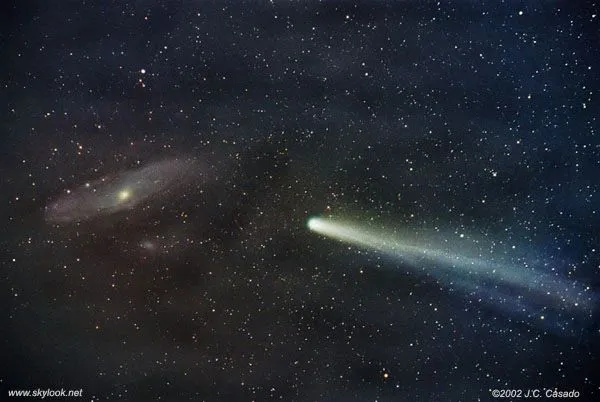
From a location above 1100 meters (Eastern Pyrenees near Figueras, Spain), astrophotographer Juan Carlos Casado used a guided exposure and telephoto lens to capture the conjunction of the bright comet Ikeya-Zhang (right) and the Andromeda Galaxy (left).
This celestial scene would have been a great visual reward for the famous 18th-century comet hunter Charles Messier.
While Messier searched for comets in the French skies, he carefully cataloged the positions of objects that were fuzzy or resembled comets, taking note of those that did not move relative to the stellar background (thus deducing they were not comets).
The Andromeda Galaxy, also known as M31, is the thirty-first object in this famous catalog.
Object number 110, a later addition to the Messier catalog, is a faint, diffuse satellite of Andromeda and can be seen just below M31.
Our present-day knowledge allows us to see the Andromeda Galaxy as a large spiral galaxy about 2 million light-years away.
The photogenic comet Ikeya-Zhang, recorded next to M31 on April 5, 2002, was NASA's Astronomy Picture of the Day (APOD) for April 12, 2002. Also on Observatorio.
Credits & Copyright: Juan Carlos Casado
The Snake Nebula
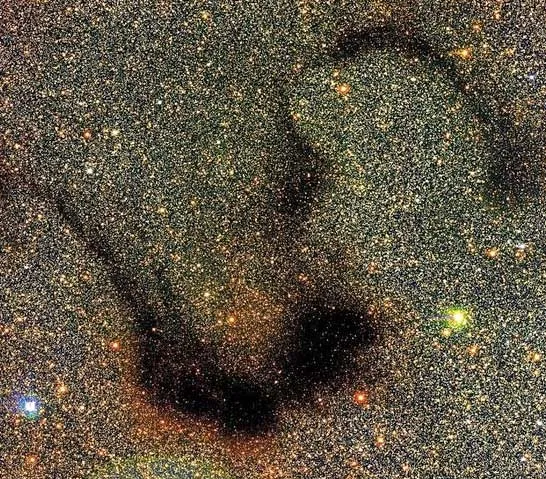
The dark lines visible in this photo, part of the constellation Ophiuchus, belong to the Snake Nebula.
Also known as Barnard 72, the Snake Nebula is a series of dark absorption clouds composed of molecular gas and interstellar dust.
Interstellar dust – predominantly composed of carbon – absorbs light from visible stars and re-radiates much of it in the infrared.
This absorption causes the stars behind the clouds to appear dark, or in other words, gives the sky the appearance of missing stars.
Molecular clouds like the Snake Nebula are places where new stars form.
This nebula lies only about 650 light-years away and spans an angular width in the sky equivalent to a full moon.
By the way, don't you see a resemblance in that silhouette to Alfred Hitchcock?
It was NASA's Astronomy Picture of the Day (APOD) for April 9, 2002. And on Observatorio.
Credits & Copyright: Jean-Charles Cuillyre (CFHT), Hawaiian Starlight, CFHT
Images of the week
In the gas and dust of the Seven Kids
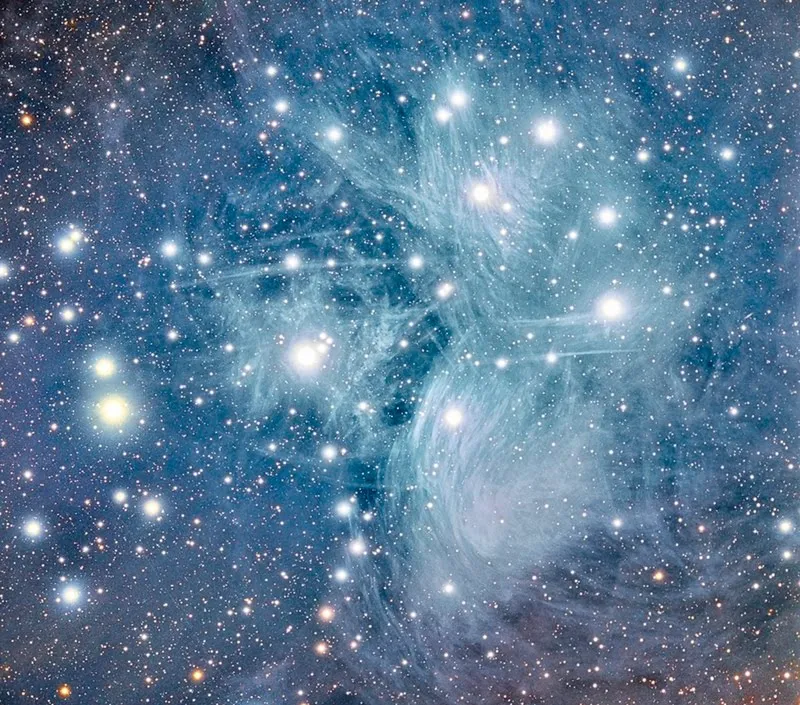
M45 is the famous open cluster of The Pleiades or Seven Kids and is one of the most beautiful and easy-to-observe regions in the sky.
This beautiful photographic record was obtained by Marco Bastoni from the town of Cozzano, Italy, with his FSQ-106 Q + CCD Atik 4000LE.
It was the Amateur Astronomy Picture of the Day (AAPOD) for April 10, 2012.
Tight and bright
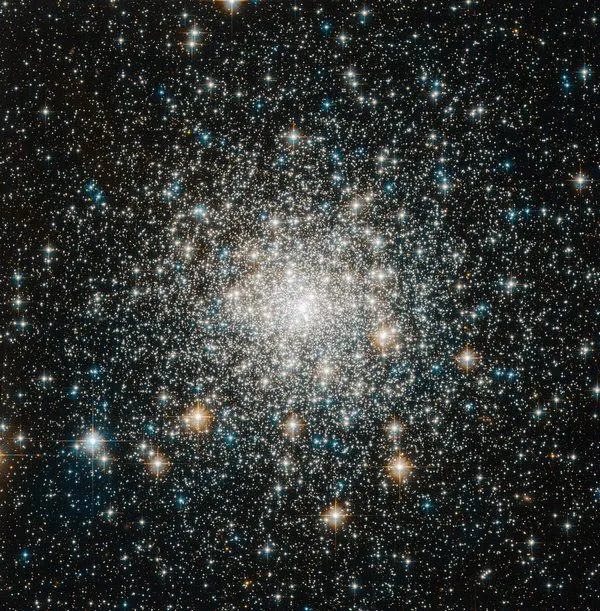
In this image, the Hubble Space Telescope captured the bright, compact center of Messier 70, a globular cluster in Sagittarius about 30,000 light-years from Earth and near the galactic core.
Credits: NASA/ESA Hubble
It was the Space Telescope Image of the Week.
Space Music
Messier 31 by Dzibaob
Dzibaob is the stage name of Mexican David Campos Ríos, who hosts a couple of albums on SoundCloud and Jamendo, including Nous whose fifth track alludes to the neighboring Andromeda Galaxy. More information about the artist can be found on MúsicaCopyLeft and ReverbNation.
Science in motion
Dreaming the universe
Work inspired by the work of Argentine visual artist Gyula Kosice and created by the students of 7th grade A, morning shift, in the areas of Visual Arts and Computer Science.
2009 - School No. 8 DE 6 - ME - GCABA - DINTEC.
To access previous editions of this section, consult the Multimedia Selection Series. The series attempts to show that the immensity of the universe can be perceived in different ways. I choose some images from a decade ago -so they are not forgotten- and from the current week that ends, as well as sounds/music and videos that are artistic forms of expression with content related to astronomy and related sciences.