A collection of links to music, images and videos relating art and science. Today: Images of the Tarantula Nebula; White dwarfs in M4; Moon and Milky Way; Alnitak. Music by Stellardrone. And a video for a Sunday afternoon stroll through the universe.

Images of the decade
Tarantula Nebula
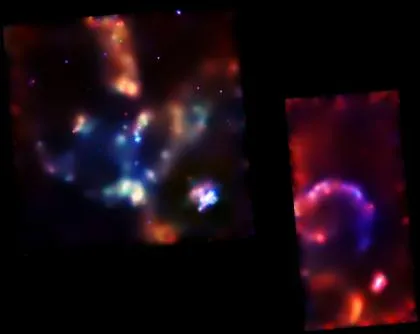
This image of 30 Doradus or NGC 2070 gave scientists a close-up view of the drama of star formation and evolution in the Tarantula Nebula. It is one of the most active star-forming regions in our Local Group of Galaxies. Massive stars produce intense radiation and very hot winds that carve out gigantic superbubbles in the surrounding gas. Other stars evolved into supernova events leaving behind pulsars and remnants that encourage the giant clouds of gas and dust to form new generations of stars.
The Tarantula is located 160,000 light-years from Earth, in the Large Magellanic Cloud. At least 11 extremely massive stars, with ages of 2 million years, were detected in the bright star cluster in the center of the first image (left panel). The brightest source is Melnick 34, a star of 130 solar masses located slightly down and to the left of the image center. The supernova remnant N157B with its pulsar is visualized in the lower right panel.
The image composition was made with data from the Chandra X-ray Observatory. The lower energy X-rays appear in red, the medium energy in green and the higher energy in blue.
Credits: NASA/CXC/Penn State/L.Townsley et al.
The image was published on the Chandra Site on April 23, 2002.
Old "clocks" to read the age of the Universe
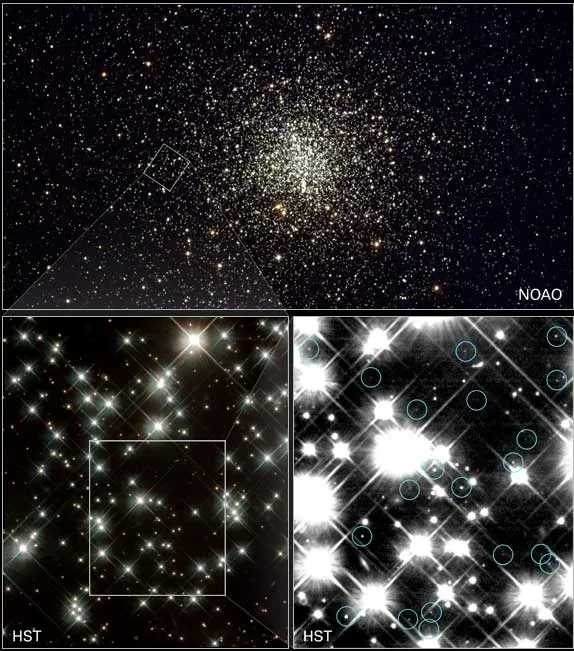
NASA's Hubble Space Telescope pushed the limits of its powerful vision to find ancient white dwarfs between 12 and 13 billion years old. As previous observations made with the same instrument showed that the first stars formed less than a billion years after the birth of the universe in the big bang, discovering the oldest stars allows calculating the age of the universe.
These new observations are the product of research by Harvey Richer of the University of British Columbia, Canada.
Since white dwarfs cool and become fainter, less bright, Hubble required several images of the ancient globular star cluster M4. Over 8 days of exposure, over a period of 67 days, the faintest stars became visible -as their light accumulated- even though some of them are magnitude 30!
Let the reader know that this communication and the associated images are from a decade ago, as indicated by the section title, and that since then various measurements of the age of the universe have been made.
The image consists of three parts. The top panel shows a shot of the M4 cluster by a ground-based observatory, Kitt Peak. Hubble studied a small region of the entire cluster, seen in the lower left panel. An even smaller sample, just 1 light-year in diameter, is seen in the next panel. In that small area, Hubble discovered a number of faint white dwarfs. The blue circles identify some of those stars. The M4 cluster lies 5,600 light-years away, in Scorpius, near Antares.
The observations were made from January to April 2001 and the image was released on HubbleSite on April 24, 2002.
Credits: NASA and H. Richer (University of British Columbia)//NOAO/AURA/NSF
Images of the week
The Moon and the Milky Way Arc
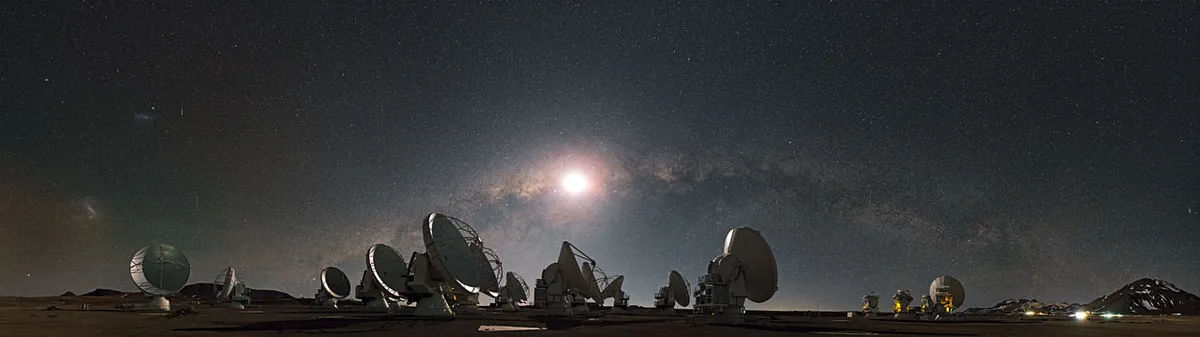
One of ESO's Photo Ambassadors, Stéphane Guisard, captured this beautiful panorama of the ALMA site, the Atacama Large Millimeter/submillimeter Array, in the Chilean Andes. Numerous antennas dominate the center of the image. When ALMA is complete, it will have 54 antennas of 12 meters in diameter. Above, the arc of the Milky Way. When the image was taken, the Moon lay near the center of the Galaxy in the sky and its light bathed the antennas in a ghostly nocturnal glow.
It was the ESO Picture of the Week.
Credit: Stéphane Guisard
The Vicinity of Alnitak
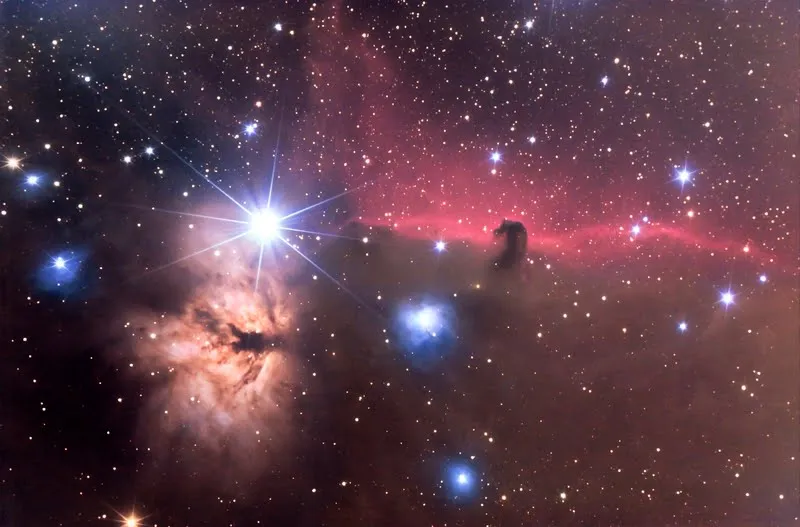
This incredible image of the Alnitak region was recorded by Kike Diez Alonso, from Gijón, Asturias, with a Newton 150/752 in 190 minutes and a Canon EOS 400D.
The images were later processed by Delio Tolivia Cadrecha.
Alnitak, needless to say, is one of the "Three Marys" that make up Orion's Belt. To the right, Barnard 33 or the Horsehead Nebula is observed.
It was the Amateur Astronomical Picture of the Day (AAPOD) for April 24, 2012.
Credits: Kike Diez Alonso and Delio Tolivia Cadrecha
Space Music
Stellardrone: Invent the Universe
Stellardrone is the pseudonym of an amateur composer from Edgaras, Lithuania, born in 1987, who began creating music at the age of 20 using only software, virtual synthesizers.
Of his five albums, available on his website and on Jamendo, I share here the second one, Invent the Universe, whose first track is The Belt of Orion.
Animated Science
Space Travel for a Sunday Afternoon
The author of this video, YouTube user Pegusis2, notes that he made it on Sunday, April 22 of this year. Hence the title. He felt like traveling and why not to space? Imagination breaks boundaries and so he embarked on this production that allows us, over 19 minutes, to enjoy splendid cosmic landscapes accompanied by soft music.
He used 4 audio fragments created in SmartSound and 36 film segments including 12 fractal videos created with Scratch.
http://youtu.be/4vHt5_wiTfE
To access previous editions of this section, consult the Multimedia Selection Series. The series attempts to show that the immensity of the universe can be perceived in different ways. I choose some of the images from a decade ago -so they don't fall into oblivion- and from the current week that ends, as well as sounds/music and videos that are artistic forms of expression with content related to astronomy and related sciences.