A collection of links to music, images and videos relating art and science. Today: Images of a binary cubewano; M42; NGC 2240; and the Large Magellanic Cloud. Music by Luminance Factor: Cubic Skies. And a video about Earth Day.

Images of the decade
Hubble finds a binary cubewano
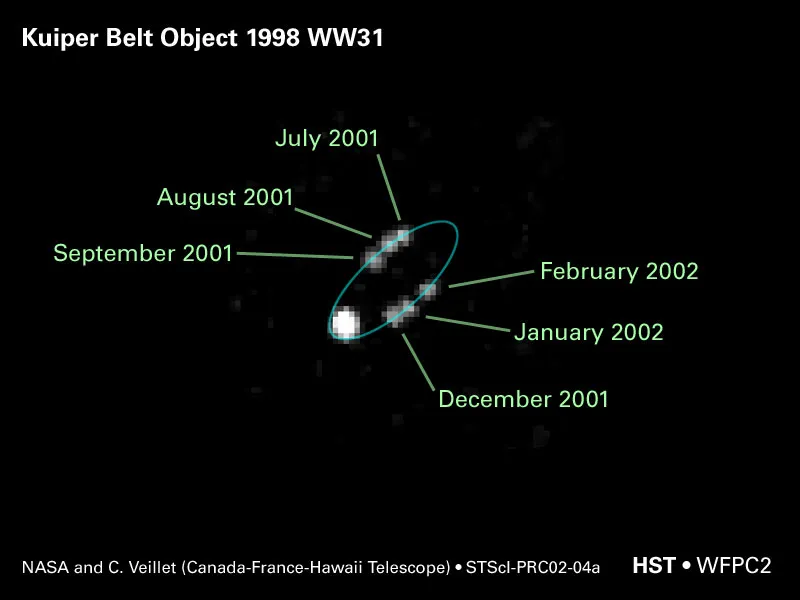
Christian Veillet of the CFHT in Hawaii reported observations of the Kuiper Belt Object 1998 WW31 which had been discovered four years earlier. The year before these observations it was discovered that the object was binary.
Just like Pluto and its moon Charon, there are countless icy objects called KBOs from the English acronym meaning "Kuiper Belt Objects". That "reservoir of material" left over from the formation of the Solar System extends from the orbit of Neptune, which is why those objects are also called Trans-Neptunian Objects.
The belt, named after astronomer Gerard Kuiper, extends from 30 to 50 astronomical units from the Sun.
Among the asteroids that reside there are the "Classical Objects" like 1992 QB1, the first transneptunian discovered (after Pluto and its moon), in 1992. As a result of this object, a family or classification of QB1 objects was created, which was translated into Spanish as "cubewanos".
The image is a composite showing the orbit of one of the objects (with several observations indicated by the dates) in relation to the other (the brighter object). Both actually orbit around a common center of gravity. The blue oval in this case does not represent a famous car brand, but the orbit. The image was composed by astronomers from six exposures taken from July to September 2001, December of the same year and January and February of the following year.
Credits: NASA and C. Veillet (Canada-France-Hawaii Telescope)
The image was presented on HubbleSite on April 17, 2002.
M42 by 2MASS
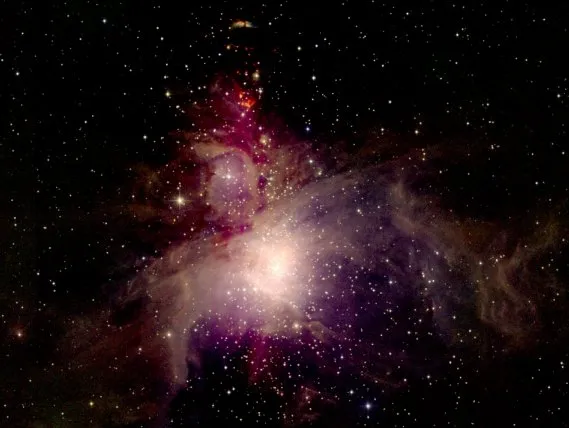
The title might well seem part of a mathematical equation but refers to one of the most observed objects, the Orion Nebula.
The immense molecular cloud, 1,500 light-years away, was observed and recorded by the All-Sky Survey known as 2MASS which used two automated 1.3m telescopes, in Arizona and Chile, each equipped with a three-channel camera capable of observing the sky simultaneously at 1.25; 1.65 and 2.17 microns. (1 micron = 0.001 mm).
Those wavelengths correspond to infrared radiation, ideal for penetrating the dark dust clouds.
On the 2MASS site it is possible to download this photo at a larger size.
Credits: 2MASS Collaboration,U. Mass.,IPACMosaic by E. Kopan
It was NASA's Astronomy Picture of the Day (APOD) for April 20, 2002. Also on Observatorio.
Images of the week
Hubble spies inside a Star Cloud
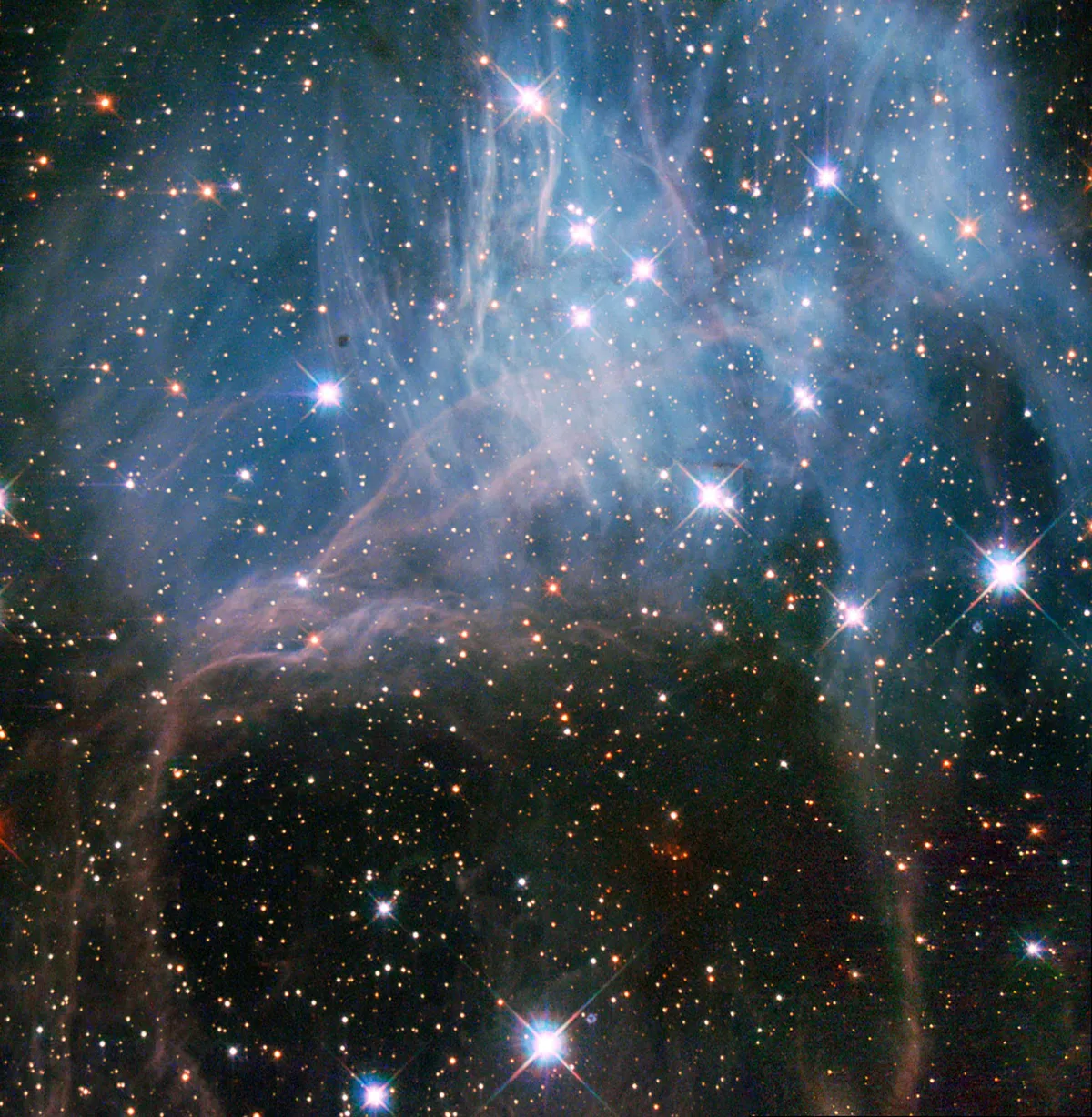
These luminous stars shining through what looks like a fog in the night sky are part of a young cluster in one of the largest star-forming regions in the Large Magellanic Cloud, a dwarf satellite galaxy of the Milky Way.
The cluster is known as NGC 2040 or LH 88 and is an OB association, meaning the group contains up to 100 O- and B-type stars, massive and short-lived stars.
A version of this image entered the Hubble Hidden Treasures contest. It is an initiative that invites astronomy enthusiasts to search the Hubble archive for incredible images that were never seen by the general public.
Credit: NASA/ESA Hubble
It was the Hubble Space Telescope Picture of the Week.
The Large Cloud from Areco
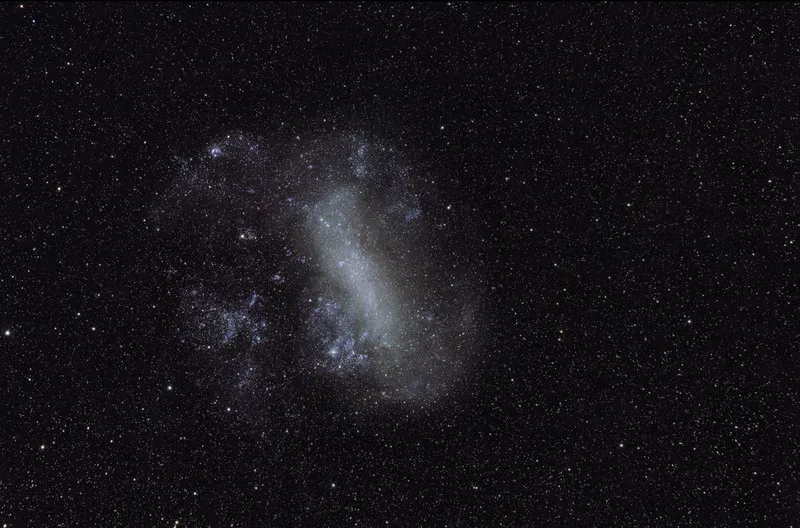
With his Canon EOS 1000D on an EQ3 and a total exposure of 2.5 hours, the Argentine astrophotographer known as Sonovasco (or Vasquito) achieved this beautiful record of the Large Magellanic Cloud from San Antonio de Areco, Province of Buenos Aires, on December 17, 2011.
Is there any other notable object in this photo?
It was the Amateur Astronomy Picture of the Day (AAPOD) for April 18, 2012.
The day before another image by an Argentine was part of AAPOD and is worth enjoying. It is an image of the transit of the ISS through the tail of Lovejoy recorded by Carlos Caccia.
Space Music
Luminance Factor: Cubic Skies
My friend Gonzalo González (whom I talked about here in Multimedia Selection 2011-28) has just released his latest production titled Cubic Skies.
From the Luminance Factor site we can listen to the 8 tracks + bonus, as well as buy all or some of his tracks through MyCD.
The production fits perfectly into what can be described as "space music" because it includes sounds that create atmospheres we link with documentaries and science fiction films, although it should not be confined exclusively to that theme, certainly.
González creates harmonies ideal for relaxation and enjoyment. Cubic Skies can be the perfect soundtrack for directing our own mental movies, at nap time.
Some of the tracks have a somewhat epic nuance, probably due to subtle crescendos that make our emotions climb on a base that remains, as in the title track of the album.
In other cases, the base is more rhythmic, as in Dancing on the Azimuth, one of the best tracks, to my personal taste.
The quasi-nostalgic sound is not missing in The Last Constellation, which can refer to a loss or a distance.
Universal Message is the track on whose version the DJ Ibetcebel (Juan Oscar Morat) made a formidable remix, with a dance rhythm, including a child's voice (Gonzalo's son?).
I think Cubic Skies is a progression from the previous works, Atmosphere and Into the Universe, as it has greater elaboration and textures.
Astronomical observation is fabulous when done in a group. These days the Star Party Mendoza 2012 is taking place, for example. However, it is also an activity that we can perfectly well do alone. And I, personally, enjoy it much more with background music. Because we can also daydream. And there I am accompanied by the sound of Luminance Factor.
Congratulations to Gonzalo González on his new production. The artist, who generously shares his music freely, has decided in this case to also put his work up for commercial sale, even though we can enjoy his art for free. It is my wish that grateful users know how to reciprocate the kindness and that Gonzalo can continue to provide us with his creations in the future.
Animated science
Earth Day 2012
The Earth Day is a day celebrated in many countries on April 22. The initiative was born in 1970 promoted by a U.S. senator and environmental activist (Gaylord Nelson) after witnessing the ravages of the massive oil spill in 1969 in Santa Barbara, California. Let the reader think that that spill was about 12,000 tons of oil. Very, very far from the disasters of Deepwater Horizon, the Prestige, Exxon Valdez and the Gulf War.
It is an occasion to become aware of the importance of natural resources and of proper planning of their consumption for human well-being, in an attempt to generate the least possible impact.
NASA has a section on its site with images of Earth that are worth seeing: NASA Earth Day.
What follows is a video by professor Lucio Flores.
To access previous editions of this section, consult the Multimedia Selection Series. The series attempts to show that the immensity of the universe can be perceived in different ways. I choose some images from a decade ago -so they don't fall into oblivion- and from the current week that ends, as well as sounds/music and videos that are artistic forms of expression with content related to astronomy and related sciences.