Stephen Hawking's contributions have been synthesized in an infographic that aims to inspire doctoral students.
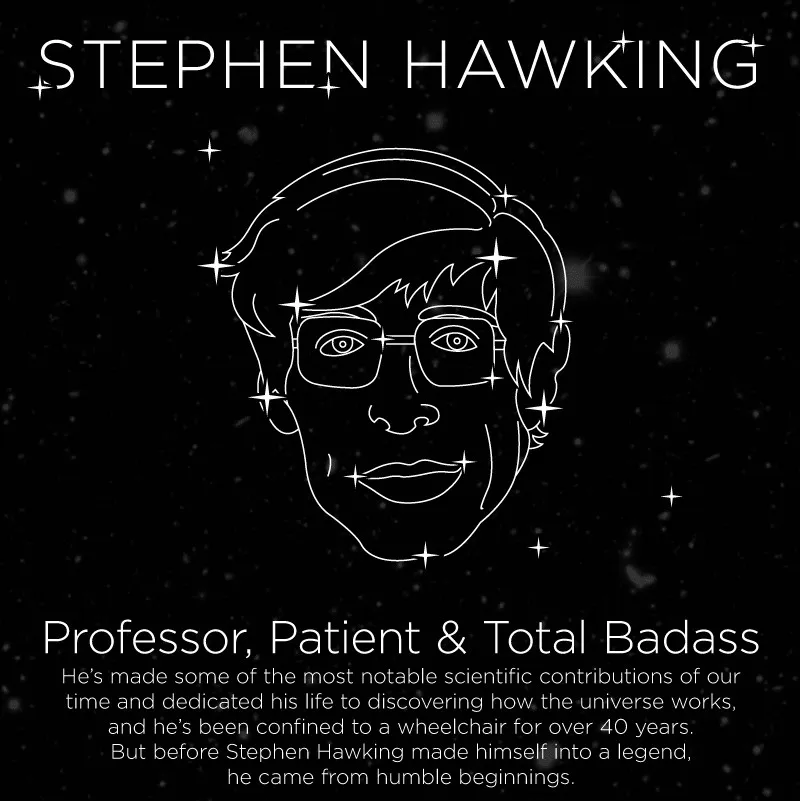
Peter Kim alerts me to this new infographic about Stephen Hawking at OnlinePhD.
Under the title: PhD at 23: Stephen Hawking, the site notes (*):
"If you are working on your doctorate, you may secretly dream of making a revolutionary discovery. In a time of constant technological change and expectations of advances, new ideas and discoveries are born every day. But in recent decades, one brilliant mind has surpassed the rest. Stephen Hawking, who turned 7 decades old this year, did not fail to produce significant research and paradigm-shifting discoveries from the moment he began his career. As you progress toward your doctorate, there is probably no greater inspiration than Stephen Hawking, who received his PhD at the age of 23. On the side, he made some of the most notable scientific contributions of our time and dedicated his life to understanding how the universe works. Furthermore, he has been confined to his wheelchair for more than 40 years. He is the longest-surviving ALS patient, a certified genius, and an indomitable one".
(*) The translation is mine and has some minimal alterations compared to the original text, except for the term "badass" translated here as "indomitable" which deserves some clarifications. The adjective alludes to someone "crabby", of "bad temper". However, I do not interpret it as a quality of the person in this case, but as an image that a person gives to society (or that society interprets as such) linked to attitude. From this point of view, it would be a person who does not conform to the rules, from whom "anything" can be expected, who rebels against authority. In short, untamed. A "Maradona" of physics, if you allow me the comparison.

The English physicist, who will have a participation in the next episode of The Big Bang Theory on April 5 to fulfill Sheldon Cooper's dream (another "badass"), is already a legend of astrophysics, both for his scientific achievements and for his attitude (haughty, arrogant) and physical situation generated by Amyotrophic lateral sclerosis (ALS, in English).
On January 8, 2012, Hawking turned 70 despite medical prognoses that in the early 1960s already diagnosed him with few years of life.
He is, in this sense, a fighter, so "badass" is also a way of valuing the man's effort not to be subdued by the disease.
Scientific idol?
The English scientist is considered by some of his colleagues and, fundamentally by public opinion, as one of the most influential minds of our time. Other astrophysicists have been elevated to "superior" categories like Newton or Galileo, Einstein, and even Carl Sagan. Thus, certain simplifications are generated, such as thinking that Edwin Hubble is the "father" of the expansion of the Universe (and, by extension, of the Big Bang).
Those who understand things that way quickly show why these people should not be "glorified", not turned into caricatured characters, and their contributions should be valued more objectively and not so much by issues external to their scientific production or the impact of certain mass disseminations.
Making these clarifications implies a form of relativization, that is, it attempts to dilute ideas considered exaggerated and also show other aspects of the people and, in this case, objectively consider the scientific contributions.
Thus, one could "dilute" the exaggerated concepts about Hawking, Einstein, Newton, or Hubble, pointing out the changes of opinion and snubs of the modern physicist; the inclusion of a cosmological constant by the German; the esotericism of the author of the Principia; or the "bad" estimation of the famous Hubble constant.
And it is also possible to use relativism to show how other people, perhaps less valued, have had contributions as or more important than other researchers and thus mention Vesto Slipher in relation to Hubble, to cite one of the many possible examples.
On the other hand, inside and outside of science, we are all human beings, limited, fragile, weak, or reckless. The strength of will, together with "genius" - be it intellectual or physical - astonishes us because they do not seem to be common characteristics.
Hence, Hawking's story is inspiring. We could say no less about the members of Mundo Alas.
But that inclusion of personal characteristics among scientific achievements also has another side in public statements and attitudes. In some cases, we already know, things are not as they are told to us, but a journalistic exaggeration.

http://es.xkcd.com/strips/stephen-hawking/
Ultimately, for the scientists themselves, in this case in astrophysics, it is possible that Hawking is not considered a superlative genius, although that does not mean they disdain his contribution on black holes and the radiation that bears his surname. In contrast, for the rest, those of us who are not dedicated to research, it is possible that we make a different "estimation", including not only his scientific contributions, but also other variables.
Media idol?
For those who do scientific outreach, those other variables are important, but also a double-edged sword. That Hubble is "the father of expansion" or that Hawking is "the father of black holes" is, certainly, a simplification that ignores many other people who decisively influenced the reach of those discoveries.
On the other hand, some of us like certain topics to be raised, especially when we agree with those ideas. In many cases, all that is generated is media uproar, partly due to the press, partly due to publishers looking for ways to better sell a book.
And we also look unfavorably when a scientist expresses an opinion contrary to our ideas.
Doctoral inspiration
The graphic, I believe, must be understood in its context. Created at OnlinePhD, it implies that, just as is the site's objective, it aims to present potential and current doctoral students with necessary information to prosper in their activity. Its desire is to help these people achieve their goals through higher education and present different perspectives.
And I don't think it's bad. In fact, here I have conducted interviews with various Argentine researchers who, without the credentials of the English physicist, can inspire and motivate young fellow citizens to pursue natural and exact science careers and show that it is possible to make important contributions.
The Stephen Hawking infographic is a way to highlight his life and achievements, in the same way that works highlighting the life and work of Milstein and Leloir, Maradona or Antonio Berni have been made in our country.
That very fact indicates that it is NOT necessary to be Stephen Hawking, with all that implies, but that effort, the perseverance to achieve goals, is valuable. The assessment of achievements, however, cannot be based exclusively on public opinion. I don't think Dr. Jorge Sahade or Dr. Gustavo Romero are widely known, but they are undoubtedly among the most important Argentine astronomers, to name a few, who have made and are making important contributions and who would well deserve an infographic of this kind.
An interview with Drs. Di Gregorio and Gattone, who carried out the only experiment to detect dark matter in Argentina (and in Latin America), will be published here soon. It is a very little-known fact, but incredibly valuable, regardless of the impact of the results or the popularity of those people.
Hence, in my view, it is better to present the successful careers of people who have made good contributions but are not so popular.
In science communication, we cannot exaggerate the life and work of researchers, deifying them almost dogmatically. Yes, it is good to tell stories that are worth telling. But without star worship. Hawking is not a god or a demigod or a superman, nor is it necessary to present him as such. You may like his supposed rebelliousness, you may not appreciate his dialectical arrogance.
Certainly his scientific achievements carry weight and it is no small feat that he achieved them in his physical condition. What's more, he got married and divorced! Twice!
In science communication, no god is needed (in other contexts, either). And Hawking, I believe, would agree with this. But he is indeed a person worthy of imitation in his effort, which achieved motivating contributions.
We could make similar analogies regarding The Beatles, Luis Alberto Spinetta or Messi. However, that should not be an obstacle to recognizing many other musicians, soccer players or astronomers who, without having a superlative image in public opinion, work with effort and passion and also make significant contributions.
The idea is that saying one thing does not hide the other.
Thanks to Peter Kim for the heads-up!
Sources and related links
About the images
- Credit: Online PHD.