A simple educational model gives an idea of how astronomers detect planets around other stars through the radial velocity technique.
Planets are difficult to detect, even in our own solar system. And, beyond the Sun, around other stars, the difficulty increases. Planets can be giants, like Jupiter or even larger, however, unlike stars they do not emit their own light.
Researchers use various techniques such as transit and radial velocity, two of the best known.
Among the most important projects in search of exoplanets is HARPS, through which several exoplanets were found, such as the 50 announced last September.
In science it is difficult to make predictions about the next great discoveries, however, it feels like soon a planet will be found that meets many conditions similar to Earth. The discovery of such a planet has been announced more than once, but the atmospheric conditions and the location of the planet in the so-called Habitable Zone are usually based on estimated calculations.
The search for a planet very similar to Earth seems to be one of the "Holy Grails" of astronomy, partly because if in this world we inhabit, with these conditions, life arose, then on other planets with very similar characteristics, it is possible that it could too.
Incidentally, there are indications that this is a biased view. Earth's conditions are varied, which includes characteristics that would seem, a priori, not suitable for life, of high temperatures for example, and yet extremophiles have been found.
On the other hand, the topic captures the attention of professionals, amateurs and the general public, as finding life on another world would be the big news. And this awakens all kinds of pseudo-scientific speculations everywhere.
At the same time there are the pseudo-skeptics, those who say they do not believe in scientific claims, such as the existence of black holes or planets around other stars. And sometimes this is argued by pointing out that it is impossible to detect distant planets because they do not emit their own light.
For these reasons it is valid to disseminate, at least roughly, how astronomers detect exoplanets.
An educational model has been proposed for a long time and in various ways, for example, to exemplify detection by radial velocity, through Styrofoam balls.
A production of that model can be found in Planetary Society, in its number 2, Volume I, of Planetary Kids. [1]
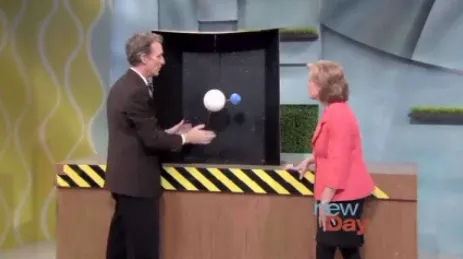
That model was shown on a US television program (New Day NW) by Bill Nye himself (in English). It can be seen at http://bit.ly/TPS0603.
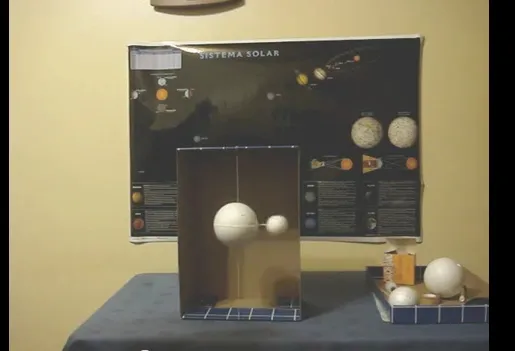
A version in Spanish was made by me, very simply, without proper lighting, but enough to be able to see and understand the procedure and get an idea of how to build a model in class or at home.
Construction of the model
The model is based on Styrofoam balls. They can be found in art supply stores or stationery stores. It is necessary to have a large ball, which will act as the star, and one or several smaller balls that will act as planets.
Styrofoam balls or spheres are sold according to size with a number. Here a number 10 and other smaller ones were used.
The star-ball must be fixed with an elastic band to a box. And a planet-ball will be attached to the star-ball with a toothpick.
This star-planet system will have a diameter that must be taken into account when choosing the size of the box. A large box is better, so that the diameter of the system can be changed by increasing the size of the toothpick and the planet-ball.
The elastic band can be the one used for clothes, but elastic thread (sold in haberdasheries) or rubber bands (they break more easily, but they work) can also be used.
To pass the elastic band through the Styrofoam star-ball, a toothpick like those used for skewers (these are also sold in art supply stores) or rods used in modeling can be used.
With the rod we will make a hole in the ball from "pole to pole". Then, to pass the thread we can help ourselves with a long needle.
Once the elastic band is passed through, we tie it to the box, top and bottom, as close as possible to the opening.
But the ball, if we do nothing else, will fall to the base of the box, due to gravity. To keep it fixed in the middle of the thread, the hole we made earlier can be filled with glue, fabric adhesive, even with some putty or modeling clay.
Thus we will have a star that can "rotate" if we twist the elastic band to one side several turns and release it.
Styrofoam balls usually have their "Equator" well marked, but we can add marks to better visualize their rotation. If well made, the star should rotate evenly, without "wobble". In practice, there will be some wobble, but it should be minor.
However, if we then attach the planet, the same procedure will cause the star to "wobble" more noticeably.
To attach the planet we also use a small piece of rod.
We can test the procedure with planet-balls of different sizes and also with longer and shorter toothpicks.
The use of longer rods will be conditioned by the dimensions of the box.
It is a very simple model that can be made easily and that, with some modification, can also be used to show the concept of an eclipse (both solar and lunar) and even the transit technique to detect exoplanets.
The star and planet balls can be painted with watercolors, markers, etc., to give them a characteristic appearance.
There is also fluorescent paint that would allow seeing the model at night or decorating the background of the box to give it an appearance of "deep sky", dark with bright dots, or shapes of spiral galaxies or constellations.
Here, a modest demonstration video:
The music used in the video is the track Exoplanet, from the album PsykoMysik, by Tony Ferreira.
Note written for the XXVIII Carnival of Physics, in this edition hosted by Física, Arroz y Frijoles. To join and read the entries there is a social network on Ning.
Sources and related links
- How do we detect far-away planets?, Vol.I, Number 2, September 2011, in The Planetary Report, Vol. 31, Number 4. See www.planetary.org/kids.
- The Extrasolar Planets Encyclopaedia
About the images
- Screenshot of the video from the New Day NW program featuring Bill Nye and his demonstration of the model.