A collection of links to music, images and videos relating art and science. Today: Images of HCG 87; M100. Music: We Broke Symmetry - HCG 87 Cluster. Video: Borrowed Light.

Images of the decade
The HCG 87 Galaxy Group
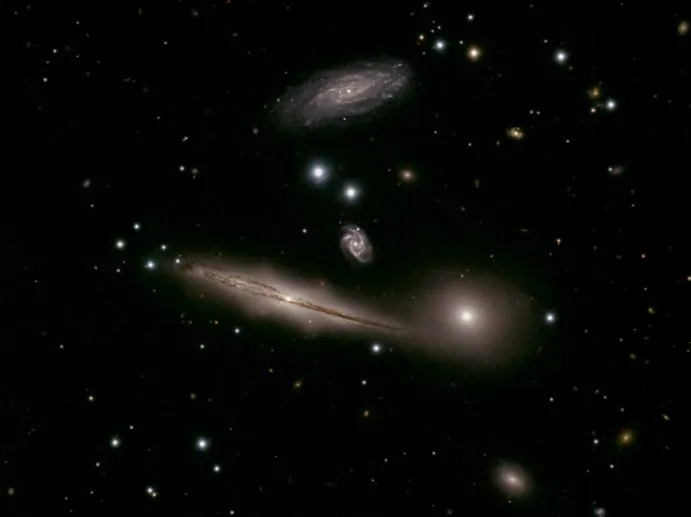
Posing for this cosmic family portrait are the galaxies of HCG (Hickson Compact Group) 87, about 400 million light-years away, in the constellation of Capricornus.
The large edge-on spiral near the center, the fuzzy elliptical galaxy just to its right and the spiral at the top are already identified members of the group, while the small spiral galaxy at the top is probably a background galaxy. In any case, a detailed view of the image reveals the presence of other galaxies that are surely beyond HCG 87.
These images taken from the ground were considered at the time as "the sharpest ever obtained of astronomical objects from Earth". Nothing to envy from the photos of the same group taken with the Hubble Space Telescope (see Hubble Heritage).
Credits: GMOS-S Commissioning Team,Gemini Observatory
It was the Astronomy Picture of the Day (APOD) of July 31, 2003. In Spanish at Observatorio.
Images of the week
Messier 100 — the splendor of a grand design spiral galaxy
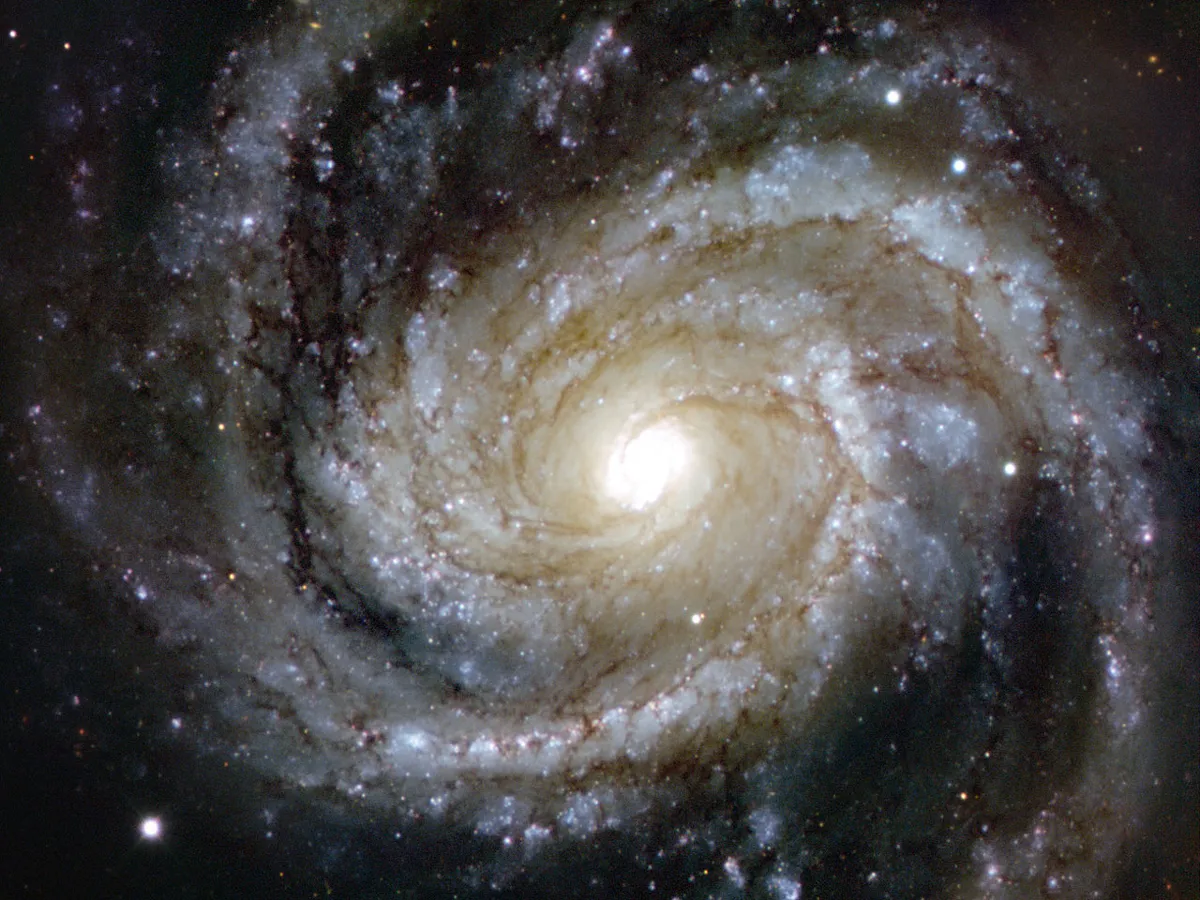
Normally, spiral galaxies are very attractive objects from an aesthetic point of view, and even more so when we see them face-on. Specifically, this image is a splendid example of this: it is the grand design spiral galaxy Messier 100, located in the southern part of the constellation Coma Berenices (Berenice's Hair), which is about 55 million light-years from Earth.
Although Messier 100 shows very well-defined spiral arms, it also shows a weaker bar-shaped structure in its center, which classifies it among SAB-type galaxies. Even though it is not easy to distinguish in the image, scientists have been able to confirm the existence of the bar by observing it at other wavelengths.
In this detailed image we can see the main features expected to be found in a galaxy of this type: large clouds of hydrogen in the form of gas, glowing in red areas when they re-emit the energy absorbed from nearby massive newborn stars; the uniform glow of yellowish, older stars near the center; and the black streaks of dust weaving through the galaxy's arms.
Messier 100 is one of the brightest members of the Virgo Cluster, the galaxy cluster closest to our own galaxy, the Milky Way, and which contains about 2,000 galaxies, including spirals, ellipticals and irregulars. This image combines images obtained with the FORS instrument, installed on ESO's VLT (Very Large Telescope) at the Paranal Observatory (Chile), taken with red (R), green (V) and blue (B) filters.
It was the ESO Picture of the Week.
Credits: ESO.
Space Music
We Broke Symmetry: HCG 87 Cluster
I found this track on SoundCloud in which apparently the Compact Group referred to at the beginning inspired this Canadian musician in his composition.
Animated Science
Borrowed Light
The caretaker of an abandoned observatory takes on an impossible task: to show the city that surrounds him something incredible. An animated short about conflicting existences, natural wonders, and a small theft on a large scale.
Light pollution is generated by all the artificial light used unnecessarily at night in large cities that "steals" the light of the stars from us, as well as meteor showers (we are passing through the Capricornids).
The beautiful short was directed by Olivia Huynh.
Borrowed Light from Olivia Huynh on Vimeo.
To access previous editions of this section, consult the Multimedia Selection Series. The series attempts to show that the immensity of the universe can be perceived in different ways. I choose some of the images from a decade ago -so they don't fall into oblivion- and from the current week that ends, as well as sounds/music and videos that are artistic forms of expression with content related to astronomy and related sciences. I am also collecting these materials in the Pinterest account