A collection of links to music, images and videos relating art and science. Today: Images of Mars: a decade since the close encounter; The day the Earth smiled. Music: Planetary by Thomas Allen Cummins. Video: MPG/ESO 2.2-meter telescope.

Images of the decade
Mars: a decade since the close encounter, the lie is out there
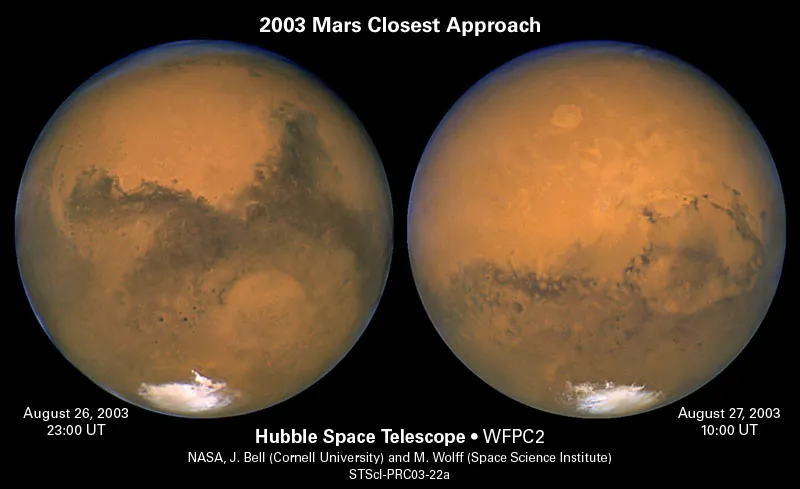
These two images, taken 11 hours apart with Hubble, reveal two nearly opposite sides of Mars. The records were made as the red planet approached its closest approach to Earth in almost 60,000 years.
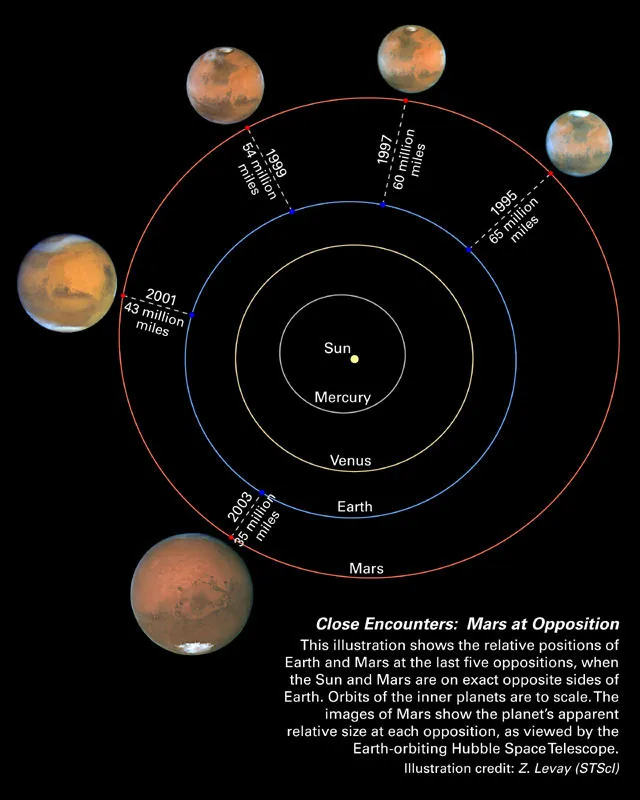
The following diagram shows the relative positions of Mars and Earth in the last five oppositions (up to that point, in 203), when the Sun and Mars are on opposite sides of Earth. The images of Mars show the apparent size relative to each position, as seen by the Hubble Space Telescope.
In 1995, Mars at opposition was more than 104 million km from Earth. In 1997, 96 million. In 1999, 86 million. In 2001, 69 million km. And in 2003, 56 million km from Earth.
When we walk down the street and see a tree in the distance, it appears very small to our sight. We could "measure" it from a distance with our fingers. That is called apparent size. As we get closer to the tree, it appears taller to our sight. It's not that the tree grows in that period, but rather that the apparent size depends on the distance (and the size of the object).
The Moon is much smaller than Mars, but it is closer. That's why, when there is a full moon, we see the moon at a certain size that is usually measured in degrees (considering the concept of the "celestial sphere," the sky, divided into 360º) and is called angular size. It is often said that, with an outstretched arm, a closed fist measures 10 degrees. The Moon measures half a degree (just like the Sun).
If the Moon came closer to Earth it would look bigger, as happens at its closest approach (which the media has called a Supermoon), although only a little bit.
Mars, at its closest approach, DOES NOT LOOK BIGGER. It continues to be seen, as it has always been seen, with the naked eye, but as a bright point of light. This is because if we see a small tree at a distance of 500 meters, and we get only 100 meters closer (to 400 mts from the tree) the difference is very small to notice any significant change.
However, since that maximum approach of Mars, a confusion arose that became popular on the internet, giving rise to the fallacy of Mars' approach.
Let's think of it this way: Mars is almost twice the size of the Moon. For the planet of war to appear as large as our satellite, it would have to be at twice the distance of the Moon, which lies 384,000 km from Earth. That is, Mars would have to be 800,000 km from our planet to appear in the sky as large as the Moon. But at its closest approach it was 56 million km away.
More details at The Lie About Mars.
Credit: NASA, ESA, STScI, J. Bell (Cornell U.) and M. Wolff (SSI) for image 1 and Z. Levay (STSci) for illustration.
Additional image processing and analysis support from: K. Noll and A. Lubenow (STScI); M. Hubbard (Cornell U.); R. Morris (NASA/JSC); P. James (U. Toledo); S. Lee (U. Colorado); and T. Clancy, B. Whitney and G. Videen (SSI); and Y. Shkuratov (Kharkov U.)
The images were published by HubbleSite on 27 de agosto de 2003.
Images of the week
The day the Earth smiled
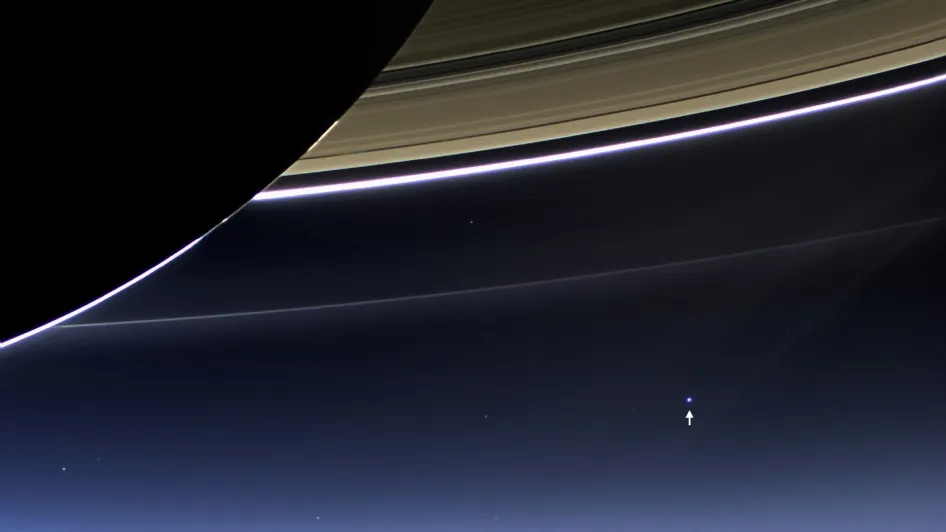
This was the resulting image from the initiative The Day the Earth Smiled taken on July 19 with a camera on the Cassini spacecraft near Saturn. Earth was 1,440 million km from the spacecraft.
and appears as a blue dot in the center right of the image. The image scale on our planet is 86,620 km per pixel.
Although the Moon is not visible to the naked eye in this image, a higher resolution detail does allow us to distinguish Earth from our natural satellite.
The image was published by NASA on 24 de julio de 2013.
Space Music
Planetary by Thomas Allen Cummins
This American musician, from Florida, created Planetary in 2012. It is a collection of instrumental rock pieces with the solar system as the theme.
Animated Science
ESO reviews the images taken with the MPG/ESO 2.2-meter telescope
Located at the La Silla Observatory in Chile, the telescope was operated by ESO, and made available to its entire community, as well as to users of the Max Planck Society (MPG). Until this year. However, in the future, ESO will stop offering the telescope to its members, even though the Max Planck Society will continue to use it. In this EsoCast video they review its best shots.
More information at ESO.
To access previous editions of this section, consult the Multimedia Selection Series. The series attempts to show that the immensity of the universe can be perceived in different ways. I choose some images from a decade ago -so they don't fall into oblivion- and from the current week that ends, as well as sounds/music and videos that are artistic forms of expression with content related to astronomy and related sciences. I am also collecting these materials in the Pinterest account