A collection of links to music, images and videos relating art and science. Today: Images of M16; Prawn Nebula. Music: Autobahn 73. Video: A Night on Mount Hehuan.

Images of the decade
Inside the Eagle Nebula
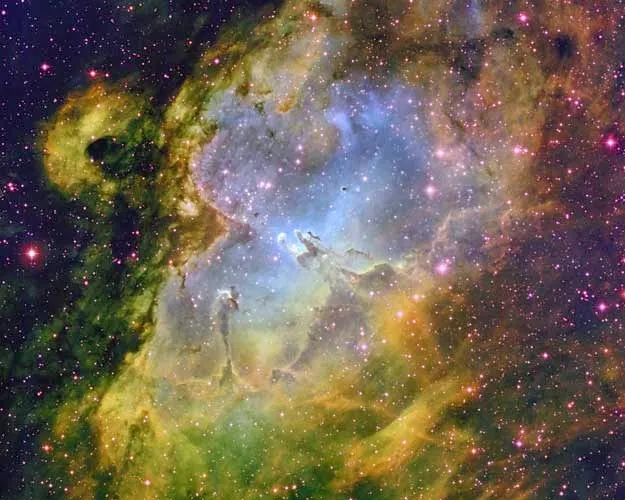
From afar, the whole thing looks like an eagle.
However, a closer look at the Eagle Nebula shows that the bright region is actually a window into the center of a larger dark shell of dust.
Through this window, a brightly-lit workshop appears where a whole open cluster of stars is being formed.
In this cavity, tall pillars and round globules of dark dust and cold molecular gas remain where stars are still forming.
Already visible are several young bright blue stars whose light and winds are burning away and pushing back the remaining filaments and walls of gas and dust.
The Eagle emission nebula, tagged M16, lies about 6500 light years away, spans about 20 light-years, and is visible with binoculars toward the constellation of
Serpens (The Serpent).
Credit & Copyright: T. A. Rector & B. A. Wolpa, NOAO, AURA, NSF
It was the Astronomy Picture of the Day (APOD) on September 21, 2003.
In Spanish at Observatorio.
Images of the week
Prawn Nebula
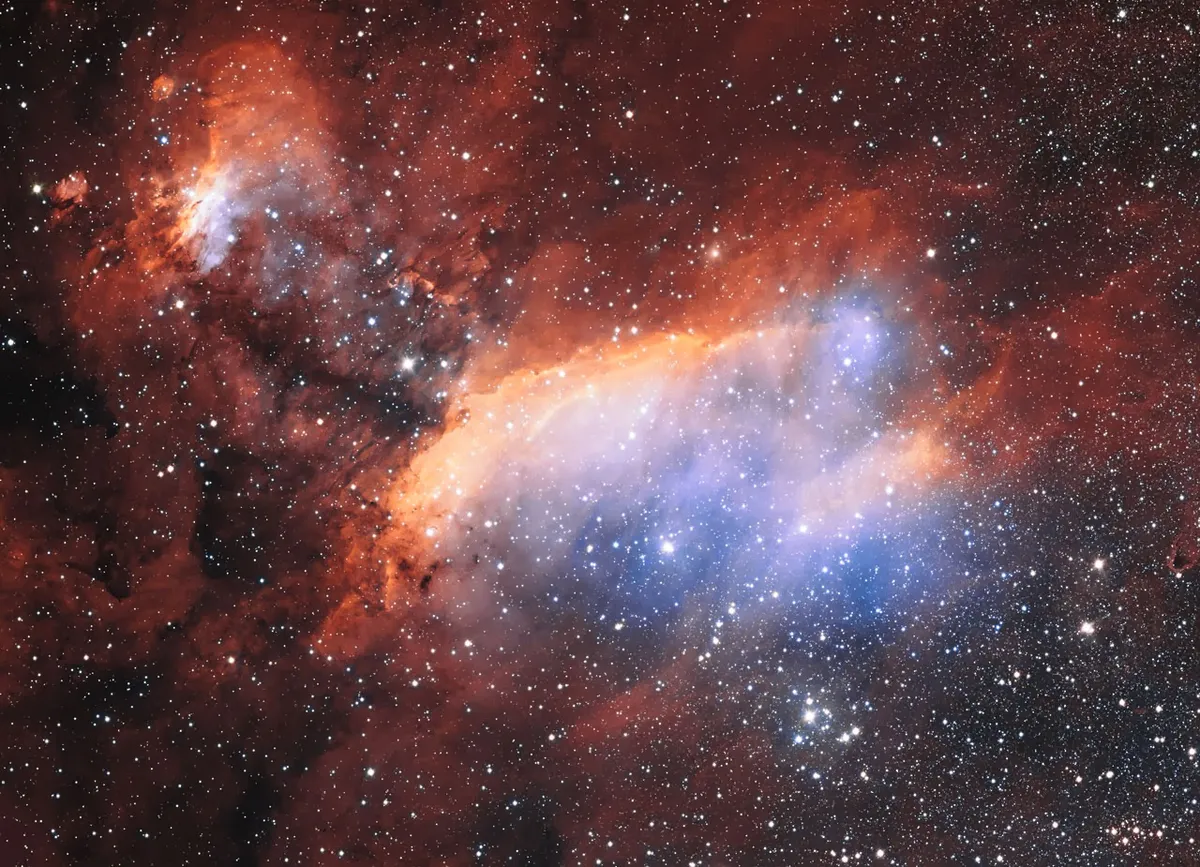
The glowing jumble of gas clouds visible in this new image form a vast stellar nursery nicknamed the Prawn Nebula (for the crustacean). This image, taken with the VLT Survey Telescope at ESO's Paranal Observatory in Chile, may be the sharpest picture ever taken of this object. It shows clusters of hot newborn stars nestled among the clouds that make up the nebula.
Located about 6,000 light-years from Earth, in the constellation of Scorpius (The Scorpion), the nebula officially known as IC 4628 is a huge region filled with gas and dark bubbles of gas. These gas clouds are star-forming regions that generate bright, hot young stars. In visible light, we see these stars in blue-white colors, but they also emit intense radiation in other parts of the spectrum—mostly in the ultraviolet.
The image is part of a detailed public survey of a large part of the Milky Way called VPHAS+, which uses the power of the VST to search for new objects such as young stars and planetary nebulae. The survey will also provide better images of many vast, bright star-forming regions, like the one featured in this news story.
The detailed VST images were enhanced by including additional high-quality images taken through other filters to bring out the colors. These images are the work of Martin Pugh, a skilled amateur astronomer who captured his images from Australia using 32- and 13-centimeter telescopes.
Credit: ESO. Acknowledgement: Martin Pugh
It was the ESO Picture of the Week.
Space Music
Autobahn 73 - Eagle Nebula M16
Autobahn 73 is Juan Manuel Ruiz Súnico, who recorded the album Fluir between 2009 and 2010 at Estudios Capsula in Palermo. The work consists of 13 tracks and opens with the track El sueño del universo. Súnico mixes Britpop, indie and kraut rock with his own lyrics sung in Spanish.
Here I share track 11, inspired by the stellar object cataloged as M16 discussed above.
The album can be listened to and downloaded from BandCamp, where the lyrics of the songs are also listed.
Animated Science
A Night on Mount Hehuan: An Apology for Insomnia
In this video created by Charles Chang, we see what could be called a "star party," a gathering of amateur astronomers atop Mount Hehuan in Taiwan, at over 3,000 meters high. Being there is like touching the sky with your hands.
The video's title is "Sleepless in Hehuan," which might be a way of playing with the title of the movie "Sleepless in Seattle," known in Argentina as Sintonía de Amor and in Spain as Algo para recordar.
Sleepless in Hehuan from Charles Chang on Vimeo.
Just as there are people who cannot sleep at night and listen to the radio, like in that movie, and become curious about some life story, there are those who do not sleep to look at the sky, also awakened by a curiosity. And perhaps, in both cases, the curiosity is the same.
To access previous editions of this section, consult the Multimedia Selection Series. The series attempts to show that the immensity of the universe can be perceived in different ways. I choose some images from a decade ago—so they are not forgotten—and from the current week that is ending, as well as sounds/music and videos that are artistic forms of expression with content related to astronomy and related sciences. I am also compiling these materials in the Pinterest account.