A collection of links to music, images and videos that relate art and science. Today: Images from the Gemini North Observatory; The Milky Way by ESO. Music: Particles, by Ulises Labaronnie and Silvia Goytía. Video: The Milky Way from La Palma.

Images of the decade
Gemini's Sky
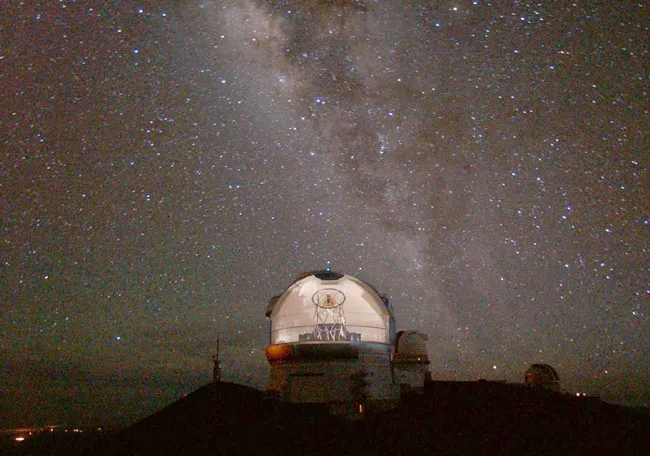
We see the sunset and Gemini North, one of Earth's largest telescopes, preparing to delve into the distant universe. The 8.1-meter flexible mirror of Gemini has truly already taken humanity to distant stars, nebulae, galaxies and quasars, telling us things about the geometry, composition and evolution of the universe. The image above is actually a composite of more than 40, taken while the Gemini dome was rotating; later, an image of a star field seen from that same location was added. The Gemini dome is not transparent—it only appears so because it was rotating while the exposures for this image were being taken. Above the dome, the constellations of Scorpius and Sagittarius can be seen, as well as the broad band of our galaxy, the Milky Way, which includes the direction of the galactic center. The twin of Gemini North, Gemini South, is located on Cerro Pachón, Chile. That night, August 19, 2003, Gemini North only took us to the outer solar system, observing Pluto in a new attempt to better determine the composition of its thin atmosphere.
Credit: Gemini Observatory, Peter Michaud & Kirk Pu'uohau-Pummill
It was the Astronomy Picture of the Day (APOD) for September 9, 2003.
In Spanish at Observatorio.
Images of the week
The best 3D map of the central bulge of the Milky Way is made
Two teams of astronomers have used data obtained with ESO telescopes to create the best three-dimensional map made to date of the central regions of the Milky Way. They have discovered that, from some angles, the inner regions appear to have a peanut or X shape. This strange shape was mapped using public data from ESO's VISTA survey telescope, along with measurements of the motion of hundreds of very faint stars belonging to the central bulge.
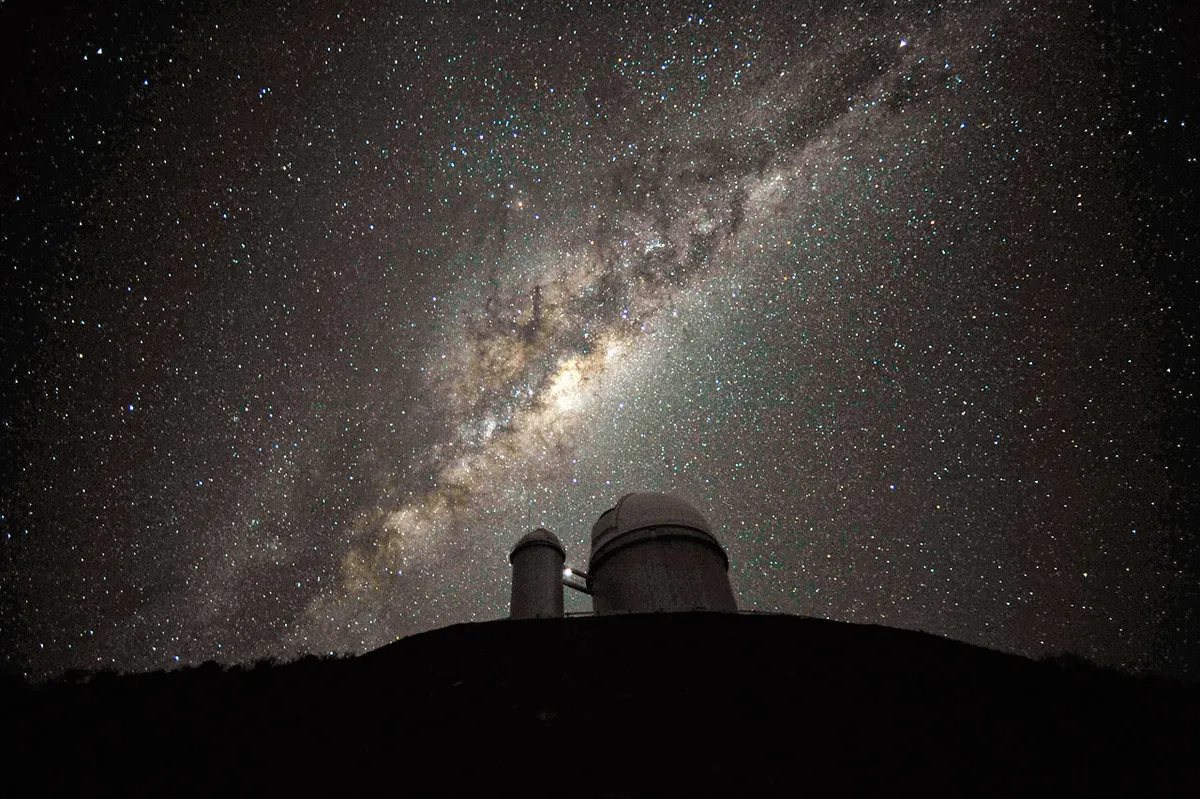
ESO's 3.6-meter telescope at La Silla during an observation. The Milky Way, our galaxy, stretches across this image: we can clearly distinguish a disk-shaped structure seen from one end. Above the telescope dome, illuminated by the Moon and partially hidden behind dark clouds of dust, is the prominent yellowish central bulge of the Milky Way. The entire plane of the galaxy is populated by about one hundred billion stars, as well as significant amounts of interstellar gas and dust. Dust absorbs visible light and re-emits it at a longer wavelength, so it is completely opaque to our eyes. Ancient Andean civilizations shaped their constellations with animal forms in those dark lines. Following the dark line that seems to grow from the center of the galaxy towards the top, we see the reddish nebula around Antares (Alpha Scorpii). The Galactic Center itself is in the constellation Sagittarius and reaches its maximum visibility during the southern winter season. ESO's 3.6-meter telescope, inaugurated in 1976, currently operates the HARPS spectrograph, the world's most precise exoplanet "hunter." Located 600 km north of Santiago, at an altitude of 2,400 meters, on the slopes of the Chilean Atacama Desert, La Silla was ESO's first site in Chile and, at the time, was the largest observatory in the world.
This photograph was taken by ESO Photo Ambassador Serge Brunier.
Credit: ESO/S. Brunier
More at ESO.
Space Music
Particles, by Ulises Labaronnie and Silvia Goytía
In this segment we usually put music. But today it will be a video. It's that it's possible to relate both things to create something new.
This space has different objectives, among them showing that there are bridges between science and art. One of them is that in both cases there is an attempt to understand reality from different points of view.
If science does not merely settle for the apparent, artists do the same by breaking structures and allowing themselves a different look, a different approach to reality. Here is the work of two artists who exhibited at the Sonoimágenes 2013 festival in Rosario.
www.elektronnie.blogspot.com.ar
Animated Science
An amazing view of the Milky Way from La Palma
In this video, two visitors—Randy and Brenda—to La Palma Island in the Canaries, show us what the sky looks like there.
They also tell us what instruments they used: basically a camera, a fisheye lens, a tripod.
In another video, a certain Richard shows us the sky of Australia with four amateur telescopes.
A Breathtaking View of the Milky Way from La Palma from Randy and Brenda on Vimeo.
The equipment used by these people is much more accessible than setting up a large telescope to capture images like the ones we show here at the beginning, like those made with ESO and Gemini telescopes.
Although the equipment used by Richard is much more accessible than setting up a professional observatory, it is still very expensive and out of reach for the masses.
In contrast, the images by the visiting couple in Spain were made with equipment closer to the pocket of the common citizen.
It is clear, however, that there is a long way to go if we want to build bridges between science and society.
Show at the Planetarium
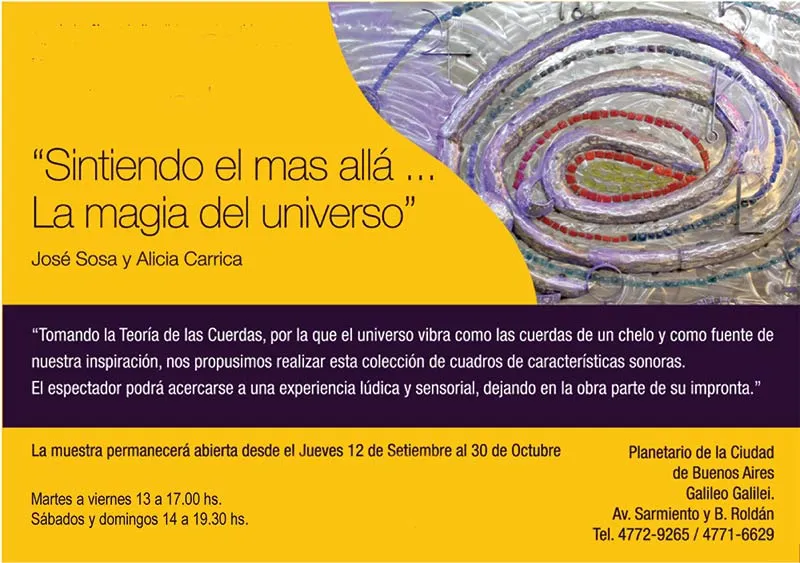
For more information consult the website of the Galileo Galilei Planetarium.
To access previous editions of this section, consult the Multimedia Selection Series. The series attempts to show that the immensity of the universe can be perceived in different ways. I choose some of the images from a decade ago—so they don't fall into oblivion—and from the current week that ends, as well as sounds/music and videos that are artistic forms of expression with content related to astronomy and related sciences. I am also collecting these materials in the Pinterest account