A collection of links to music, images and videos relating art and science. Today: Images of standing eggs, myth and equinox; A new star in the neighborhood. Music: Blue Lunar Quartet - Equinox reggae. Video: The ecliptic and the seasons.

Images of the decade
Egg-ing the autumnal equinox
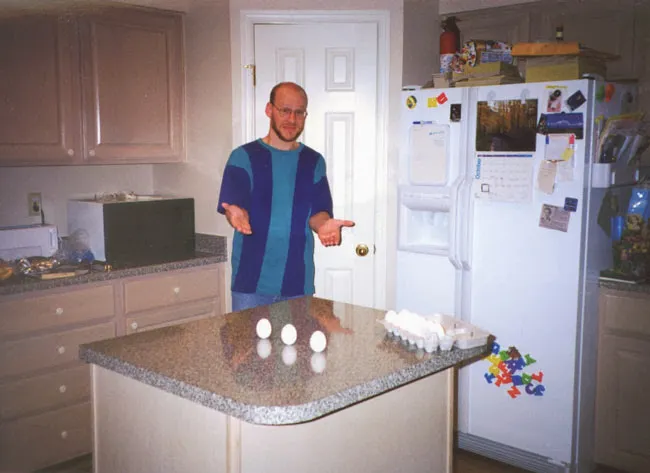
On the autumnal equinox: should eggs be able to stand on end?
There is a myth that says that ONLY on the vernal equinox is it possible to stand a raw egg.
This long-lived myth loses much of its mysticism after a demonstration that you can stand an egg on end any day of the year.
Above we see how Dr. Phil Plait (Sonoma St. Univ.), author of the BadAstronomer blog, balanced three raw eggs on end in late October 1998.
Then, more modestly, his wife balanced five more.
The little-appreciated fact that most eggshells have small dents allows this seemingly impossible task to be accomplished.
Although during an equinox every place on Earth experiences equal length for day and night (12 hours each), this fact has no practical effects on the stability of eggs.
Note: Sometimes it is said that, in the times of the internet or the information society, this type of myth or false truth is easily verifiable. However, it is not quite so. A person can read about a "curious" fact in a forum, it catches their attention, they remember it, but no real interest in verifying it arises and the idea sticks. Astrology is based on myths and, yet, many people still consider it "true" and horoscopes are published in newspapers with total naturalness.
It was the Astronomy Picture of the Day (APOD) for September 23, 2003. In Spanish at Observatorio.
Note 2: The equinox does not always occur on the same day. Since the note was originally published ten years ago, it is indicated -in the original note- that the phenomenon had occurred that same day. This year, a decade later, the vernal equinox occurred on September 22 at 20:44 UTC.
Images of the week
A new star in the neighborhood
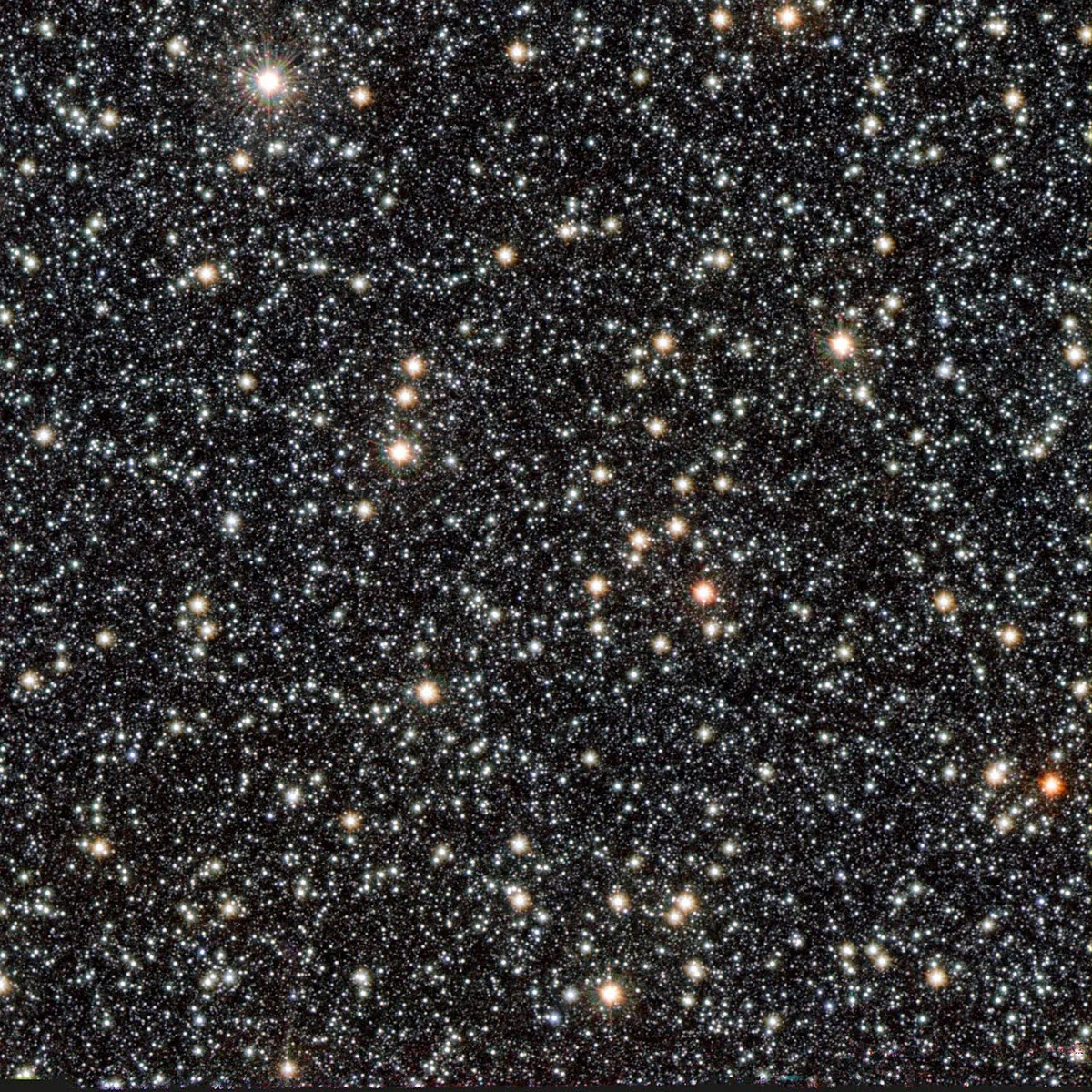
At the center of this new image (on which we can zoom), obtained by ESO's VISTA telescope, we can see VVV BD001, a newly discovered brown dwarf. This is the first brown dwarf detected by the VVV survey in our cosmic neighborhood. VVV BD001 is located about 55 light-years away, towards the crowded center of our galaxy.
Brown dwarfs are stars that have not managed to grow to become stars like, for example, our Sun. They are often called "failed stars"; their size is larger than planets like Jupiter, but smaller than a star.
This dwarf is peculiar for two reasons: first, it is the first found if we look towards the center of the Milky Way, one of the most crowded regions of the sky. And second, it belongs to an unusual type of stars known as "unusually blue brown dwarfs" — it is not yet well understood why these stars are bluer than expected.
Brown dwarfs are born like stars, but they do not have enough mass to trigger the "burning" of hydrogen and thus become a normal star. For this reason they are much colder objects and emit much less light, making them harder to detect. Generally, astronomers search for this type of object using special telescopes and cameras that observe in the mid and near infrared, a range sensitive to these very cold objects, but they usually avoid looking in areas teeming with stars — like the central region of our galaxy, for example.
VISTA (Visible and Infrared Survey Telescope for Astronomy) is the world's largest survey telescope and is located at ESO's Paranal Observatory in Chile. It is carrying out six independent sky surveys, and the VVV survey (VISTA Variables in the Via Lactea) is designed to catalog a billion objects located in the center of our galaxy, the Milky Way. VVV BD001 was discovered by chance during this survey.
Scientists have used the VVV catalog to create a giant color image of 108,200 by 81,500 pixels containing nearly nine billion pixels (eso1242), one of the largest astronomical images ever produced.
Credit: ESO, and D. Minniti and J. C. Beamín (Pontificia Universidad Católica de Chile).
It was the ESO Picture of the Week.
Space Music
Blue Lunar Quartet: Equinox reggae
This quartet from North Carolina, called Blue Lunar Quartet, on their self-titled album available on BandCamp, performs the track Equinox Reggae. Despite the title, the style of the track and the band is jazz.
Animated Science
The ecliptic and the seasons
What is the equinox after all? It is when the ecliptic and the celestial equator coincide, which happens twice a year, in March and September. And what is the ecliptic?
Videos can be a good educational tool. But if the topic interests you, there are other more elaborate sources of knowledge.
http://youtu.be/gsZrTYeW0Tw
Are there equinoxes on other planets? The cause of equinoxes is the same as the origin of the seasons: the tilt of Earth's equator relative to the plane of its orbit. Mars has a tilt similar to our planet, so from the red planet equinoxes would also be experienced.
Does something special happen on those days? There are things that happen every day, like sunrise and sunset for Earth's inhabitants. Eclipses happen from time to time. As a phenomenon becomes less frequent we consider it infrequent and, in that sense, they are special. Equinoxes are special because they occur only twice a year. Only for that reason. Sunlight has the same energy any day. We do not receive a "special energy" on those days. That's what ancient humans thought. They also thought the Earth was flat and the center of the Universe.
To access previous editions of this section, consult the Multimedia Selection Series. The series attempts to show that the immensity of the universe can be perceived in different ways. I choose some images from a decade ago -so they don't fall into oblivion- and from the current week that ends, as well as sounds/music and videos that are artistic forms of expression with content related to astronomy and related sciences. I am also collecting these materials on the Pinterest account