A collection of links to music, images and videos relating art and science. Today: Images of the Horsehead Nebula; The Toby Jug Nebula. Music: Horsehead Nebula by acrampinmythorax. Video: The sky in the cloud.

Images of the decade
The Colorful Horsehead Nebula
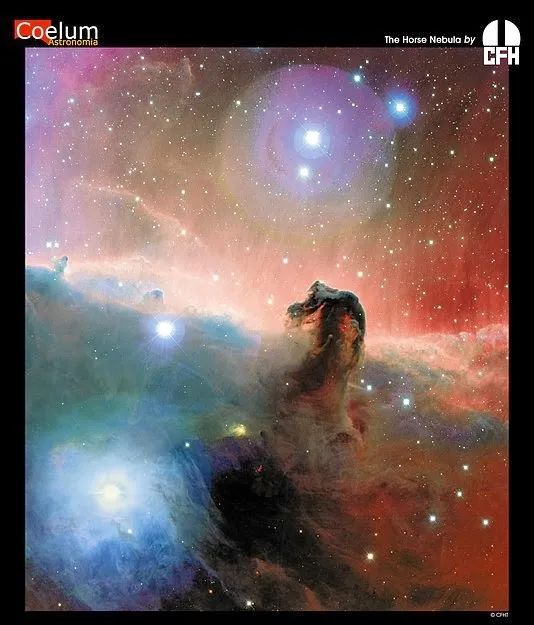
As it drifts through the cosmos, a magnificent cloud of interstellar dust is sculpted by stellar radiation and winds, thus assuming a recognizable shape.
With a very fitting name, the Horsehead Nebula is included in the vast and complex Orion Nebula.
The dark molecular cloud, which is approximately 1,500 light-years away, was cataloged as Barnard 33 and is visible only because its dust is silhouetted against the glow of the emission nebula IC 434.
The blue glow of the reflection nebula NGC 2023 is seen below, to the left.
The prominent horse head is only part of a larger dust cloud, seen along the entire bottom of the photograph.
The Horsehead Nebula is difficult to observe with a small telescope. This beautiful color photograph was taken by the large 3.6 m Canada-France-Hawaii Telescope in Hawaii, USA.
It was the Astronomy Picture of the Day (APOD) for October 7, 2003. In Spanish at Observatorio.
Credits & Copyright: Canada-France-Hawaii Telescope, J.-C. Cuillandre (CFHT), Coelum.
Images of the week
The Toby Jug Nebula closer up
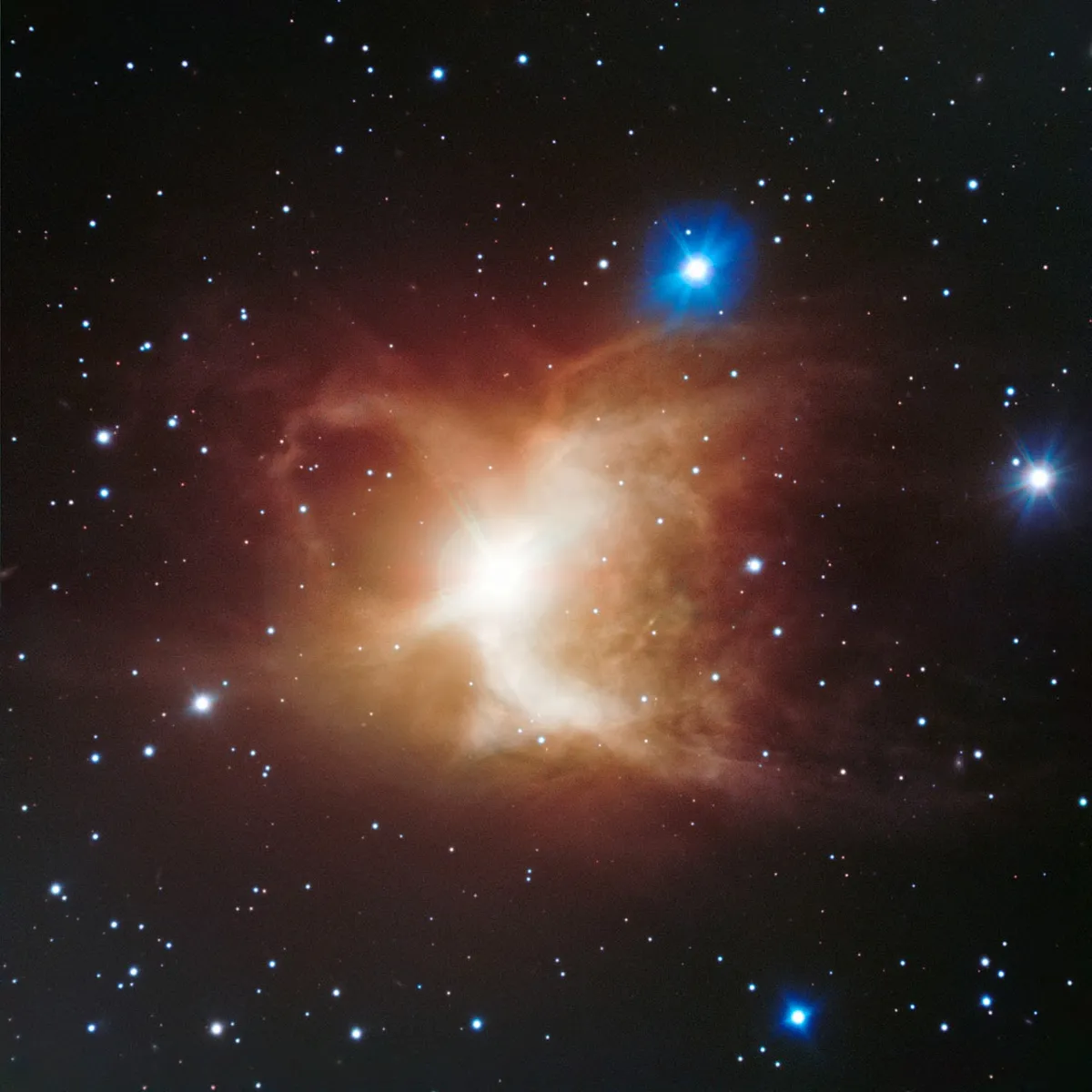
ESO's VLT (Very Large Telescope) has captured a surprisingly detailed image of the Toby Jug Nebula, a cloud of gas and dust surrounding a red giant star. This image shows the characteristic arch-shaped structure of the nebula, which, true to its name (in English, "Toby Jug" refers to beer mugs shaped like a man), resembles a jug with a handle.
Located about 1,200 light-years from Earth, in the southern constellation of Carina (The Keel), the Toby Jug Nebula, formally known as IC 2220, is an example of a reflection nebula. It is a cloud of gas and dust illuminated from within by a star called HD 65750. This star, of a type known as a red giant, has five times the mass of our Sun, but is in a much more advanced phase of its life, although, in comparison, it is young, being only about 50 million years old.
In billions of years our Sun will also reach the red giant phase. The solar atmosphere is expected to expand beyond Earth's orbit, engulfing all the inner planets in the process. By then, Earth will not be at its best. The great increase in radiation and the strong stellar winds that accompany the stellar inflation process will destroy all life on Earth and evaporate the water from the oceans before the entire planet ends up melted.
British astronomers Paul Murdin, David Allen and David Malin gave IC 2220 the nickname Toby Jug Nebula because of its shape, similar to an old English jug called a Toby Jug that was familiar to them in their youth.
This image was obtained as part of ESO's Cosmic Gems program, an outreach initiative intended to produce images of interesting, striking or visually attractive objects using ESO telescopes for educational and outreach purposes. The program uses observing time that cannot be used for scientific observations. All data obtained are made available to astronomers through the ESO science archive.
The image was published by ESO on October 9, 2013.
Credit: ESO.
Space Music
Horsehead Nebula, by acrampinmythorax
This musician from the United States named Nathan Staupe created this track uploaded to SoundCloud, inspired by the object Barnard 33, the Horsehead Nebula.
Animated Science
The sky in the cloud
Saturday at 20 h in Buenos Aires. Very cloudy sky. But if there were no clouds, you could observe Venus near Antares in Scorpius and perhaps also Mercury and Saturn, closer to the horizon. It may happen that a person can look out their window or from the garden at the night sky and wonder what those very bright objects are. One way to find out is by using software. And if clouds sometimes bother, another "cloud," the computing cloud, allows us to access web services such as Sky View Café, an online planetarium. Although it is in English, it is very simple to use and fulfills that function: knowing what objects are in the sky we see. On the blog De Tales a Newton, Juan Meléndez Sánchez took the trouble to make this educational video to explain the use of the site.
Looking at the sky: 1.- Introduction: The moving sky from De Tales a Newton on Vimeo.
To access previous editions of this section, consult the Multimedia Selection Series. The series attempts to show that the immensity of the universe can be perceived in different ways. I choose some images from a decade ago -so they don't fall into oblivion- and from the current week that ends, as well as sounds/music and videos that are artistic forms of expression with content related to astronomy and related sciences. I am also collecting these materials in the Pinterest account