A collection of links to music, images and videos relating art and science. Today: Images of NGC 6888. Westerlund 1. Music: Entropy, by Benigno Lunar. Video: The Umbrellas of Thessaloniki and entropy.

Images of the decade
Crescent Nebula
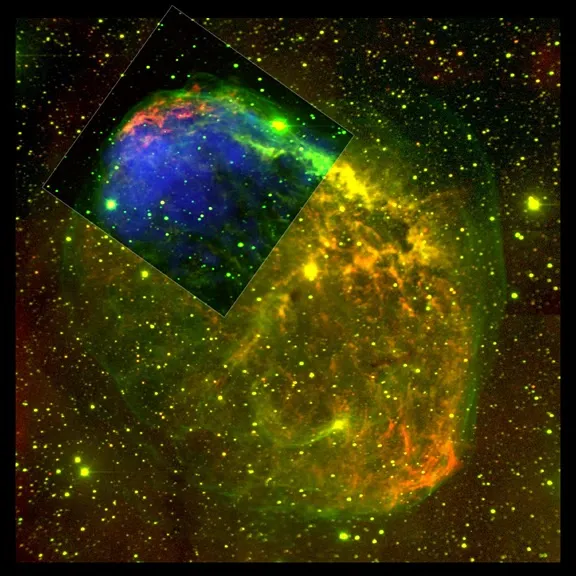
Massive stars have very short and spectacular "lives". Another star, but from Hollywood, shared the same idea: James Dean popularized the saying "Live fast, die young and leave a good-looking corpse".
This composition in X-rays (blue) and optical (red and green) reveals in dramatic detail a portion of the Crescent Nebula (NGC 6888), a giant gas cloud created by the winds of the massive star HD 192163 (at 5000 light-years away), also called WR 136, which is not seen in the photo.
After only 4.5 million years (one thousandth the age of our Sun), the star began its path to supernova. First it expanded enormously to become a red giant and eject its outer layers into space. Two hundred thousand years later the intense radiation from what remained of the star began to push the gas at incredible speeds.
When that wind collided with the previously ejected material, a dense shell was created. In the image, a portion of that shell is shown in red. The force of the collision created two shock waves: one moving outward to create the filamentary structure in green, and another moving toward the shell to produce a bubble of very hot gas (in blue). The massive star that originated all this cosmic mess appears as a bright point at the center of the image.
It's not that the star was a "rebel without a cause": like the others, during its life it had to deal with a struggle between the pressure of radiation, outward, and the force of gravity, inward, in search of equilibrium. Who wins? Entropy...
The image was part of a scientific investigation and was published on the Chandra site on October 14, 2003.
Credits: X-ray: NASA/UIUC/Y. Chu & R. Gruendl et al. Optical: SDSU/MLO/Y. Chu et al.
Images of the week
A surprise cloud around a gigantic star
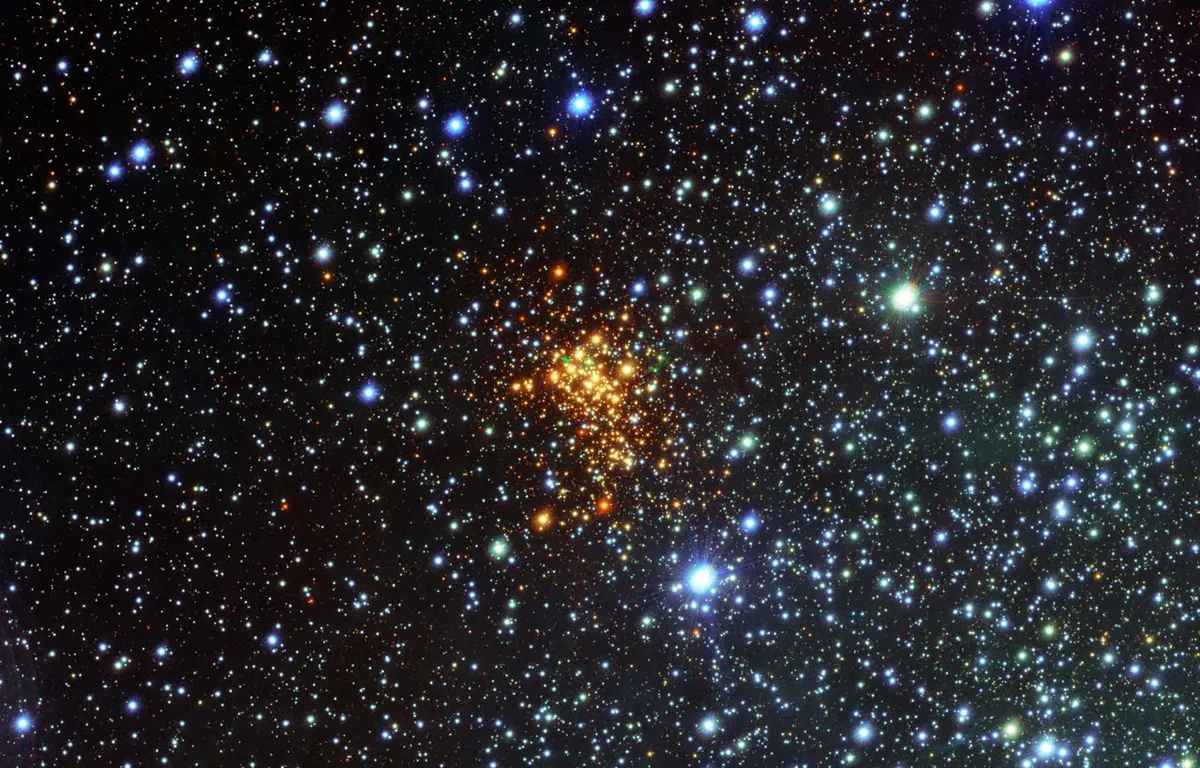
In this new image from the VST (VLT Survey Telescope), installed at ESO's Paranal Observatory, we can contemplate the extraordinary super star cluster Westerlund 1. This exceptionally bright cluster is located about 16,000 light-years from Earth, in the southern constellation of Ara (The Altar). It contains hundreds of very massive and bright stars, all of them only a few million years old — in stellar terms, they are star "babies". But our view of this cluster is hindered by gas and dust that prevents most of the visible light coming from the star cluster from reaching Earth.
Now, astronomers studying images of Westerlund 1 from a new survey of the southern skies have located something unexpected in this cluster. Around one of the stars — known as W26, a red supergiant and possibly the largest known star — they have discovered clouds of glowing hydrogen gas, which we can see in green tones in this new image.
This type of glowing cloud around supermassive stars is very unusual, and even more so around a red supergiant— it is the first ionized nebula discovered around this type of star. W26 itself would be too cold to make the gas glow; astronomers speculate that the source of the ionizing radiation could be either hot blue stars somewhere in the cluster, or possibly a fainter but much hotter companion star to W26.
W26 will eventually explode as a supernova. Studying objects like this new nebula around W26 will help astronomers understand the mass loss processes these massive stars undergo, which leads to their explosive end.
Credit: ESO/VPHAS+ Survey/N. Wright
It was the ESO Picture of the Week
Space Music
Benigno Lunar: Entropy
This group from Córdoba recorded the album "Astronauta" in 2009. From there I share the track Entropy. Benigno Lunar are Emanuel Bastos (drums), Guillermo Ochoa (first guitar), Robertino Metral (bass and vocals) and Nicolás Rizzo (guitar and vocals).
Animated Science
The Umbrellas of Thessaloniki
In that Greek city there is a famous sculpture or installation that attracts tourism and was created by the artist Georgios Zoggolopoulos (1903-2004).
Depending on the season of the year and the weather, it generates a different image in space and the environment for the viewer.
On Vimeo, a couple of years ago, a user recorded the sculpture during the day. It certainly awakens several poetic senses.
Everything we see in the video, everything, requires energy. And not all energy can be used. A part is not "useful".
With human beings, does the same thing happen? Is what's important utility?
What is the utility of Mozart's work or that of Atahualpa Yupanqui? What is the utility of knowing more about Westerlund 1?
And are these questions useful?
To learn more about the umbrellas visit MMCA.
entropia from Dafni Psarra on Vimeo.
To access previous editions of this section, consult the Multimedia Selection Series. The series attempts to show that the immensity of the universe can be perceived in different ways. I choose some images from a decade ago -so they don't fall into oblivion- and from the current week that ends, as well as sounds/music and videos that are artistic forms of expression with content related to astronomy and related sciences. I am also collecting these materials in the Pinterest account