What does a professional astronomer do? What is their work, their daily life like?
In this blog I have been showing what types of relationships exist between astronomy and society, for example through music. In that search, years ago I found a page by astronomer Paul Francis that contained links to music.
Francis is an astrophysicist at the Australian National University who, in addition to researching comets, Lyman-alpha objects and quasars, has dedicated himself to teaching and thinking about astronomy education.
To teach, he has used and designed role-playing exercises based on problems. He has written about it on his website.
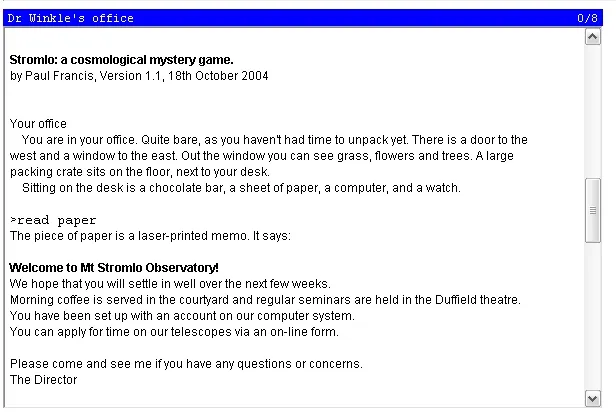
One of these games is called Stromlo: a Cosmological Mystery.
The entire game is in English, so proficiency in that language is essential to play it. It is not a common game. At least not for the most rabid contemporaneity: it is a text adventure.
It is possible to establish a classification of video games. One way to divide them is by platform. This is a computer game, not for consoles. Among video game genres we will find a genre that has been left aside: interactive fiction or text adventures. This is because its graphical interface does not contain moving images, but only text. (There are interactive fictions that contain some reference image).
Therefore, it is not a "common" game for today: you don't have to kill aliens. But a role is assumed, as in any video game, in this case the role of a professional astronomer. This astronomer's task will not be to go out and kill journalists with their telescope, but to investigate.
The game was written in the TADS language.
The game file is downloaded from the page for that purpose on Paul Francis's site.
To run the file, a program is needed which is downloaded from the same page.
There is an online version that uses Jetty, a Java interpreter. It requires us to give it permission.
Within the game page there is a link to another page: the manual.
There we are told that the game is designed for us to discover for ourselves the Big Bang theory and how it was discovered. (Actually, the expansion of the universe).
We play the role of a young astronomer who recently passed their doctoral thesis and has a position at the prestigious Mount Stromlo Observatory (in Australia). We must walk around the mountain, use telescopes, search in the library, talk with other astronomers and combine all the necessary clues to discover how the universe began.
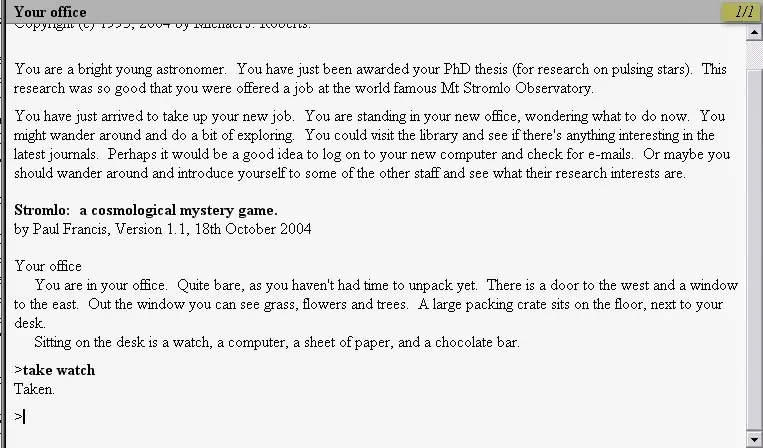
The character whose role we will assume wrote a thesis on variable stars (RR Lyrae). We have just obtained the position at the Observatory, we are in our office, in which there are some objects. We don't know anyone.
The interactive fiction is based on "dialoguing" with the program through text. At the beginning we will be told that we are in the office and that there are some objects there.
Communicating
To interact with the game we will have to use some commands:
To head somewhere we will use the cardinal points. All commands can be abbreviated. In this case, typing n, s, e, w, we will go north, south, east, west.
If we cannot advance where we indicate, the program will return a message saying that we cannot go there.
On the other hand, if we can advance in the indicated direction, it will tell us what is in that direction.
It is also possible to go up or down (up, down)
The game can be saved (save).
The character will be able to look (look), examine (examine), read (read), say and ask (ask, tell), wait (wait), observe (observe), take (take), log on (regarding the computer).
For example, at the beginning we will be told that we have some objects in the office. Some we can take, others we will have to examine. When examining we notice something in detail that we can then, for example, read.
The thesis that the character wrote is around there and it will be necessary to read it.
Upon leaving their office, the character (that is, us), we will find ourselves with hallways, as we are inside a building. In those hallways there will be other offices and in them, people. We will have to ask and tell these people, who are astronomers of both sexes.
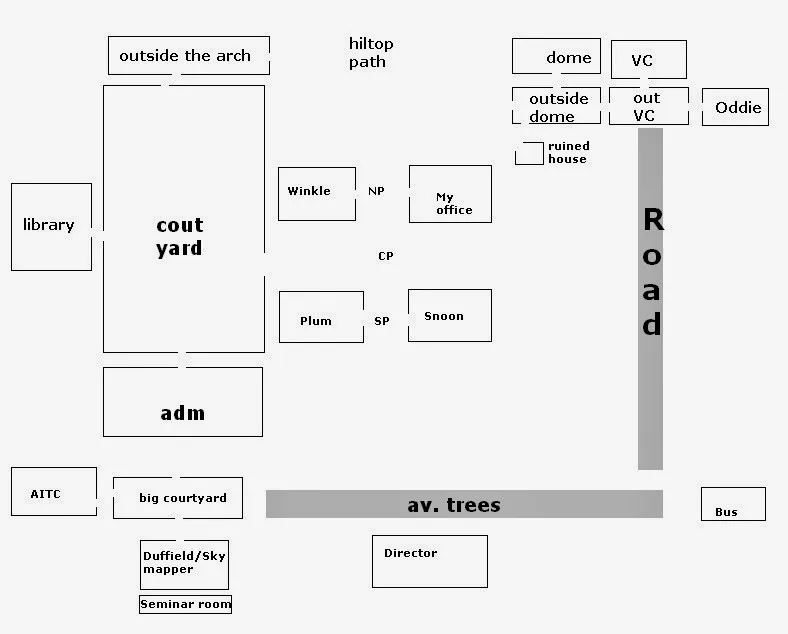
If we wander around the place we will see that it is easy to get lost. This is common in this type of game, to the point that there are tools to create schematic maps of interactive fictions.
Without using those tools, I made my own sketch on paper, so as not to get lost. When transferring it to the PC, it looked something like this:
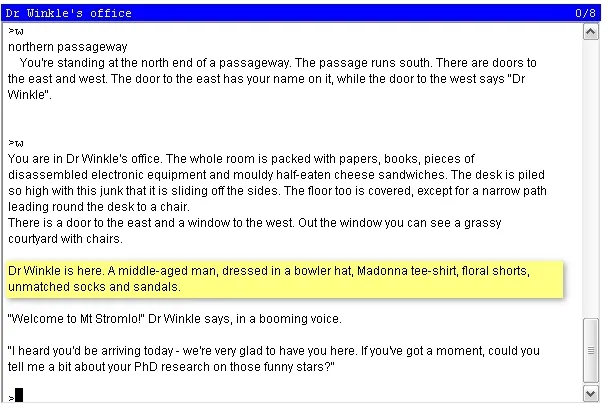
On the tour we will meet other astronomers. Note that they are described: what they do and how they look (age, clothing).
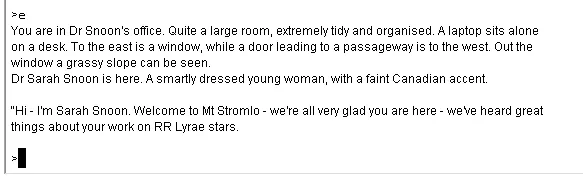
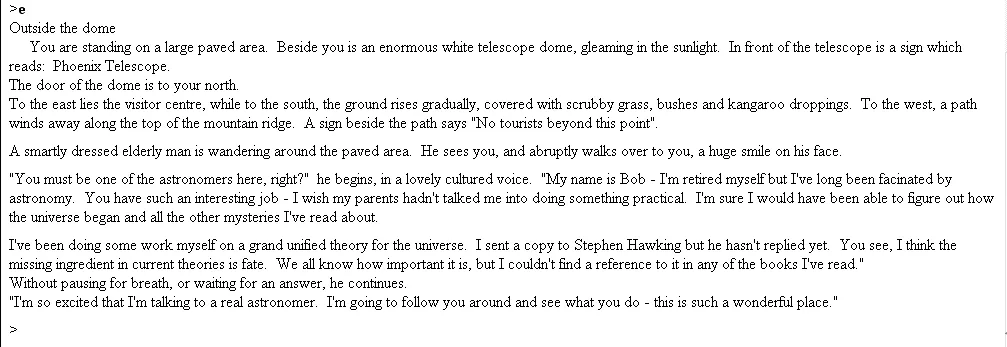
One part is very funny where our character finds, near the Visitor Center, a curious amateur with strange ideas. It will be difficult to get rid of him because he will stick to us like a fly to soup. (I must confess that I tried to "kill him", but that is not the solution...)
Everything takes place at Mount Stromlo Observatory. All fiction contains real-world data. In this case, that Observatory exists. If you search the web, we will even find a map of the place, and we will notice that the design of the fictional place has some relation to the real space.
Points
Both in the online version and the PC version we will notice that at the top right two numbers are indicated. The first number refers to "goals achieved" and the second to the "number of steps".
The game has a final objective for which several intermediate things need to be achieved. That measures the first number, the intermediate achievements. The second is the number of moves.
Attending a seminar, taking some objects, obtaining telescope time, observing objects, reducing them, are some of the actions that can be considered intermediate "achievements" for the academic end.
The game makes use of time in various ways. The z command allows waiting, making time pass. If we look at the clock and it is noon, after a few z's, it will be afternoon.
Also, upon reaching certain points, the character will go home (motu proprio), sleep and be back in the office in the morning.
From the computer in our office we can fill out a form to request observing time. We will be asked on which telescope and what type of objects we want to observe and for what purpose.
We will be answered by mail. But not really! We must wait for the game time to pass and then check the mail in the program. It's possible we won't be granted the requested time the first time.
Investigating
If the game has an internal objective, it is an objective associated with astronomical research. How to investigate?
Well, let's start from the basis: our character did a thesis.
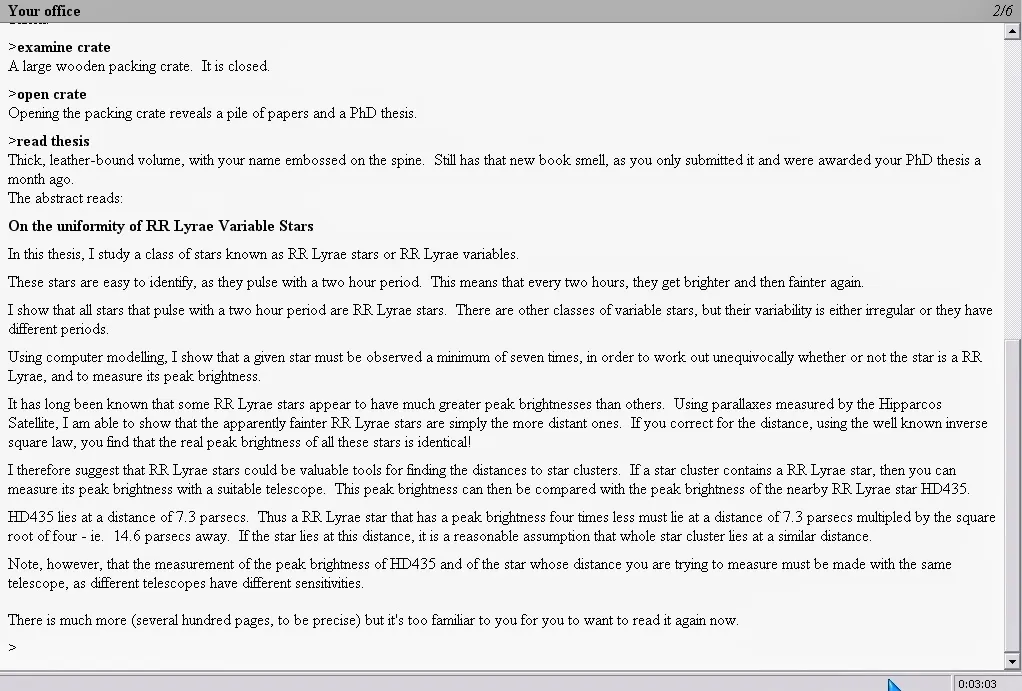
The thesis is about the variability of RR Lyrae stars. With that information and the inverse square law, we could calculate distances to distant objects. If we read other documents, talk with the other astronomers, we will notice the main contradiction of the game: although everything seems to happen in the present (there is a telescope called Phoenix because it "rose" from the ashes, as it suffered a fire, a real fact from 2003), there is a technology center, there are computers. But what we discuss with other astronomers tells us that we are, in reality, in the 1920s, in terms of astronomical knowledge. It is the decade of the "Great Debate": were those observed nebulae galaxies (island universes) or part of the Milky Way?
The mystery was solved by Edwin Hubble (thanks to contributions like those of Henrietta Leavitt).
So that must be the internal objective of the game. To discover that those nebulae are indeed other galaxies very far from ours. The next step would be to realize that they are moving away from us at a constant rate.
So, while playing I thought I had to find clues to achieve this.
One clue I found was this:
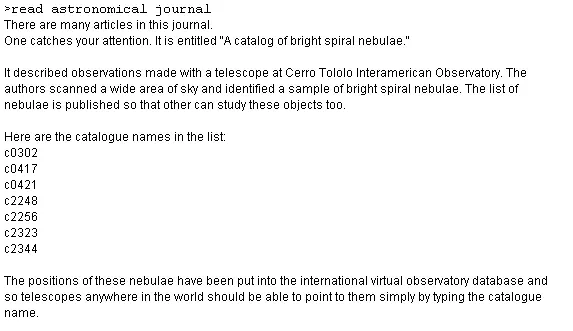
It is a listing of spiral nebulae (which we will later call galaxies). The final phrase is indicative: with these designations I could use a telescope. However, I should observe RR Lyrae stars in those galaxies. Will there be a catalog? I didn't find it. But...
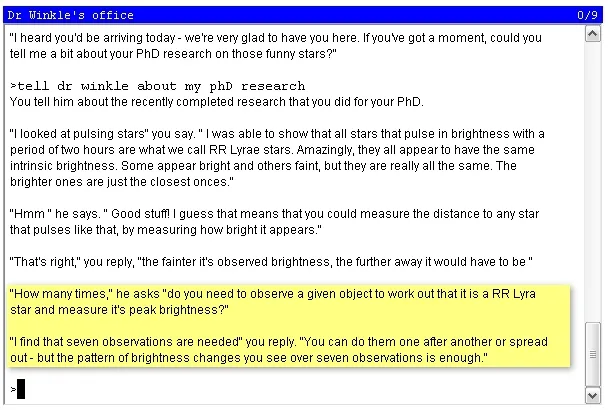
With this data it's not enough. But... if we reread the thesis, the distance to an RR Lyrae is indicated. Let's try with that data.
OBSERVE AND ANALYZE
So I had to request observation time. It was a bit hard to find the right commands, but I managed. The first request was denied. What a disappointment! And now?
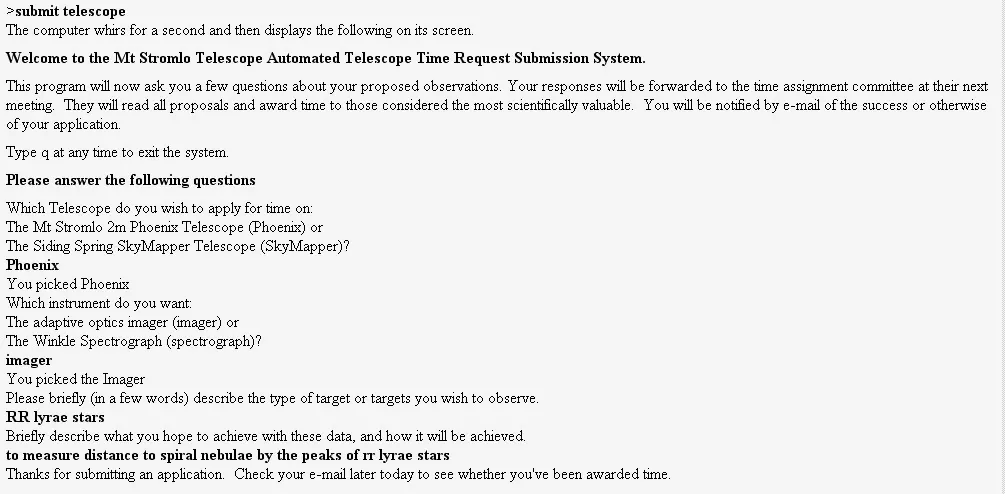
I wandered around there, attended seminars, talked.
And I tried again. This time, yes. This is getting exciting!
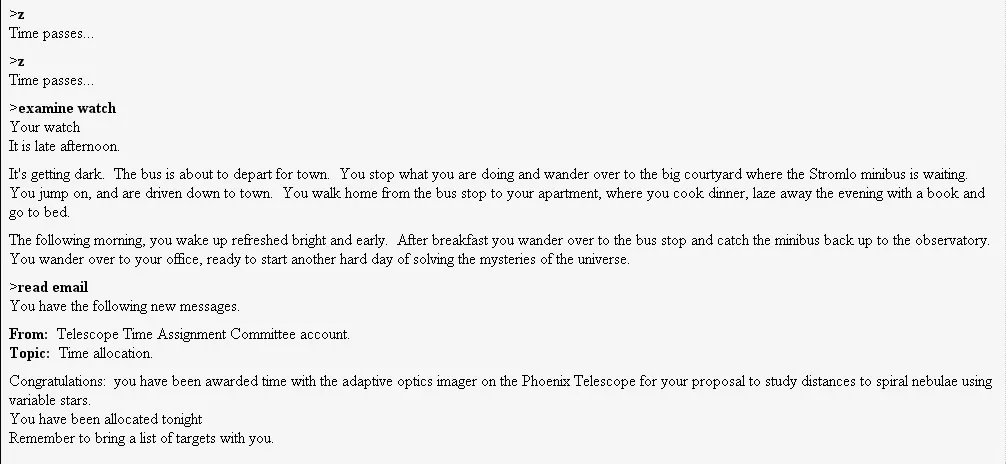
I couldn't wait to use the telescope, so I made time pass. And the moment arrived.
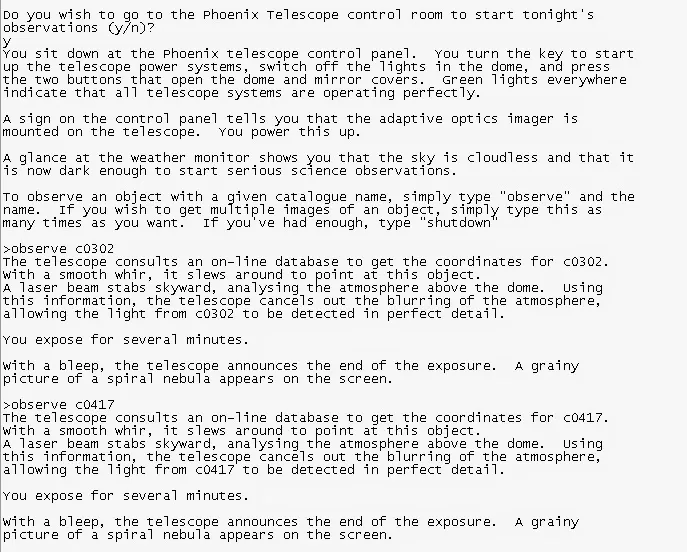
This way I observed each object from the Astronomical Journal listing seven times, plus HD435.
And now?
We'll have to analyze those images. I went back to the computer. What will the command be?
Ah...
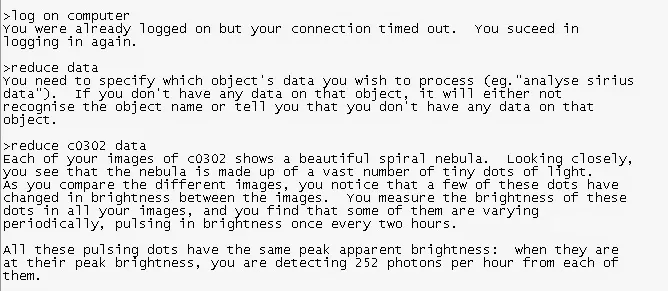
And also:

Wow! That's a difference. For what reason would we have so many photons per second from HD435 and so few in the rest of the objects?
If we do some calculations, and indeed our thesis is correct, then the "spiral nebulae" from the paper, which send a few hundred photons per hour, must be much farther away than HD435 which sends trillions of light particles per second!
THE ROLE OF THE ASTRONOMER
To characterize is to know. But it is also to know partially. The characterization that the mass media make of scientists in general and astronomers in particular is very poor, in my view.
Being an astronomer is a job and therefore, a social practice. This game includes several aspects of such practice: the bureaucratic relationship with institutions (the administrator will tell us we must fill out a form again); with the Observatory Director; with the other astronomers. The latter can lead to "healthy" competition or to a savage statistical sport.
A command the game does not have is Write. Nor Teach or Talk (Conference). Furthermore, the game is based on the work of the astronomer, so it is reduced to their stay at the Observatory. We are told they go home and nothing more.
Despite these missing aspects, logical because it would be difficult to contain everything, it is a good way to delve into the academic world, especially for people who want to pursue a university career, as well as for students in the first years.
On his page Paul Francis has given an account of results, positive and negative, of using these games in class, as well as other types of role-playing games.
I think it is an interesting and pedagogical way to understand that a university career is a job that involves a process over time. And that this process is by definition dynamic, changing, that establishes relationships between subjects and the use of objects. The purpose of the game, the meaning Francis wanted to give it, is surely more specific to astronomy education: the correlation of previous data (theory), with the obtaining and analysis of new data (practice).
But what is the objective of astronomical practice? To produce new knowledge?
It happens that if the ultimate goal were such, then there would be a little problem. The discourse would not circulate. To communicate is as important as to produce. But, communicate to whom? How? With what language and with what idiom, and in what context?
If, as I said, astronomy is a social practice, then it should leave the universities and observatories. After all, it should be done for that. But for it to leave, first you have to enter. And Stromlo: a Cosmological Mystery is an excellent introduction to professional astronomy.
Sources and related links
- PAUL FRANCIS, Using Role-Playing Games to Teach Astronomy: An Evaluation
AER 4, 1 (2005); http://dx.doi.org/10.3847/AER2005016 - Paul Francis's site
- Stromlo: a Cosmological Mystery
About the images
- Screenshots of the PC and online version of Stromlo Game.