A physics video went "viral". A paper attempts to account for the causes.
As part of a bachelor's degree in physics at the University of Bath, England, students carried out a year-long project for their final work, in teams of two, one day a week. In the 2011/2012 academic year one of the projects, based on the Leidenfrost effect in water droplets, produced results of sufficient quality and quantity to be published in a journal from the Nature group. (#1)
It was also accompanied by a modest communication from the university's press office (#2). Despite the small scale of the "publicity", the project received substantial attention and was covered by several science blogs. However, even before the publication of the paper and the press release, there were signs that there was something attractive about the topic due to the way the students were captivated by the physical phenomenon.
The authors considered that beyond its relative accessibility and novelty, the visually astonishing nature and the sound contributed to creating a feast of visual, auditory, and kinesthetic sensations in accordance with the preference model for learning of the VARK model.
The experience, along with the filming and photography recorded during the project, were presented at a meeting of artists and scientists whose goal was to explore possible collaborations to communicate science in an entertaining way.
http://youtu.be/w0lMJcAfzU4
The video shows that the Leidenfrost Effect occurs at a temperature higher than the boiling point of water, in this case. It first shows what happens with a surface below the Leidenfrost temperature and then what happens with a higher temperature is perceived, showing the elapsed time. Then it is indicated, in English, that when the hot surface has the shape of small saw teeth, the droplets are propelled in a fixed direction. Then the labyrinth is shown.
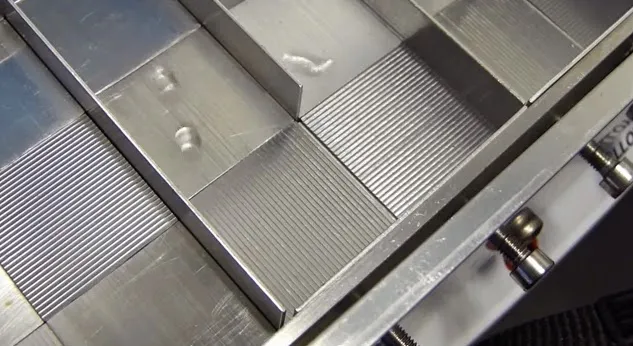
The initial project laid the groundwork for a later one: the project carried out during the 2012-2013 academic year was to design, build, and test a demonstration to be used in science outreach events, with the sole requirement of using water. As a conclusion, it was chosen to make a "Leidenfrost Labyrinth". It was an aluminum structure with 30mm squares per side, 13mm thick, with different surface textures (smooth or with sawtooth topography).
The labyrinth is operated by placing it on a hot spot, keeping the surface temperature in a range of 240-270ºC and then simply dropping water droplets. Small blocks with an inclined surface and a depression were also prepared.
The Use of the Labyrinth
The experiment was used in university open days and in local schools. A video was also made to be used in the demonstrations, as well as with the goal of the audiovisual being another outreach resource (beyond the demonstrations). For this, it was chosen to publish the video on YouTube.
A paper was recently published recounting these facts, as well as analyzing the statistics of the video in question. In addition, the scientific basis is reviewed.
In the analysis of the video (a discourse) it is indicated that the public does not want to wait long for something to surprise them. On the other hand, it is considered that the impact of the video is not given only by the number of views, but by the meta-discourses, that is, websites, blogs, social networks where the referred video is commented on. In such communications it is noted that many have researched the Leidenfrost effect in resources like Wikipedia since part of the text from the online encyclopedia appears in the blogs.
The most interesting thing about the recently published analysis is that, although it takes quantitative statistics into account, the droplet experiment is not exhausted in mere quantities.
Comments on blogs, social networks, as well as television programs (like the Spanish program El Hormiguero) took up the topic (see on YouTube). Among the conclusions of the paper's authors, it is indicated that the key ingredient was the combination of accessibility (being understandable) with novelty. The video was also part, last October, of the BBC2's IQ program (see on YouTube).
Among the public feedback inspected, some very amusing ones are rescued. Comments like "I feel sorry for the poor little droplets" or "I can almost hear the drops saying 'Ouch, Ouch, hot, hot'".
The paper is accompanied by statistical data, some of which I show here.
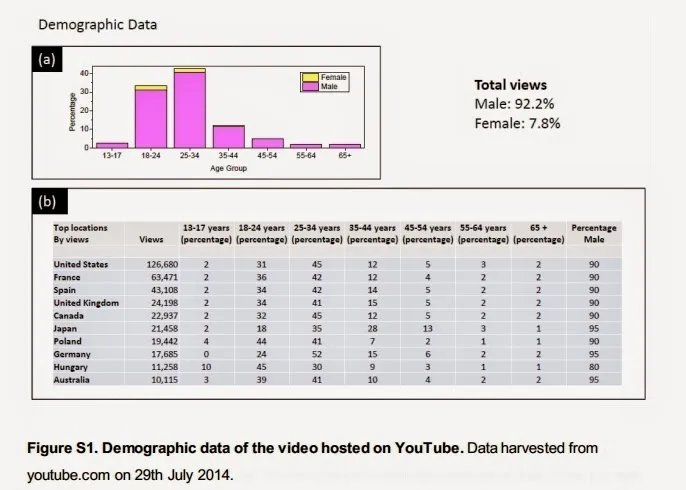
In image 1 we see two graphs. Graph (a) shows the percentage of the audience that watched the video by age range and sex, with data harvested from YouTube as of 07-29-2014.
As can be easily seen, the majority were men (pink color) and the majority of women who watched the video were between 18-24 and 25-34 years old.
Graph (b) shows that a majority of the views were from the United States with twice as many views as from France. Except in Poland and Hungary, the highest percentage by age was in the 25-34 year range and in all cases the relative number of men is widely superior to the female audience.
These data, as the paper's authors point out, cannot be easily extrapolated, but they should be taken into account.
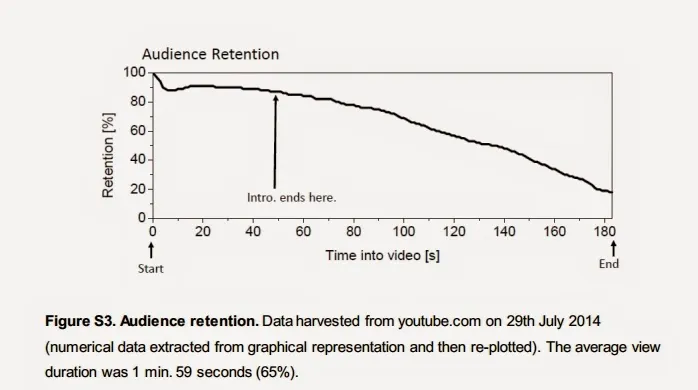
Audience retention shows that, beyond a valley in Figure 2 -which could be considered an accidental pause of the video-, the public begins to lose interest after 50s, when the introduction ends. The average duration of the views was 2 minutes (65%). The video lasts 180 seconds.
SCIENCE AND COMMUNICATION: MORE QUESTIONS THAN ANSWERS
The paper demonstrates that not only does how the universe works matter, from a "natural" point of view, which leads scientists to experiment, theorize, and discover phenomena like the Leidenfrost effect. But it is also important to know why people do what they do.
As a synthesis, one might then ask: why do physicists do what they do?
There is no doubt that there is no science without communication. This is widely agreed upon if communication is considered as part of the scientific work intended for the scientific community.
In my view, it is necessary to be broader. There is no science without communication, both to the community of researchers and to the general public.
Otherwise, science ends up being the property of an elite.
Even though this may seem logical, rational, and necessary, the idea that mass communication is a mere simplification, a vulgarity, still lingers within the scientific community.
But we must take another step further. If we agree on the need to communicate science to the general public, we should still ask ourselves: for what? With what objective?
Could it be to know for the sake of knowing? Could it perhaps be to teach in order to produce? To produce what?
These are not scientific questions (or not entirely scientific) but rather philosophical ones. Because if there is no science without communication, there is also none without reflective thought.
Sources and related links
- The paper discussed here is The Leidenfrost Maze, Carmen Cheng et al 2015 Eur. J. Phys. 36 035004 DOI::10.1088/0143-0807/36/3/035004. The article is FREE.
- (#1)Enhanced Droplet Control by Transition Boiling, Alex Grounds, Richard Still & Kei Takashina, Scientific Reports 2, 720 doi:10.1038/srep00720
- PhysicsWorld: What makes a physics experiment go viral?, by Tushna Commissariat
- (#2)U. of Bath: When the heat is on, water travels uphill, 30-10-2012
About the images
- Image 1 and 2 taken from the paper Carmen Cheng et al 2015 Eur. J. Phys. 36 035004.
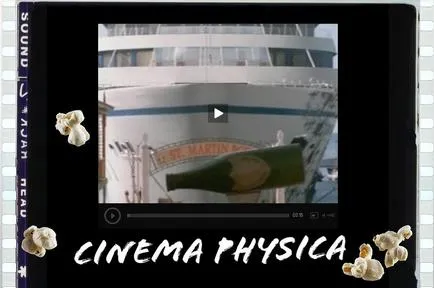
- Initial image: Screenshot from the video on YouTube.