Knowledge as entertainment in the era of remote silliness.
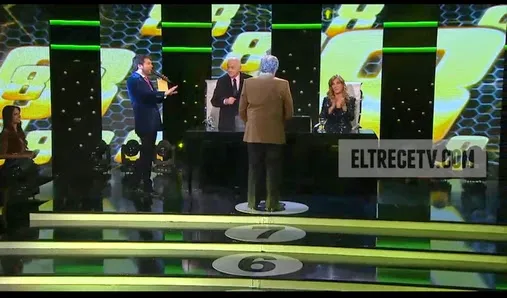
At the beginning of the year, channel 13 of Buenos Aires (El Trece) began broadcasting the program "Los 8 escalones", produced by Endemol, hosted by Guido Kaczka and with the fixed participation of Gerardo Sofovich plus another rotating guest (whom I will call "contestants").
The program has been airing since January 27, 2014. It does not seem a coincidence that it was created by Martin Kweller a few months after the success that began for the application Preguntados, by Argentine Máximo Cavazzani, which launched in October 2013.
A salient feature that the mobile game introduced into the universe of "cultural" entertainments is that the questions are asked by the public. Sofovich clarified that the same thing happened with the questions on Los 8 Escalones, during its first broadcast, although it is never specified who sent the question.
Entertainment programs on television have existed for decades, often tinged with suspicions of being "rigged" partly due to lack of transparency, partly due to concrete facts duly documented throughout the history of the boob tube. The scandal produced by the program Twenty-One, in the United States, generated a book and later a film produced by Robert Redford called "Quiz Show".
Sofovich hosted and produced several cycles on TV with questions and answers, and broadcasts like Odol pregunta or Tiempo de Siembra are remembered among the most notable.
These programs are a transposition of a "universal" genre: riddles. It is risky to say that this discursive genre is universal, but in any case we could say that it is "primary", the basis of other genres like entertainment programs. We can then speak of transgenres, as the Argentine semiotician Oscar Steimberg does in a mandatory reference work on the subject.(1)
A characteristic of these programs is that the participant is also a visitor. I point this out because a current program is "Lo sabe, no lo sabe" in which participants were found on the street, instead of going to a television studio, at least that's how it was until last season.
These visitors historically formed part of the general public, although there were programs with participants who belonged to a sector: housewives, students, etc. Jorge Romano has hosted and produced programs with students. Curiously -or not so much- his programs are often categorized as educational or pedagogical and not as entertainment. See for example Elemento Vital or Encuentro del Saber.
However, as Steimberg points out, despite this sectorization of the participants, it is about the general public: "but these belongings are sufficiently universal as not to affect, even though names are given, the generic condition -one could say, almost: anonymous- of the visitor," notes the semiotician (p. 137).
In riddles we find elements similar to puzzles and there are also traces of what we could call a "test", in that in certain circumstances the correct answer can be rewarded with admission to a group. In the transpositions we will still find those elements in other forms of reward and punishment, not only economic. "The riddle strengthens the ego," according to Steimberg's citation of W.H. Jansen, both of the participant and the opponent, as well as the audience.
On the site Eltrece.tv, where complete episodes of the program can be seen, it is also possible to leave comments. Some people point out that they think Sofovich is pedantic, doubt that he knows almost all the answers, and complain about some kind of arrogance in his responses.
Sofovich embodies a persona of "unbeatable", as another program with similar characteristics, hosted by Susana Giménez, was called.
This type of discourse implies a social distance between questioner and questioned. When this genre was taken up by television, that distance came to have differences. It is no longer the grandfather questioning his grandson, but here the distance is that by which two individuals from different social sectors meet, who in another place would not have met.
Another characteristic is a different dimension of the concept of enigma on television. I refer to the "hook" to which we are already accustomed, but which continues to exert its force, both in television series, soap operas, as well as in these question-and-answer programs. That "hook" is a form of enigma, but not posed to the participant, but to the viewer. It occurs when a participant reaches a decisive stage at the same time that the program's time slot comes to an end. And then the outcome remains pending and thus the suspense or enigma in the viewer of whether the interviewee -provisional hero of our daily life- manages to defeat the Tele-Minotaur in his feat.
In the case of Los 8 escalones, this occurs, fundamentally, when a participant reaches the eighth step and, while in that position -in which they can be asked several questions and have the possibility of "defeating" the "unbeatable"- the end of the program is reached, prolonging the viewer's unease, in the style of Jorge Suspenso, a character by Capusotto. At the time of writing this note -May 27- I evaluated 46 broadcasts from the start to May 25, considering on which step the participants were at the moment the program ended.
In 19 out of 46 occasions, the participants were on the last step at the moment the broadcast ended, that is 41%. (See table below). Furthermore, the program changed its broadcast day. Curiously, it began to be broadcast on Sundays on April 13, the same night that the 2014 cycle of Periodismo para Todos by Jorge Lanata began. Since then it has been broadcast on Saturdays and Sundays. The five Sundays that passed in that interval (not counting the Sunday when the Mamarrachos Fierros awards were given) the program ended with a participant on the eighth step. A coincidence, surely, that guarantees -incidentally- good ratings for the program that follows....
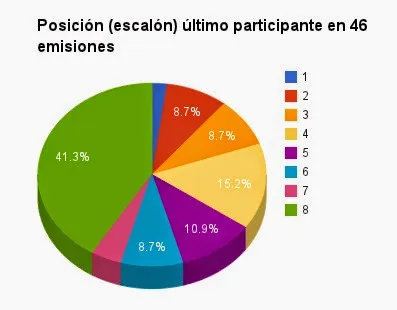
The data can be seen here.
In the public messages through the comment form on the Eltrece.tv site, what Steimberg and his group had already noticed in their fieldwork a decade ago is evident: the audience either values genre traits or what is valued are style traits. Steimberg finds these differences because he conducted 120 interviews with people who were readers of the newspapers La Nación or Diario Popular, noting differences in the expectations of those readers regarding the entertainment programs of that time.
Today, although without having conducted a systematic study, it is possible to notice a similar phenomenon in the comments of the public who either reject some "elitist" characteristic in the participants (as I will point out shortly), or complain about the awkward hosting by Guido Kackza that would take away "seriousness" from the matter.
What are the problems with these programs and with Los 8 escalones in particular?
1-They assume a form of "encyclopedism" in the sense of compiling data as an index or synonym for knowledge, wisdom, or intelligence. This "index" is, by the way, misleading. Someone may know the year World War II started and yet not know what role Japan played in that conflict. One may know who wrote Das Kapital, but not have read that work.
2-The participants in this particular program are people competing in a show that awards an economic and social prize they do NOT need.
Judging by the profile the participants denote, whether by their academic level, their job status, or other biographical data, they do not seem to come from the "popular classes," but rather quite the opposite. Money, in that sense, they do not need. They may desire it, since greed has always existed, but it is not necessary for them. On the other hand, what kind of mass recognition could someone who holds a high academic/job status need?
A change that could be somewhat significant is that if the visitor profile remains the same, then they should not compete for an economic prize for themselves, but for public institutions that need it and that they themselves could choose. By the way, in programs like Bailando por un sueño that mechanic existed, completely blurred because those "dreams" took a back seat, but if they were actually realized it would be a way to help those who truly need it. On this point, some reader-commenter on the channel's site agrees when asking for a broader participant profile.
3-Both the participants and Sofovich or the other invited opponent have the possibility to "guess." In programs like Feliz Domingo para la Juventud, in games like the "ping-pong" of questions and answers, it allowed to "pass." That mechanic implies greater intellectual honesty. (See aside) Changing that mechanic could mean the program has less "excitement," in favor of greater "rectitude." Aren't these programs supposed to be an "example" for the community? Note: it seems they are going to consider the game Preguntados as being of "cultural interest." Isn't it of cultural interest to be honest and learn when you don't know, instead of winning by luck? I understand, on the other hand, when one has doubts or can answer with a logic of "elimination," deduction through it. But on more than one occasion Sofovich chose his answer with "Una do li tuá".
One must acknowledge, however, the producer's attitude when faced with a silly question about the Transformers saga, which he refused to answer.
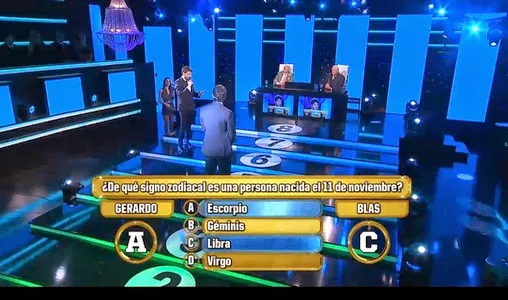
4-I understand that the questions must be sufficiently general, but not for that reason poorly made. On more than one occasion, questions about astrology were asked. Astrology is a myth and should be presented as such. Two examples:
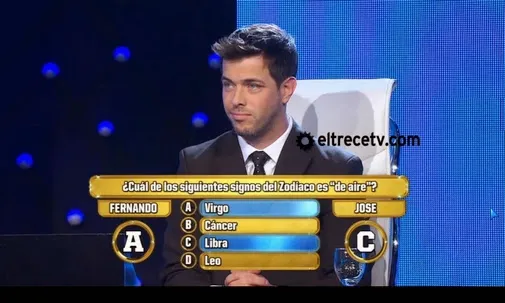
In this episode the invited opponent was José Bianco, who happily commented that he did not believe in "almost" anything about astrology. The question does not include the word myth.
http://www.eltrecetv.com.ar/los-8-escalones/16-de-abril-los-8-escalones_068160
Here, another similar example:
In contrast, when asking about the god of the sea, the word is included:
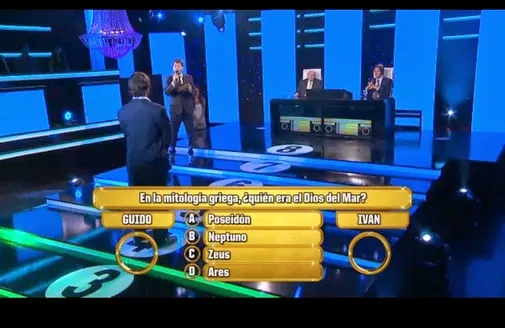
http://www.eltrecetv.com.ar/los-8-escalones/la-pregunta-enganosa-de-los-8-escalones_067994
Why are Poseidon and Neptune associated with mythological gods and not with astrological signs?
In astronomy we use names that come from the Greco-Roman tradition, but only as a reference, not for meaning. In astrology, those names are used for meaning and reference. For astrologers, Mars influences because they are not talking about a ball of matter, but about a god whose influence is felt through "divine influxes." Myths have always fulfilled some kind of function (more than one). Modern myths are in film and TV, they are Superman or The Matrix. They are stories that influence our thinking, not our personality. Mercury, on the other hand, does not influence us at all. If someone has good fortune it is NOT because of Mercury, it is for other kinds of reasons. Reasons.
5-In the different programs of this type, there have been multiple modalities when giving the correct answer. It is desirable that if the program has a minimal educational intention, correct answers that explain are given, not just the appropriate option. The opponents (Sofovich, mainly) sometimes complete their answer with contextual, historical information, but only on occasion. On the other hand, it would not only be necessary to add data to the correct answer, but also to disambiguate the incorrect options.
For example, on 5-17 they asked: What is the vocal organ of birds called? Options: Syrinx, Pharynx, Spring, Furcula. The participant, like her opponent Iván de Pineda, answered correctly Syrinx. What then are the remaining options? That information is usually not there.
6-Transparency -another face of honesty- is shown and demonstrated, but not in this program. If there is nothing hidden or "fixed," it is not enough, because as viewers we have the right to doubt. I will be told that this criticism does not consider the "prestige" of the opponents. A commentator on the site Eltrece.tv points out something neat: that Sofovich has always shown off his knowledge and that he likes to bet, so he does not need to know the questions in advance, what is at stake is adrenaline and, we could add, his self-esteem. That would be "showing." Demonstrating is different. In this type of program, susceptible to defrauding the public, a notary should intervene to provide a reliable account of a transparent process in the production and selection of the questions, as well as their handling in the production of the program (that they do not circulate among the opponents).
7-When I was a teenager I lived for a few months in the Belgrano neighborhood (when my family was in a time of fat cows) and attended a school in the area. I had a classmate who liked astronomy and was a "know-it-all." Once, on a bus trip, someone pointed out that I also liked that science and a "combat" started: one would ask the other a question, and vice versa. I remember I didn't do very well, the other one knew more.
This form of guessing game we could call reciprocal, and it has the enormous advantage of fostering good questioning and not just good answering. And it would also be functional regarding the previous point. Of course, the cycle was not thought of in a dialectical way and now it would be difficult to implement such a mechanic. Which shows that the purpose of the program is not to educate, but to entertain through competition. In short, to win even by guessing and to have fun until you die.
8-In some programs of this genre, participants can choose questions among categories. These categories can be fixed in each episode, can be chosen by the participant, or chance can mediate, like a spinning wheel, in the style of Preguntados.
In Los 8 escalones, questions are asked about different categories, without specifying or choosing them.
But in no TV program (of what we call TV, which is fundamentally the commercial system) are we going to find deep questions, those whose category could be philosophical, but not in an encyclopedic sense.
Why does poverty and wealth exist?
Why, if people besides instinct have reason and morality, do robberies and murders exist?
In reality, is there matter and spirit?
Can learning be fun?
Why do we expect television to be entertaining?
These questions point to answers that are not just facts or information, but knowledge. I will define knowledge as the set of INTERPRETED facts and related to each other. This implies that knowledge is facts + interpretation. Let's take the double-slit experiment. Let's take the data produced by that experiment. What do they mean? We won't know if we don't interpret them. The same with historical data. Without interpretation we can know that Rome defeated Carthage. It's a fact. Not knowledge, unless we know how to interpret it in relation to other data, in a dialectical way.
DIALECTICS OF TV
A dialectic is an interpretation of the data of reality (produced by the sciences) that is based on the idea that in reality there are different "parts" that interact with each other in a reciprocal way. Reciprocal means in a bidirectional way, regardless of whether that bidirectionality is explicit/active or implicit/passive, of equal or different direction/quantity/quality.
When we watch TV we react to what we see and hear. If we postulate that watching TV is a unidirectional action, we will realize that in such a relationship there could be no reactions. There are because every action is reciprocal, even if it is not of equitable reciprocity.
Neil Postman in his famous book "Amusing Ourselves to Death" points out that you cannot make a television program about philosophy. (2) Why? According to the author, because the "form" of the message is given by the characteristics of the perceptual matter. The audiovisual, according to the author, is a "fog." This assumes that no audiovisual message can be profound, regardless of its content.
That interpretation is unsatisfactory. A university class is "profound" and will continue to be so if I record it on video. The discourse does not change (from the point of view of the sender). What does change between watching a video and attending class is the expectation of the receiver. We are "expectators."
I agree with Postman, in a different sense.
Just as we think that television is composed of different discourses classified into genres (newscasts, soap operas, entertainment programs), we can also think that television as a system is something like a genre, since there is a set of expectations related to television as a whole. Thus, "televisual discursivity" is composed of several parts:
Some historical characteristics of content broadcasting, associated with intentions, and some predispositions on the part of the public.
Cognitive psychologists tell us that in our brain there are two "systems" (3). One is older (or less "evolved") that responds very quickly almost "without thinking": it is a quasi-automatic action associated with instincts. Reflex acts are vital in our daily lives.
Another "system" is more "modern" and functions with other timings. That system allows for deeper elaboration of data and that has as a consequence a longer response time and a greater expenditure of energy. We use this system a lot in daily life, but only when we believe it is necessary.
This second system that demands concentration, effort, energy expenditure, we use in our jobs, when we go to study, as well as when we walk down the street (whether we are pedestrians or vehicle drivers). All those activities demand concentration, that is, paying focused attention so that cars don't run us over or we don't crash the vehicle; so that we get correct change at the supermarket; to understand what a professor says (which is usually a "complex" discourse); to read a book (and understand it).
After that great expenditure of energy and effort during many hours of our day, we need to "turn off" that part of the brain. We "unplug" and at that moment -paradoxically- we turn on the TV.
The historically constructed expectations in relation to TV assume that we are not willing to make a great effort when watching TV, as we are in other areas or circumstances. It is possible, however, to change that, but what we normally expect from TV is a "non-demanding" discourse.
The broadcasters, for their part, considering that the public expects that, offer that, because also the financing of that system is fundamentally based on mass advertising that requires a large audience to achieve economic-statistical success.
So the broadcasters offer content such that it is watched by a large number of people whose expectations are "simplistic," not because those people are "stupid," but because they are not willing to make a great intellectual effort when watching TV.
What came first? Did what the broadcasters offer condition the expectations of the receivers or was it the other way around?
To answer this question we would have to do a historiographical tracing and we will surely say that both the broadcasting characteristics and the public's expectations were partly "inherited" from radio. And how were those characteristics generated in radio? We will surely find traces of its characteristics in certain written and mass publications, like newspapers and magazines, but also the orality of popular tales and theater. And so on.
However, the "origin" no longer matters. That is, historical tracing is important, but not for understanding what happens today in a given program, since we are talking about dynamic processes in which there is no longer "chicken and egg," but a reciprocal relationship between senders and receivers. In this process, the medium and the perceptual material also have their influence. Can "complex" knowledge be transmitted by SMS? Certainly the technological medium is a variable to consider, within a dynamic scheme in which other variables are also present.
Does this mean then that these supposed "knowledge" programs are useless?
No. Every social practice is significant and valuable. But we cannot confuse what is knowledge and what is information.
We cannot consider it knowledge to answer separate questions, unrelated and not deepened through interpretation. Information (a set of data related in a space-time configuration) is important, like the weather forecast. But "knowing" the forecast is not the same as understanding how it is produced because for that something more than data is needed.
KNOWLEDGE AND MEMORY
On the other hand, our use of memory is also at stake. The various technologies that appeared associated with communication, from writing to the internet, were fabulous tools that allowed us to store data outside our memory. And this can be harmful in one sense: storing trivial data in our brain, assuming that the important data we can store outside it, for example on Wikipedia.
Therefore, the discursiveness of TV in these programs, associated with orality which supposed using our memory to store vital data, could encourage the need to recover that human capacity to record history, but not to gather data as a hobby in a useless collectionism.
The Italian semiotician Umberto Eco glimpsed something of this regarding a quiz show on his country's TV called "L’Eredità", in an article published here by Clarín. (The video he refers to can be seen here)
What Eco does is understand that what happens on TV happens for some underlying reason, which is a sign-index, symptom, of something that happens to us not individually, but collectively.
The bad thing is to assume that this is corrected by learning data by heart. That would be a simplistic and very "televisual" "solution". Diego Golombek and Adrián Paenza are exponents, as I noted earlier with Jorge Romano, of communicators who understand that it is necessary to break with that contingent and conjunctural system that is commercial TV. But, I insist, it is a process and therefore demands a dialectical interpretation, which is that which is not taught even in universities, something "out of fashion" and destroyed by the division of labor and specialized knowledge. Sign of liquid times.
On intellectual honesty
If they ask me which river flows through Madrid and I don't know, but they give me options like Manzanares, Tajo, Nile, Paraná, I might think: "I don't know which one it is, but I think it's Tajo, because it sounds Spanish to me" and answer: "Tajo," in which case I would be being honest, since I would be saying what I think. But what really happens is that I don't know. When I say: "I don't know" I am being intellectually honest. This honesty implies the recognition of one's own error or contradiction, it implies putting oneself in a situation of vulnerability, because if I say Tajo maybe I'm right and no one finds out that I really didn't know, but if I say directly that I don't know I am acknowledging it, without it being apparently necessary. But it is necessary if what it's about is telling the truth.
---------
Selection of comments made by the public on the Eltrece.tv site in the videos of the program Los 8 escalones. Below each comment is indicated the link where it appears (at the time of writing this note). When no link is indicated, it is because that comment appears on the same page as the immediately preceding comment in this selection.
Nestor Alejandro Teruelo
Dear friends: I think it's a very good program, but to improve the clarity of the program they should review some rules, I'll detail them:
1.- to win the 50000 it should be that the contestant answers 10 questions correctly after the three in which he wins the 20000. this is because if Gerardo (whose intellectual honesty I do not doubt) only repeats the contestant's answer THE CONTESTANT COULD NEVER WIN. thanks it's a suggestion (I hope someone reads this) Regards. Alejandro http://www.eltrecetv.com.ar/los-8-escalones/17-de-mayo-los-8-escalones_068958
ALICIA LILIANA PERILLO yes, it's very good, of very good level, it was needed, only that it's absurd at times so much pausing by the host, it not only stresses and makes one change the channel, to follow with something calmer and continuous, we are not primary school kids, and also, mentioning so much the social condition of the contestant, moderate a little, I say, but in marketing matters I'm not a pro. AH! And don't eat up valuable minutes of Lanata's program, please because on Sunday it started late and we lost fifteen minutes of juicy dialogue. in general, congratulations.
http://www.eltrecetv.com.ar/los-8-escalones/27-de-abril-los-8-escalones_068401
Ricardo Echezuri
I know Mr. Sofovich somewhat, since I participated answering in some of his programs, and I clarify that I am at the antipodes of him regarding ideology and politics, but that does not mean that, as Olga rightly says, I revere his knowledge. The guy is very cultured and has 2 huge advantages: his age and having traveled a lot. Also those who know him as a player... can they think he would accept having the answers? A gambler like Gerardo is not going to play at the casino if they tell him what number is going to come up on the roulette wheel, he loses the adrenaline which is the only thing that interests him.
http://www.eltrecetv.com.ar/los-8-escalones/23-de-abril-los-8-escalones_068324
Cristina
The program is good, but it's very obvious that both Gerardo and the others who participate on the jury are given the answers beforehand or they are told the topics they are going to ask about and they study them. It can't be that they answer everything correctly and also give so many extra explanations. Gerardo is quite arrogant because when a contestant doesn't get it right he says something like: "everyone knows that", for example when they asked where Palito Ortega was born, or "the answer is in the question" and so on many other times. "Odol pregunta" was a serious program, although of different characteristics, but it was trustworthy. Which is not the case with this one. It lacks seriousness. Fortunately many people think like me and have the same impression, as I read the comments left here, from other episodes. They need to get their act together and everyone, contestants and jury, need to have the same possibilities and opportunities. The jury should win the prize for erudition or the Nobel of "wisdom", invented exclusively for them.
jimmy
I agree with Cristina's comment, the program is based on the morbid curiosity generated by beating Sofovich, which is why they aim for contestants from a university target to generate even more stress points to position the core of the program, it's interesting because as entertainment in some way one analyzes general culture topics, but the flaw is that it cannot guarantee that Sofovich is not prepared for the answers,
I think this makes the same morbid curiosity that the program seeks to beat him cause it to segment the viewers and in my personal experience it no longer generates the expectation of watching it and faced with more sincere entertainment options it will cause it to lose ratings
Comments about the Bible and a question answered, apparently, incorrectly, in the episode from 4-22. People very concerned about what that book says, revered as "sacred". If encyclopedism was born during the Enlightenment, then this Catholic "neo-Enlightenment" is a real "cambalache":
http://www.eltrecetv.com.ar/los-8-escalones/22-de-abril-los-8-escalones_068289
More angry people in the comments of the video from the episode of 4-21:
http://www.eltrecetv.com.ar/los-8-escalones/21-de-abril-los-8-escalones_068260
dario
The program is good for its content and because one learns general culture, but really Guido is very annoying as a host, let's say he is too repetitive almost irritating, I only endure him for one step already the others bore me. I'm sorry.
http://www.eltrecetv.com.ar/los-8-escalones/16-de-abril-los-8-escalones_068160
Fer S
Hello Lalu I was on the program and the production told us that above all it is a show and everything is done, even the ease or difficulty of the questions, based on the show, on what is more televisual. There is no notary, you can't demand it to be impartial because it's just a show and that's how TV is run.
luciaco I agree with Alejandro, although the revolution was from '53 to '59, Guido says the Cuban revolution in '59, at that point he was 31. They should cancel that question and continue from that point.
http://www.eltrecetv.com.ar/los-8-escalones/3-de-abril-los-8-escalones_067864
Note: it refers to an error in the wording of the question and the answer given as valid. In the video it happens at minute 37, approx. They ask Che Guevara's age at the time of the revolution, as if it were a specific instant and not a historical process...
Diana
I consider this program very good, it gives cultural knowledge an agility and captivating entertainment to keep learning. I also believe that for it to be absolutely transparent, the contestants should choose the envelopes that contain the questions.
angela moix I have some criticisms of the program...they should leave all the questions on a table and have the contestant choose the envelope. It's speculative the questions the secretary brings. And there was something very unfair with the contestant yazmin..when they ask about the president who resigned from his position in 1974...the first question..ivan gets it wrong and the answer is given by sofovich...in the question about which tango repeats a neighborhood three times...sofovich covering his mouth talks to iva...I think that for the program to be transparent the two who answer shouldn't even see each other...sofovich many gestures with his fingers. thank you very much for reading me!
http://www.eltrecetv.com.ar/los-8-escalones/11-de-marzo-los-8-escalones_067334
sergio
Program plagued with more doubts than certainties night after night. Why does Sofovich say the president's name before Ivan answers?. I also agree with Angela, in the answer about the tango, because it gives the sensation that Gerardo is whispering it to Iván. There are too many doubts in this program that has some aspiration to be cultural entertainment, and there is no clarity or transparency in those who are in charge of it.
Néstor González
The program Los 8 escalones I would love if Sofovich were not in it, the arrogance of this man, makes one think that he knows the questions that are going to be asked because besides the haughty gestures, he responds with precise comments, too prepared, I'm sorry, the format of the program is interesting.
http://www.eltrecetv.com.ar/los-8-escalones/19-de-febrero-los-8-escalones_067065
Sources and related links
- (1) STEIMBERG, OSCAR. Semiotics.The semiotics of genres, of styles, of transposition (2013) Eterna Cadencia.
- (2)POSTMAN, NEIL. Amusing ourselves to death. Public discourse in the age of show business. 20th. Anniversary Edition. (2006) Penguin books. The specific quote (on p. 7) is: "You cannot do political philosophy on television. Its form works against the content."
- (3)I take this idea from Daniel Kahneman, in his book "Thinking, Fast and Slow", Random House Mondadori, 2012.
About the images
- Images captured from the videos on eltrece.tv.